
A B2B sales qualified lead (SQL) is a lead that sales has verified against written criteria: ICP fit, a real business problem, budget and authority, a relevant solution, and a decision timeline. It is a human-confirmed status, not a score or a click count. If a lead fails any of the five gates, it is not a SQL.
SQL definition B2B qualification is where pipeline reporting quietly breaks. Most teams think they have a lead problem. They have an operations problem.
You probably know the symptoms. The pipeline looks full, but it does not close and it does not forecast. Sales rejects leads that marketing calls qualified. Attribution reports activity, not verified buyers.
Qualification is really a decision about who to say no to. This piece covers the SQL definition B2B qualification needs, the gates, and where it has to live to work.
What is a good SQL definition?
A good SQL definition is written, short, and binary. It lists the gates a lead must pass and names who verifies each one. A failure on any gate means "not yet" or "no". It never depends on a score alone.
Scoring ranks, gates decide. A lead can score high and still fail on fit. That is the whole job of SQL definition B2B qualification: decide who counts. Start from a locked B2B ICP definition, because how you define your ideal customer profile is the first gate every other gate depends on. A SQL is something sales checks, not something a model guesses.
Three terms get blurred here, so keep them apart:
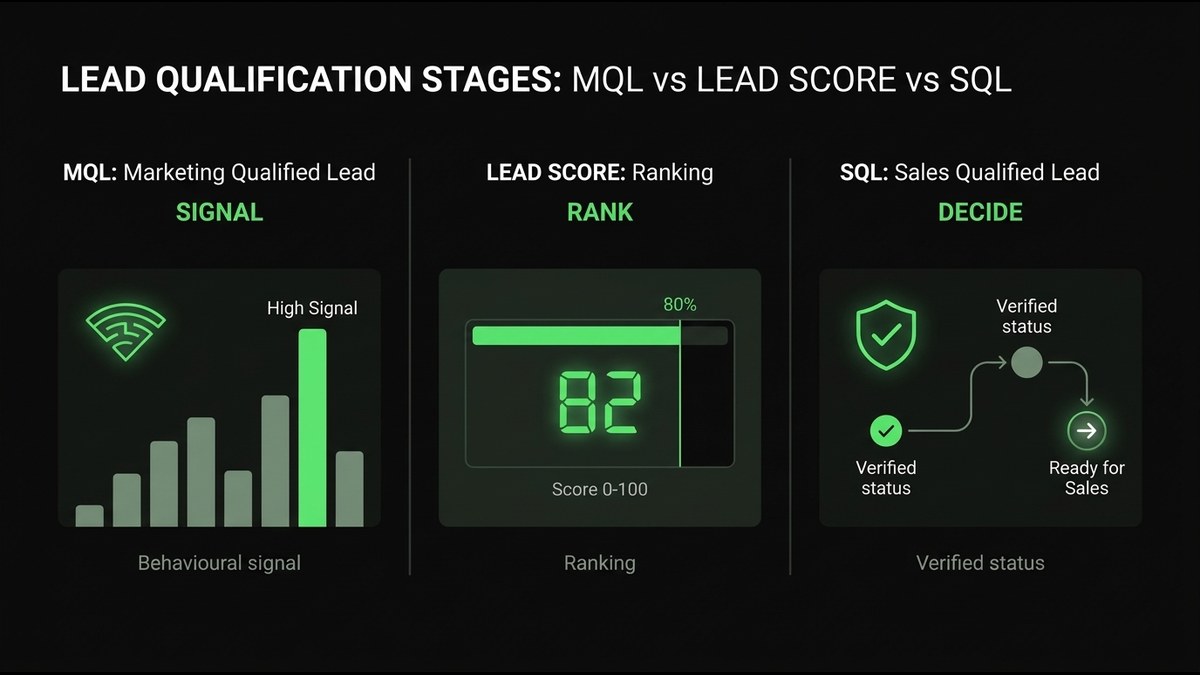
- MQL. a behavioural signal. The contact did something.
- Lead score. a ranking. It tells you who to look at first.
- SQL. a status. Sales confirmed it against the written gates.
Why does the MQL to SQL transition break?
The MQL to SQL transition breaks because marketing and sales use different definitions. Marketing counts engagement. Sales counts buying intent. With no shared written criteria, leads get passed on activity and then rejected on fit.
Nobody owns the gap. Marketing hits its number on paper. Sales quietly discards a share of what arrives. The CRM keeps both records, so the reported SQL count and the number sales believes never match.
That mismatch has a cost. Pipeline looks full, so forecasts get built on it. Then deals stall because the buyers never had a real problem, budget, or authority. Attribution then credits channels for leads that were never buyers. Most marketing teams measure activity instead of business outcomes, and a soft SQL definition is how that habit enters the pipeline.
You may worry that tighter criteria will make your numbers drop. They will drop. That is the point. A smaller, verified SQL count is the only count that predicts revenue. A larger count of leads that fail on fit only moves the disagreement from the handoff to the forecast review.
More channels will not fix this, and neither will more points in a scoring model. Fixing the SQL definition is cheaper than adding another channel, and the fix is a shared definition that both teams sign. A handoff built on activity will always be rejected on fit.
What are the five lead qualification criteria?
The five gates are ICP fit, an acknowledged business problem, budget and authority, solution relevance, and a decision timeline. A lead must clear all five. Engagement can raise priority, but it never replaces a gate. These are the lead qualification criteria worth writing down, and they are the core of any SQL definition B2B qualification process.
Gate 1, ICP fit: every lead is checked against one locked profile. No channel gets a softer version. Leads from marketplaces and paid listings pass the same gates as everyone else, with no special exceptions. If the company is outside the profile, the conversation ends here, however warm it feels.
Gate 2, an acknowledged business problem: the buyer must name a real problem in their own words. Typical ones are unpredictable pipeline, unclear ROI, underperforming outbound or demand gen, a website suppressing conversion, or tooling sprawl. A lead with no acknowledged pain exits early. Interest in your content is not pain.
Gate 3, budget and authority: someone on the call owns budget or can reach whoever does. This is where understanding the buyers and committees behind your ICP matters. Know who signs, who influences, and who blocks, so sales can tell a champion from a researcher.
Gate 4, solution relevance: your offer must fit the problem named in gate 2. A real pain you cannot solve is still a no. Saying so early protects sales time and keeps the SQL count honest.
Gate 5, a decision timeline: set a window your own sales cycle supports. Do not copy a number from another company. A lead with no decision horizon is a nurture contact, not a SQL.
Five gates, all required, no exceptions by channel. Here is how each one is verified and what failing looks like:
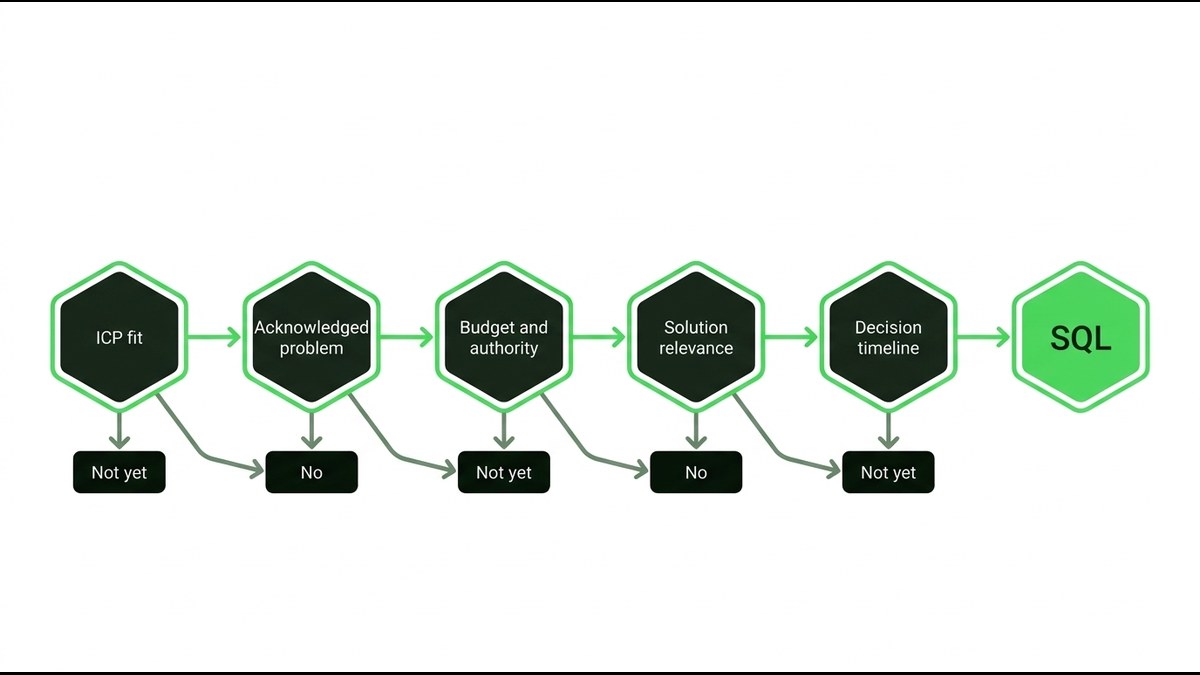
- ICP fit. confirms the company matches the locked profile. Sales verifies it. Failing looks like the wrong size, sector, or stack.
- Acknowledged problem. confirms the buyer names a real pain. Sales verifies it on the call. Failing looks like polite curiosity.
- Budget and authority. confirms money and a path to a decision. Sales verifies it. Failing looks like a researcher with no sponsor.
- Solution relevance. confirms your offer fits the problem. Sales verifies it. Failing looks like a good lead for a service you do not sell.
- Decision timeline. confirms a window that matches your sales cycle. Sales verifies it. Failing looks like "maybe next year".
How do you enforce SQL standards in CRM?
Make each gate a required field with controlled values. A lead then cannot reach the SQL stage until sales completes them. Use lead scoring to route and prioritise leads. Use the gates to decide the status. A SQL definition teams can trust lives in required fields, not on a wiki.
In practice, that means four things:
- Required fields. one per gate, filled by sales, not marketing.
- Controlled values. dropdowns, not free text, so reports stay clean.
- Stage-entry rules. the CRM blocks the SQL stage until every field passes.
- Scoring for routing only. it decides who gets called first, never who counts.
Why do SQL definitions fail even when the criteria are right?
From our work with clients, the SQL definition rarely fails because the criteria are wrong. It fails because they are not enforced anywhere in the CRM. A definition on a wiki page is a suggestion. Over 15 years working with more than 250 B2B companies, I have built HubSpot, attribution, and automation systems that replaced manual marketing workflows. The pattern is consistent. Teams that encode the rules in the system stop arguing about them.
Routing is a separate job from qualifying. Fit-based scoring, such as HubSpot lead scoring built around ICP fit, tells reps where to look first, while the gates decide who counts.
What should you report? SQLs that pass the gates, not raw counts. Review control metrics weekly, and let them govern which channels and offers get budget. Leads that fail the gates stay logged, but they do not count toward targets. A rule the CRM cannot enforce is not a standard.
Who should own the SQL definition?
Sales leadership and marketing should write it together. One accountable owner should hold it, usually revenue operations or the head of sales. Marketing should not set it alone, and sales should not change it quietly.
Joint authorship gives the definition credibility on both sides. A single owner gives it a version history. A regular review rhythm lets you tighten a gate when data says it is leaking, in the open, with both teams present.
SEO, PPC, RevOps, automation, and CRO are one growth system. A shared definition belongs to that system, not to one department. In our work with SaaS companies, better operational alignment between marketing and sales reduced CAC while improving lead quality. The gains came from the handoff, not from more spend. If your handoff is where trust breaks, start with shared definitions and a clean lead handoff. One owner, two authors, a standing review.
Fix pipeline volatility without hiring more SDRs
Fix the filter before adding capacity. Volatility usually comes from inconsistent definitions of "qualified", broken tracking and a leaky handoff. More SDRs working the same weak filter just produce more rejected leads, faster.
Pipeline volatility is also one of the clearest growth pains a B2B SaaS team can name. If it describes you, here are four moves, in order:
This is structural work, not campaign work. It sits closer to B2B RevOps than to media buying: infrastructure your own team can own and run.
- 1. Agree one SQL definition. Use the five criteria above. Get Sales and Marketing to sign off.
- 2. Record a reason code on every rejected lead. Patterns in the rejections show you which criterion is failing.
- 3. Fix tracking and CRM hygiene. Merge duplicates, map stages and make sure reports can be trusted.
- 4. Review accepted and rejected leads on a regular cadence. Run it as a decision meeting. Validate ICP fit, offer alignment and close probability. Then act on stalled deals.
What should the definition do next?
Recap the five gates in one line each:
- ICP fit. the company matches the locked profile.
- Problem. the buyer names a real pain.
- Budget and authority. someone can say yes.
- Relevance. your offer fits the problem.
- Timeline. a decision window your cycle supports.
Where to start
Qualification is the first diagnosis. We work on diagnosis before delivery, because the costliest mistake in growth is executing fast on the wrong system. A clear SQL definition is the same idea applied to your pipeline.
If you want a second pair of eyes, we will review your current SQL definition and how it is enforced in your CRM.
- ✓ A SQL is a human-confirmed status checked against five written gates, not a score or a click count.
- ✓ Most SQL disputes are operations problems: marketing counts engagement while sales counts buying intent.
- ✓ The five gates are ICP fit, an acknowledged problem, budget and authority, solution relevance, and a decision timeline.
- ✓ Enforce the gates as required CRM fields with controlled values, and use scoring only for routing.
- ✓ Have sales and marketing write the definition together, with one accountable owner and a standing review.
FAQ
What is a SQL in B2B?+
A B2B sales qualified lead (SQL) is a lead that sales has verified against written criteria: ICP fit, a real business problem, budget and authority, a relevant solution, and a decision timeline. It is a human-confirmed status, not a score or a click count.
What is the difference between an MQL, a lead score, and a SQL?+
An MQL is a behavioural signal, meaning the contact did something. A lead score is a ranking that shows who to look at first. A SQL is a status that sales confirms against the written qualification gates. Scoring ranks, gates decide.
Why does the MQL to SQL handoff break?+
It breaks because marketing and sales use different definitions. Marketing counts engagement and sales counts buying intent. With no shared written criteria, leads are passed on activity and then rejected on fit.
Will a stricter SQL definition lower my SQL numbers?+
Yes, and that is the point. A smaller, verified SQL count is the only count that predicts revenue. A larger count of leads that fail on fit only moves the disagreement from the handoff to the forecast review.
How do you enforce a SQL definition in the CRM?+
Make each gate a required field with controlled values, filled by sales. Add stage-entry rules so the CRM blocks the SQL stage until every field passes, and use lead scoring only to decide who gets called first.
Who should own the SQL definition?+
Sales leadership and marketing should write it together, and one accountable owner should hold it, usually revenue operations or the head of sales. Marketing should not set it alone, and sales should not change it quietly.
How do you fix pipeline volatility without hiring more SDRs?+
Fix the filter before adding capacity. Agree one SQL definition based on the three gates, record a reason code on every rejected lead, clean up tracking and CRM hygiene, and review accepted and rejected leads on a regular cadence.