
B2B sales leadership means senior people who can commit to scope, price and delivery without escalating. Senior buyers carry accountability for the outcome, so they expect a counterpart with matching authority. Account executives can run the process but usually cannot own the commercial decision, and that gap, not seniority snobbery, is what buyers react to.
The standard advice for a founder at a revenue ceiling is blunt: get out of sales, hire account executives, hand over the deals. For one specific class of deal, that advice is wrong. In our work with B2B clients, the stalled deal is usually not a people problem. It's an unowned handoff, and the constraint is operational. It lives in client-owned RevOps infrastructure: CRM architecture, lead scoring, lifecycle automation and attribution. Replace the founder with headcount and you keep the broken system and add a salary.
The founder-led revenue ceiling is real. But the common fix treats a systems problem as a people problem.
This piece argues a position. On complex, high-accountability deals, founder-led sales is a design choice. A workable executive sales strategy B2B teams can run starts from that point. It keeps senior people on decisions and builds a system for everything else.
What does B2B sales leadership look like to a senior buyer?
To a senior buyer, B2B sales leadership means someone who frames the problem, owns scope and pricing, and can say yes or no in the room. They are judging whether the person across the table can be held accountable for the deal.
That judgment is practical. Senior buyers answer for the outcome, and they often sit in a buying committee where one wrong vendor choice lands on their desk. They want a counterpart who can commit without a side trip to someone else's approval. Good senior buyer engagement starts with that signal, long before any proposal exists. B2B sales leadership, in the buyer's eyes, is judged in the first conversation.
Different senior roles read the signal differently:
- Founder or CEO. Makes the final commercial call and has little patience for process theatre. Responds to senior-level thinking.
- CMO or head of marketing. Feels it when channels underperform, and is often the sponsor who brings a vendor in.
- CRO or head of revenue. Cares about RevOps and attribution because those decide whether the pipeline numbers can be trusted.
Why this starts before the first call
Each of these roles wants to talk to someone who has already thought about their problem. That is why defining the buyers and committees behind your ICP matters before the first call. Roles, triggers and objections tell you who needs to be in the conversation on your side.
A clear, bounded first step also lowers the risk a senior buyer takes on. A diagnosis with a fixed scope is easier to approve than an open-ended engagement. The buyer is not buying a vendor. They are buying a decision they can defend internally.
Seniority, in other words, works as a qualification signal. The buyer is asking one question: can this person commit?
Why can't an account executive close a senior buyer's deal?
Often they can run the process but not the decision. Scope, price and delivery terms need authority the AE doesn't hold, so every hard question becomes "let me check." Senior buyers read that pause as risk and either slow the deal or ask for someone senior.
Be fair to AEs here. This is not a talent problem. A strong AE can run discovery, manage stakeholders and keep a deal organised. The issue is where the decision sits. If the AE cannot shape scope or move on price, the buyer ends up negotiating with a relay.
Call it the escalation tax. Each time the AE leaves the room to get an answer, three things happen:
- The buyer's momentum drops while they wait.
- The buyer starts to doubt who really owns the deal.
- The founder gets pulled in late, with less context than if they had been there from the start.
Who actually closes, and what fixes the gap
The deal then bounces back to the founder anyway, and the founder's calendar fills with the wrong work. Sometimes they are dragged into a deal that was never qualified.
Look at who closes in practice. In the deals we see land, the buyer is usually a CEO or founder, a CMO or head of marketing, or a head of revenue. A marketing manager or a RevOps lead often validates the details. The people with the budget expect to deal with peers.
Part of the cure is not on the sales floor at all. It is sales marketing alignment: shared definitions of a qualified lead, a clean handoff and one view of the pipeline. Without those, the AE inherits half-qualified deals and the founder inherits the mess. With them, the people in the room have the context to move.
None of this makes the AE the problem. Authority and information are the problem.
Is founder-led sales a scaling problem?
No. On complex, high-accountability deals it is a deliberate design choice, not a temporary constraint. The scaling problem is everything around the founder: qualification, handoffs, definitions and attribution that force senior time onto work a system should handle.
This is the thesis, so let me be direct about the stance behind it. Marketing doesn't have a lead generation problem. Most companies have an operations problem. A founder buried in sales rarely has too few leads or too little talent around them. They have senior time consumed by tasks that never needed senior judgment.
Separate two kinds of founder time:
- SDR work. Chasing unqualified leads, writing follow-ups, updating the CRM by hand. This is the "highest-paid SDR in your company" problem. Stop doing it.
- Problem framing and closing. Diagnosing the buyer's real constraint, shaping scope, owning the commercial terms. This is where founder time pays back.
Governing a founder-led motion
The fix is to remove the first kind of work, not the founder. We built Effiqs around Growth Operations rather than traditional digital marketing services for this reason. The biggest growth opportunities are hidden in process inefficiencies, not media budgets.
Founder-led sales also needs governance, or it drifts. A founder-led motion works when it is intentional: the founder's role is defined and reviewed on a schedule, not left to habit. That review asks which parts of the role still need the founder and which have crept in by default.
A sales playbook helps here, if it describes plays, not scripts. A good playbook documents recurring situations without removing senior judgment. The playbook captures what repeats. The founder handles what doesn't.
What should the founder own, and what should the system own?
The founder or senior seller should own problem framing, scope, pricing and the close. The system should own ICP qualification, lead handoff, follow-up and reporting. Senior time goes to decisions only seniors can make.
I call this framework the decision line. Every step in a deal is either a decision step or an information step. Senior people own the decision steps. Systems own the information steps. The founder's real problem is that both kinds of work are tangled into one calendar. As a working definition, B2B sales leadership is the discipline of keeping senior people above that line.
Here is the split as a matrix:
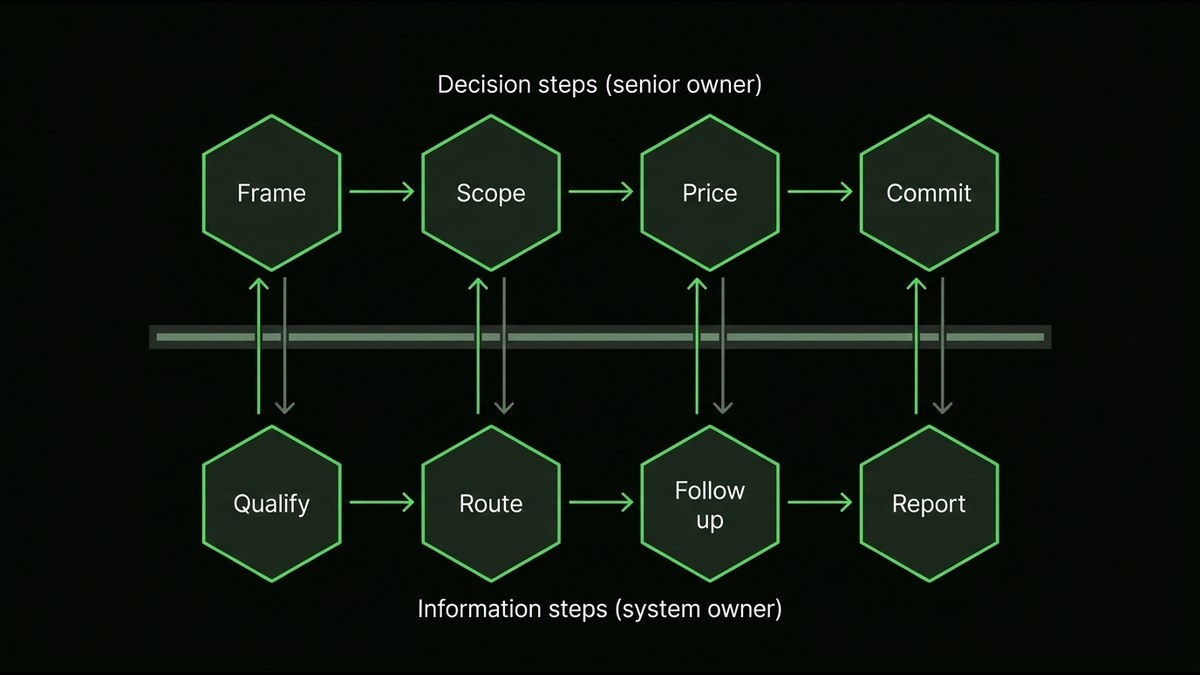
- Frame the problem. Decision step. Owner: founder or senior seller. Needs judgment about the buyer's real constraint.
- Scope. Decision step. Owner: founder or senior seller. Defines what is in and out.
- Price and terms. Decision step. Owner: founder or senior seller. Needs commercial authority.
- Commit and close. Decision step. Owner: founder or senior seller. The buyer needs a yes or no from someone who can give it.
- Qualify against the ICP. Information step. Owner: system. Rules and scoring, not a founder's gut feel.
- Route the lead. Information step. Owner: system. Defined handoff criteria, no manual forwarding.
- Follow up. Information step. Owner: system. Automated sequences with human review where it matters.
- Report. Information step. Owner: system. One pipeline view, no spreadsheet reconciliation.
Making the decision line hold
Across the B2B companies I have worked with, the pattern repeats. Qualification, follow-up and scoping live in the founder's head, and the business hits a revenue ceiling that looks like a headcount problem.
The information steps are where RevOps does its job. We have built CRM, attribution and automation systems that replaced manual workflows, and we have helped SaaS companies reduce CAC while improving lead quality through better operational alignment. SEO, paid media, CRM, analytics and automation are not separate projects. They are one growth system, and the decision line only holds if that system is wired together.
Alignment gives the system its definitions. Shared definitions, clean lead handoff and one pipeline view are what let a founder step out of qualification without losing control of it.
Attribution belongs here too. It isn't about giving credit. It's about making better investment decisions, including the decision about where senior time goes.
One more place to look is the content gap. Expensive sales time spent on work content should have handled is a common leak. When prospects arrive without understanding the problem, the founder re-explains it on every call.
Fintech GTM strategy for mid-market companies with long sales cycles: where does seniority fit?
In long, regulated, multi-stakeholder cycles, senior sellers matter most at the points where buyers must commit: scoping, risk and terms. The strategy is to keep them there and let systems carry the rest, rather than spreading them thin across the whole cycle.
Fintech is a good stress test. Cycles are long, committees are cautious and every stakeholder has a different objection. The tempting read is that compliance complexity is the constraint. It usually isn't. Unclear GTM ownership is. When nobody owns who frames the problem, who owns scope and who owns the follow-up, a long cycle gets longer.
Apply the decision line across a long cycle:
- Early stages. Systems qualify and route. A senior seller should not spend hours on a company that doesn't fit the ICP.
- Middle stages. Information steps keep stakeholders informed: follow-ups, materials for each role, one pipeline view. Senior judgment is reserved for risk questions and scope.
- Late stages. The senior seller returns for terms and commitment. By this point the buyer has seen consistent, informed contact and wants a decision-maker.
Building trust before the senior conversation
Trust has to be built before the senior conversation, and authority channels help. Webinars, events and podcasts educate senior buyers and build credibility ahead of direct sales conversations. They work best as trust-transfer channels. They are not volume lead generation, and they should not be judged on volume. Done well, they can shorten cycles because the senior conversation starts with credibility already in place.
After 15 years in B2B marketing and work with more than 250 companies, my view is that long cycles reward sequencing over effort. B2B sales leadership here is not about how much senior time the cycle absorbs. It is about whether senior time lands on the moments where the buyer needs a decision-maker. A B2B GTM strategy built around ICP, positioning and channel focus puts those moments on the map before the cycle starts.
I won't pretend there's a fintech case study here. The argument rests on the mechanism, not on a story I can't back.
How do you know a senior-led sales model is working?
Check whether senior time is concentrated on qualified deals, whether deals move without re-escalation, and whether revenue KPIs are reviewed on a fixed cadence. If the senior seller is still doing prospecting or admin, the system has a gap.
Three checks, in plain terms:
- Concentration. Look at where the founder's calendar goes. Most of it should be framing, scoping and closing on deals that fit the ICP. If it is mostly chasing and cleanup, the information steps are not automated.
- Movement. Deals should progress without bouncing back for a re-decision. Repeated re-escalation means someone in the middle lacks context or authority.
- Cadence. Revenue KPIs should be reviewed on a fixed schedule, with strategy adjusted based on what they show. The senior seller's own role should be reviewed on a schedule too, so it changes deliberately, not by drift.
Cadence, scope and the role of AI
A fixed cadence also keeps scope honest. When work is defined up front, as with fixed-scope pricing, reviews compare outcomes against a defined scope instead of arguing about hours.
AI sits in this picture as an accelerant. It won't replace marketers. It will replace marketers who don't know how to build repeatable systems. The same holds for sales: AI handles information steps well and does not fix an unowned decision step. Strong B2B sales leadership is visible in exactly this way: the decisions have owners and the rest runs without them.
Where does the decision line sit in your motion?
"Get the founder out of sales" is advice for a different kind of deal. When buyers are senior, scopes are complex and accountability is high, seniority is the qualification signal. B2B sales leadership, to those buyers, means someone who can commit.
The founder isn't the bottleneck. The tangle is: decision work and information work sharing one calendar. Separate them. Give the decisions to senior people, give the information steps to a system, and review the arrangement on a schedule.
If you want a peer-level review of where the decision line sits in your current motion, we can walk through it together.
- ✓ Senior buyers don't ask for a title, they ask for the authority to commit.
- ✓ An AE without decision authority isn't failing, the deal structure is.
- ✓ Keep the founder in the deal, and remove the operational drag that pulls them out of the right part of it.
- ✓ Seniors own the decisions, systems own the information, and the line between them is the design.
- ✓ In a long cycle, put senior time at the commitment points and build systems for everything between them.
FAQ
Why do senior buyers want to deal with senior sellers?+
Senior buyers answer for the outcome of the purchase, so they want a counterpart who can commit to scope, price and delivery without escalating. A seller who has to check every hard question with someone else reads as risk, which slows the deal or prompts the buyer to ask for someone more senior.
Why can't an account executive close a senior buyer's deal?+
Account executives can usually run the process, but scope, price and delivery terms often need authority they don't hold. Each escalation drops the buyer's momentum, raises doubt about who owns the deal and pulls the founder in late with less context. The problem is where the decision sits, not AE talent.
Is founder-led sales a scaling problem?+
Not on complex, high-accountability deals, where it is a deliberate design choice. The scaling problem is the operational work around the founder, such as qualification, handoffs, definitions and attribution, which consumes senior time that a system should handle.
What is the decision line in B2B sales?+
The decision line is a framework that splits every deal step into decision steps or information steps. Senior people own decisions like framing the problem, scoping, pricing and closing. Systems own information steps like ICP qualification, lead routing, follow-up and reporting.
How do you know a senior-led sales model is working?+
Senior time should be concentrated on qualified deals, deals should progress without being re-escalated, and revenue KPIs and the senior seller's own role should be reviewed on a fixed schedule. If the senior seller is still prospecting or doing admin, the system has a gap.