
Integrated revenue operations is better than multiple vendors because one accountable operator owns the whole revenue stack, from positioning to pipeline to performance. That removes the attribution gaps, split accountability and conflicting definitions that appear at the seams between vendors. Specialist excellence inside a single silo cannot fix those seams.
Most B2B teams don't choose a fragmented revenue stack. They inherit it. A CRM from one era, a marketing automation tool from another, an agency for demand, a contractor for the CRM, maybe a fractional leader on top. Each piece works. The system doesn't.
We see this pattern constantly as a B2B RevOps agency, and the cause is rarely effort or talent. It's that nobody owns the whole, which is the gap integrated revenue operations closes.
What is integrated revenue operations?
Integrated revenue operations is one operator owning the full revenue system: go-to-market strategy, demand, funnel execution, systems design and the performance that results. It is a model of ownership, not a product you install.
That distinction matters, because the term gets confused with two other things. It is not a single software platform. Putting everything in one tool is consolidation, and it often moves the mess instead of removing it. It is also not outsourcing execution to a task shop that closes tickets. Senior judgment and hands-on technical work have to sit in the same place.
In practice, the discipline aligns sales, marketing and customer success around one revenue architecture. In HubSpot, for example, that means building the RevOps layer so you can see the complete customer lifecycle, from first prospecting touch through post-sale. You can trace where each customer came from and what happened next.
This is also why Effiqs is built around Growth Operations rather than a menu of services. Growth Operations isn't a bundle of hours, a set of campaigns or a pile of deliverables. It's ongoing ownership of the growth engine, with continuous optimization across strategy, execution and systems, run by a single accountable operator who coordinates every lever.
Why does integrated revenue operations beat multiple vendors?
Because the failures in a multi-vendor stack don't live inside any vendor. They live between them.
Marketing blames lead quality. Sales blames routing. The automation specialist blames CRM hygiene. Each of them is partly right, and each is doing their slice well. The problem is that revenue is lost at the seams: conflicting definitions, split data and decisions nobody owns. No contract covers a seam, so no one is accountable for it.
The blunt view: marketing doesn't have a lead generation problem. Most companies have an operations problem. When a team adds a new channel or a new agency to fix pipeline, it usually adds a new seam as well. Adding channels rarely fixes growth. Better systems usually do.
That's the reason to stop treating SEO, paid media, RevOps, automation and CRO as separate projects. The work only makes sense as one system. Here are the failure modes that multi-vendor stacks produce by design:
- Attribution collapse. Each tool reports its own version of the truth, so nobody can say which investment produced which revenue.
- Accountability dilution. When a quarter misses, every vendor can show their own work was delivered.
- Integration tax. Someone has to reconcile exports, fix syncs and rebuild reports, and that time never shows up on an invoice.
- Misaligned incentives. A vendor paid on volume optimizes for volume, even when the pipeline needs quality.
- Compounding debt. Every patch makes the next change more expensive.
Why is the problem worse for multi-region teams and sales operations?
For European and multi-region teams the problem is often worse. Stacks inherited after an acquisition, or assembled country by country, produce data silos that block any unified reporting. That kind of sprawl doesn't resolve itself. It takes ongoing RevOps ownership to turn it into one coherent system.
Even within sales, the split shows. Sales operations rightly owns process integrity: CRM accuracy, deal stage governance, forecast tracking. It doesn't own revenue outcomes, and it shouldn't. That's why integrated sales operations has to sit inside the larger system, connected to demand and marketing, rather than guarding its own corner.
Is a unified RevOps platform the answer?
Not by itself. A unified RevOps platform is a useful instrument, but buying one is not the same as fixing the system.
Companies often buy software to solve problems that are actually operational. The pipeline is inconsistent, so they buy a forecasting tool. Attribution is murky, so they buy an attribution tool. Six months later they have a seventh data source and the same argument in the Monday meeting.
The question to ask first is who defines "qualified," who owns the lifecycle stages, and who decides when the rules change. A platform will enforce whatever definitions you give it. If those definitions conflict, it enforces the conflict faster.
That's why the best-of-breed argument fails at the system level. The best email tool, the best BI tool and the best attribution tool still can't share a common data model if nobody designed them to. Excellence inside each silo can even make fragmentation worse, because every tool gets configured to its own logic.
An integrated revenue operations model uses the same tools you already have, whether HubSpot, Salesforce or the rest. The difference is that one party owns the architecture and performance across all of them. The tool decision comes after the ownership decision, not before.
What does a single source of truth for RevOps actually require?
A single source of truth for RevOps is an ownership structure first and a data structure second. Four things have to be true:
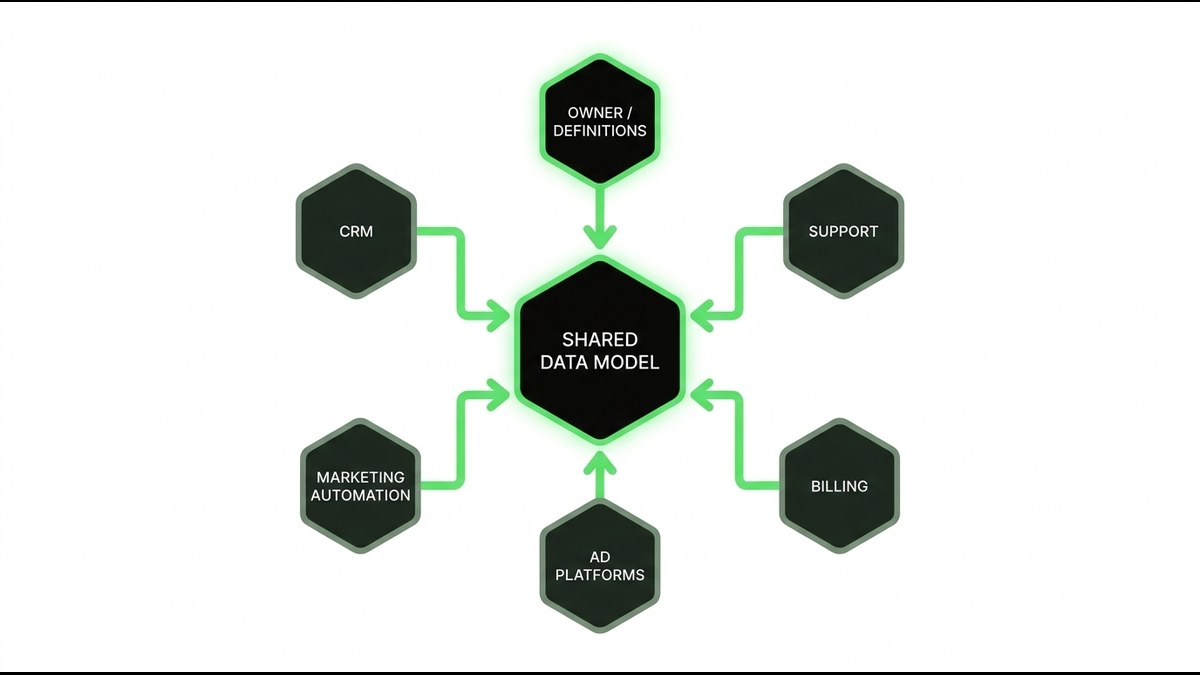
- Named ownership of definitions. Someone decides what counts as a lead, an SQL, an opportunity and a closed deal, and that decision holds across every team and tool. Without it, every report starts an argument.
- One lifecycle model. Prospecting to post-sale runs through a single set of stages with clear entry and exit rules, so the customer journey is visible end to end.
- Decision rights. Most expensive RevOps problems are ownership problems. A revenue function without decision rights becomes a request queue, reacting to tickets instead of designing the system.
- A governance cadence. CRM hygiene, stage discipline, attribution rules and SLAs need regular review. A clean system degrades unless someone keeps enforcing it.
Why do fewer, stricter definitions matter more than more data?
Notice what isn't on the list above: a new tool. The order matters. Before you add anything, audit what you already run, cut tool sprawl and find the overlaps first.
There's also a quality dimension. A single source of truth doesn't mean more data. It means fewer, stricter definitions. Loose definitions inflate pipeline numbers and hide the real conversion picture. Strict definitions make the numbers smaller and more useful.
This is also why attribution is a decision tool, not a reporting exercise. The point isn't to hand out credit. It's to make better investment decisions, and that's only possible when everyone is reading the same numbers.
When does a multi-vendor setup still make sense?
Sometimes it does. The thesis is not that vendors are bad. It's that fragmentation without an owner is expensive and invisible. A multi-vendor setup can work when the following conditions hold:
- You have a strong internal owner. A senior RevOps leader with real decision rights can integrate specialists effectively. The vendors become inputs to a system someone owns.
- The scope is narrow. A single channel push, a one-off rebuild or a specialist task with a clear start and end doesn't need a system owner.
- The stack is young. Early on, there are few seams. The cost of fragmentation grows with every tool and every team added.
How do multi-vendor, in-house and integrated operator models compare?
The in-house alternative is real too. Building the full capability internally means hiring several senior people and waiting through a long ramp, and it concentrates the perspective in a few heads. For growth-stage companies where speed and capital efficiency matter, an integrated operator gives you breadth and speed without that overhead.
Whatever you choose, insist on a scope you can see. Pricing should be tied to what gets built, not to hours you can't see, because open-ended effort is another form of the same opacity. Here is the comparison:
- Multi-vendor patchwork. Best specialist depth per slice. Weakest ownership of the system. Highest hidden integration cost. Common default.
- In-house build. Strongest internal control. Slowest to stand up. Dependent on a few people's perspective. High fixed cost.
- Integrated operator. One owner across strategy, systems and performance. Faster to start. Needs a clear scope and review cadence.
How can you tell your revenue stack has a seam problem?
You can usually tell from the meetings. Seam problems show up as recurring arguments, not as error messages. Look for these signs:
- Sales and marketing alignment is a standing agenda item rather than a solved problem.
- Two teams quote different pipeline numbers in the same meeting.
- The forecast moves sharply late in the quarter and nobody can explain why.
- Every report needs a manual reconciliation step before it can be trusted.
- When a deal stalls, each function can show that its own handoff was completed.
- You can't trace a closed deal back to its origin without asking three people.
- Each quarter you patch another leak, but the architecture stays the same.
How do you confirm it and decide when to act?
If three or more of those signs apply, you probably don't have a vendor problem. You have an architecture problem.
The way to confirm it is diagnosis before delivery. The most expensive mistake in growth is executing on the wrong system fast. A Revenue Systems Diagnosis maps the lifecycle from prospecting to post-sale, shows where definitions split, where data forks and where no one owns the handoff. Then you decide what to build.
You can start on your own by listing your tools, owners and handoffs in a structured audit. Working through it as a live teardown also helps: screen-share the attribution stack, the CRM architecture or the funnel, and show exactly where the seams are.
The decision trigger is usually external. A funding round is coming, a new revenue leader is joining, or a quarter just missed. Those are the moments when a patched stack gets exposed, and when structural change is cheaper than another point solution.
What should you do next?
Fragmentation is a tax on every revenue decision. It doesn't show up as a line item, so it stays unchallenged. The shift to integrated revenue operations isn't about having fewer vendors. It's about system ownership: one accountable party, one set of definitions, one view of the customer lifecycle.
Start with the diagnosis. If your stack is spread across several vendors and you're heading into a funding round, a leadership change or a recovery quarter, find what's broken before you add another tool.
- ✓ Integrated revenue operations means one accountable owner for the whole revenue system, not one tool and not one more vendor.
- ✓ Specialists fail at the seams, not in their slice, so only an owner of the whole system can fix them.
- ✓ Software enforces your definitions but can't create agreement about them, so decide ownership before tools.
- ✓ A single source of truth comes from owned definitions, one lifecycle and clear decision rights, not from a bigger stack.
- ✓ Multi-vendor works when someone senior owns the seams. Without that owner, integrated revenue operations is the cheaper model.
FAQ
What is integrated revenue operations?+
Integrated revenue operations is one operator owning the full revenue system: go-to-market strategy, demand, funnel execution, systems design and the resulting performance. It is a model of ownership, not a software platform and not a task shop that closes tickets.
Why do multi-vendor revenue stacks leak revenue?+
Revenue leaks at the seams between vendors, not inside any single vendor. Conflicting definitions, split data and decisions nobody owns create attribution collapse, diluted accountability, hidden integration work, misaligned incentives and compounding technical debt.
Will a unified RevOps platform fix a fragmented revenue stack?+
Not by itself. A platform enforces whatever definitions you give it, so if teams disagree on what counts as qualified or who owns lifecycle stages, it enforces that conflict faster. Settle ownership and definitions first, then choose tools.
What does a single source of truth for RevOps require?+
It requires named ownership of definitions (lead, SQL, opportunity, closed deal), one lifecycle model with clear entry and exit rules, real decision rights for the revenue function, and a regular governance cadence covering CRM hygiene, stage discipline, attribution rules and SLAs.
When does a multi-vendor setup still make sense?+
It works when you have a strong internal RevOps owner with real decision rights, when the scope is narrow and clearly bounded, or when the stack is young and has few seams. The cost of fragmentation grows with every tool and team added.
How do I know my revenue stack has a seam problem?+
Look for recurring arguments rather than error messages: two teams quoting different pipeline numbers, late-quarter forecast swings nobody can explain, reports that need manual reconciliation, and closed deals you can't trace to their origin. If three or more apply, you likely have an architecture problem, not a vendor problem.