
A sales and marketing SLA for lead handoff is a written agreement that defines what counts as a sales-ready lead, how fast sales must respond, what happens to rejected leads, and who owns each stage. Marketing commits to quality and volume, and sales commits to follow-up and feedback. Both sides are measured weekly in the CRM.
Here is the problem, stated plainly. Marketing reports MQLs. Sales ignores them. Neither side can prove the other wrong, so the argument repeats every quarter and the forecast absorbs the damage. The fix starts with declining unqualified leads early, because a clear no costs less than a slow maybe.
The root cause is undefined terms, not slow reps. If "qualified" means one thing to marketing and another to sales, no response clock will help. Budget keeps flowing to leads nobody works.
You may be thinking: "I do not control marketing." You do not need to. The SLA gives you a measurable standard, not control. It also gives sales no reason to ignore leads, because the lead record and the attribution behind it become data nobody can dispute. This piece shows how to build a sales marketing SLA lead handoff agreement that holds.
What is a sales and marketing SLA?
It is a written, mutual agreement between sales and marketing. It sets the criteria a lead must meet to be passed over, the response time sales owes once it accepts, and the route rejected leads take back. Both sides commit, and both are measured.
That is different from an alignment poster. A poster lists values and a response time. An SLA lists definitions, owners, and operational consequences.
Harvard Business Review's analysis of the war between sales and marketing describes team relationships that run from undefined to integrated. An SLA is how you move up that scale.
Our view is simple: an SLA written before the definitions are agreed only formalizes the fight. Diagnosis comes first. Agree on what sales-ready means, then set the clock. A sales marketing SLA lead handoff agreement is only as good as its definitions.
What should a lead handoff SLA define?
Five things: shared definitions of MQL, SAL, and SQL; marketing's quality and volume commitment; sales' response-time and feedback commitment; acceptance and rejection reasons; and an escalation path with a named owner for each stage. Use this as your SLA template. Each line is a field to fill in together.
Speed belongs in the agreement. Harvard Business Review's 2011 study of online sales leads found that firms that contacted a lead within an hour were nearly seven times as likely to qualify it as firms that waited even one hour longer. Pick your windows from your own data, then write them down.
Fit and engagement scoring sets the threshold for the first field. Turning fit and behavior into a sales-ready line both teams can see is the job of a lead scoring model in your CRM.
A handoff is complete only when four things are true: qualification criteria are met, the CRM record is clean and complete, the problem statement is documented, and the next-step offer is named. If one item is missing, the lead goes back.
Stage-readiness frameworks are a choice, not a default. BANT checks budget, authority, need, and timing. MEDDIC suits complex deals with many stakeholders. CHAMP starts from the buyer's challenges. Pick the one that matches your sales motion and build it into the SAL definition. Definitions come first, and the clock comes second.
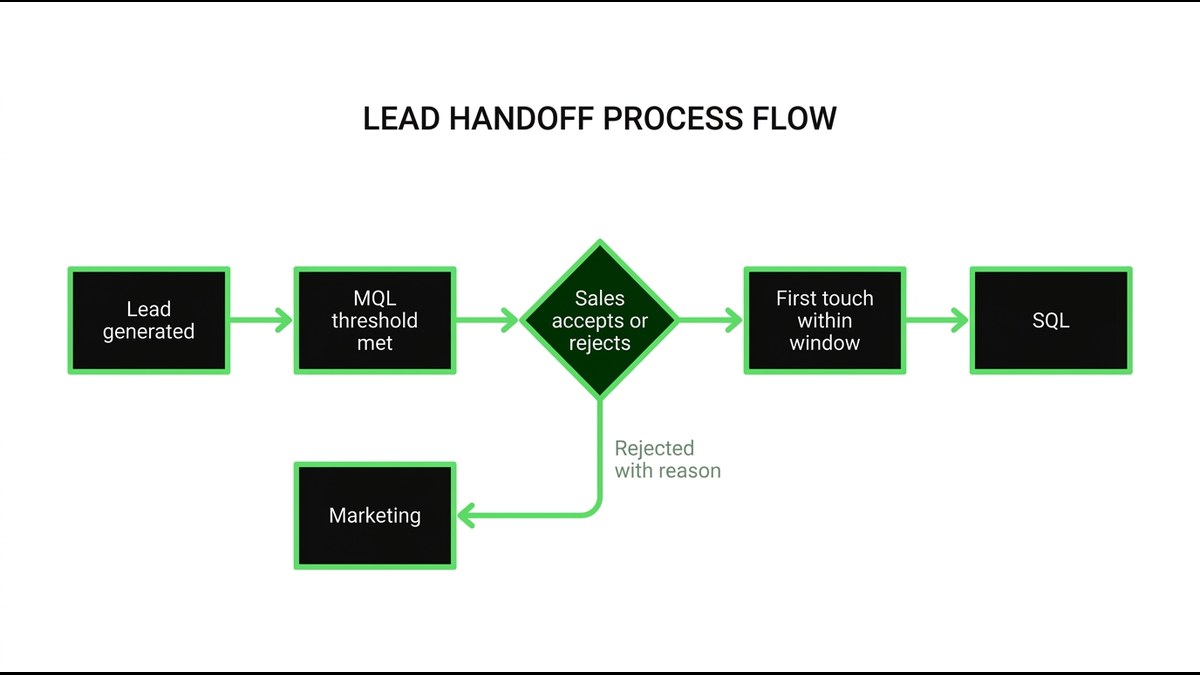
- Stage definitions. MQL, SAL, and SQL, each with fit criteria and behavior criteria, agreed jointly.
- Marketing commits to. a lead quality standard based on ICP fit, a complete record, and a documented problem statement.
- Sales commits to. accept or reject within a stated window, then make first touch within a stated window.
- Rejection reasons. a short fixed picklist, plus the place rejected leads route back to.
- Escalation and review. who is told about a breach, and the weekly review cadence.
Why does the SLA need a signed positioning statement?
Write down who you sell to and the problem you solve in one page, and have both teams sign it. Then require that statement in every handoff record. Messaging stops drifting when the lead record carries the agreed problem, not the rep's guess.
The one-page statement has three parts: the ICP, the problem you solve, and the evidence that this buyer has it. It becomes a required field in the handoff. No statement, no handoff.
This also ends the "bad leads" argument. When sales rejects a lead, the reason points to a field: wrong fit, or no documented problem. Marketing can fix both. A rep's hunch is not a reason code.
Context has to travel with the lead. B2B buying groups include several stakeholders, so the next person to speak with the buyer cannot start from zero. When the lead record carries the positioning, nobody has to argue from memory.
How do you enforce a handoff SLA?
Give every stage one accountable owner, build the SLA clock and rejection reasons into the CRM, and review the numbers weekly. Enforcement is a data and cadence problem. A named operations owner runs the process, and the VP Sales answers for the result.
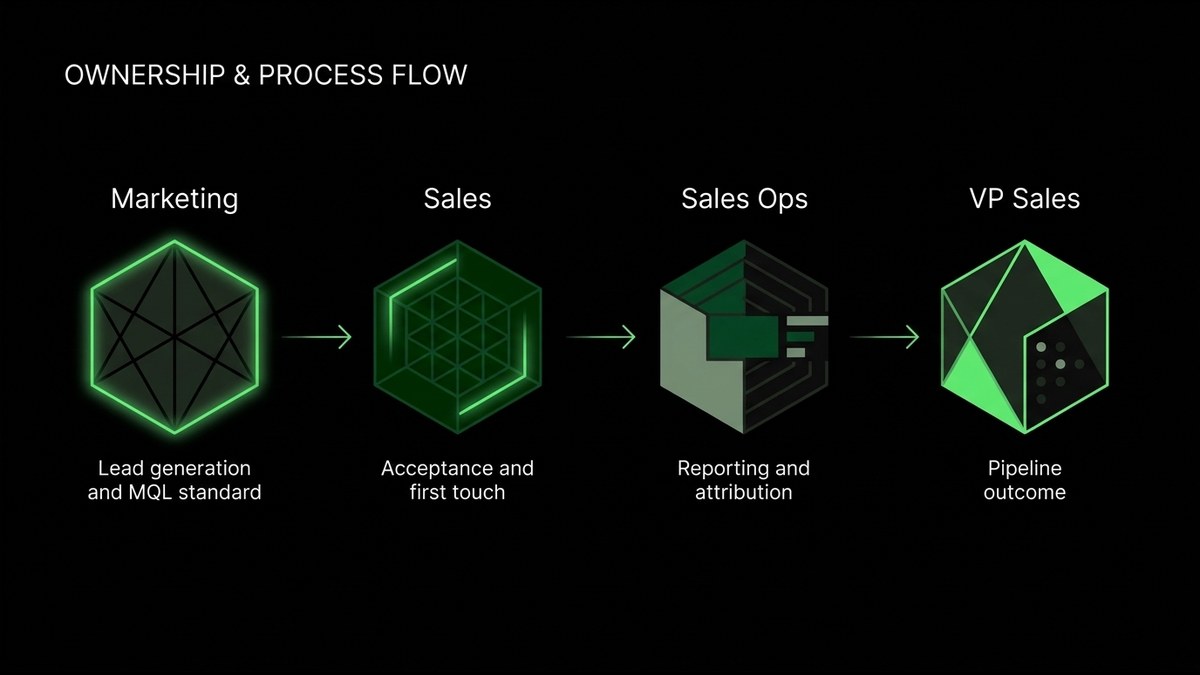
Start with ownership. Every stage has exactly one accountable owner, and no stage is shared. Marketing owns lead generation and the MQL standard. Sales owns acceptance and first touch. A named operations owner holds reporting and attribution. Shared ownership means no ownership, because nobody has to answer for a miss.
Next, put the rules in the CRM. The SLA clock starts when a lead is routed. Required fields block a handoff with an incomplete record. Rejection reasons come from a picklist, not free text. Salesforce's State of Sales research has repeatedly found that reps spend only a minority of their week selling, so manual policing will not last. Automation does. Timers and required fields should sit where reps already work, such as routing and scoring inside HubSpot.
Then review weekly. Look at SLA compliance, time to first touch, and rejection reasons by source. These control numbers should decide which channels and offers get budget.
Consequences are operational, not punitive. A missed clock triggers a re-route. A pattern of rejections triggers a re-score. A weak offer gets re-scoped. Nobody gets blamed in the meeting. The data gets fixed.
Keep the roles straight. The operations owner keeps the process honest: the records, the rules, and the escalations. The VP Sales owns the outcome: pipeline quality and conversion. Keeping process and outcome in separate hands is what keeps both credible. An SLA holds when the CRM enforces it and a weekly review reads it.
How to reduce CAC while keeping lead quality?
Stop paying to generate leads sales rejects. Use SLA rejection reasons to see which channels and offers produce unusable leads, cut or reshape them, and shift spend to sources that reach accepted, qualified status. CAC falls because waste leaves the funnel, not because standards drop.
Every rejected lead has a cost. Without rejection reasons, that cost hides inside blended CAC. With them, you can group rejections by channel and offer. One channel may send plenty of leads that fail on fit. One offer may attract researchers, not buyers. Cut or reshape those, and move the budget to sources that sales accepts.
This only works if attribution is trusted. Reporting has to connect activity to pipeline, not to form-fills. Marketing teams face steady pressure to prove return, a theme that runs through HubSpot's annual State of Marketing report. Rejection-reason data is proof you control.
Each source should be judged by what sales accepts, not by volume. The standard stays fixed, and the waste leaves. Lower CAC is a side effect of cleaner rejection data.
Four moves to a working SLA
A working sales marketing SLA lead handoff comes down to four moves.
The SLA does not hand you control of marketing. It gives both teams one standard to be measured against, and data that settles the argument before it starts.
Most teams already know where their handoff breaks. They lack the evidence to prove it. A diagnostic of the current handoff shows where definitions are vague, where records break, and where leads stall. Diagnosis comes before any build.
- Define. Agree on MQL, SAL, and SQL with fit and behavior criteria both teams signed.
- Set the clock. Fix the acceptance window and the first-touch window, and build both into the CRM.
- Name the owner. One accountable owner per stage, no shared stages.
- Review weekly. Read compliance and rejection reasons together, then re-route, re-score, or re-scope.
- ✓ Undefined terms, not slow reps, are the root cause of handoff failure, so agree on MQL, SAL, and SQL before setting any clock.
- ✓ A handoff is complete only when criteria are met, the CRM record is clean, the problem statement is documented, and the next step is named.
- ✓ Give every stage exactly one accountable owner, and keep process (operations) and outcome (VP Sales) in separate hands.
- ✓ Build the SLA clock, required fields, and rejection picklists into the CRM, then review compliance and rejection reasons weekly.
- ✓ Use rejection reasons by source to cut waste and lower CAC without lowering standards.
FAQ
What is a sales and marketing SLA?+
It is a written, mutual agreement between sales and marketing that sets the criteria a lead must meet to be handed over, the response time sales owes once it accepts, and the route rejected leads take back. Both teams commit, and both are measured.
What should a lead handoff SLA define?+
It should define five things: shared definitions of MQL, SAL, and SQL; marketing's quality and volume commitment; sales' response-time and feedback commitment; acceptance and rejection reasons; and an escalation path with a named owner for each stage.
How do you enforce a handoff SLA?+
Give every stage one accountable owner, build the SLA clock, required fields, and rejection picklists into the CRM, and review SLA compliance, time to first touch, and rejection reasons by source every week. Consequences are operational, such as re-routing, re-scoring, or re-scoping, not punitive.
How do you reduce CAC while keeping lead quality?+
Stop paying to generate leads sales rejects. Group rejection reasons by channel and offer, cut or reshape the sources that produce unusable leads, and move budget to sources that reach accepted, qualified status.
Which qualification framework should define sales-ready: BANT, MEDDIC, or CHAMP?+
It depends on your sales motion. BANT checks budget, authority, need, and timing. MEDDIC suits complex deals with many stakeholders. CHAMP starts from the buyer's challenges. Choose the one that fits and build it into the SAL definition.
Sources
- [1]Team relationships between sales and marketing run from undefined to integrated. Harvard Business Review, Ending the War Between Sales and Marketing, 2006.
- [2]Firms that contacted a lead within an hour were nearly seven times as likely to qualify it as firms that waited even one hour longer. Harvard Business Review, The Short Life of Online Sales Leads, 2011.
- [3]Reps spend only a minority of their week selling. Salesforce, State of Sales.
- [4]Marketing teams face steady pressure to prove return. HubSpot, State of Marketing.