
A positioning reset aligns your brand narrative with the language your sales team uses, the objections buyers raise in late-stage calls, and the accounts that actually close. It is not a rebrand. It is a systems audit that closes the gap between what a B2B SaaS company says it sells and what its market hears.
Brand positioning that B2B SaaS teams write in a workshop often drifts from how deals are won. Don't file it as a creative problem. It shows up as a pipeline problem: a late-stage call where the buyer describes a product you do not sell.
So the fix belongs inside your B2B GTM strategy, not in a creative backlog. This checklist shows where the drift sits and which gaps cost you the most.
What must positioning do before a deal closes?
Positioning has one job before signature: make the buyer's mental model match the product you actually sell. It has to hold across the website, the sales conversation and the proof. Buyers hesitate when any one of them contradicts the others.
Treat positioning as a revenue system, not a brand asset. A system has inputs, owners and handoffs. Positioning has all three, and most teams manage none of them. The inputs are sales learnings, product changes and the segments that convert. The handoff is the moment a claim leaves marketing and enters a sales conversation. The owner is whoever answers when the claim and the deals disagree. If nobody owns that handoff, the language gets rewritten a little at every step, and the buyer receives the distorted version.
We see the same three failure patterns in B2B SaaS and B2B tech:
- Messaging-market misfit. Retention is strong, so the product works. But the story fails to separate you from rivals in a crowded European mid-market, where buyers are skeptical by default and wary of generic, US-centric claims.
- Brand-sales disconnect. Sales pitches one story and marketing publishes another. Enterprise buyers notice, and trust erodes before procurement starts.
- Stale narratives. Messaging was refreshed internally, but deal conversations still run on the old story. Great positioning that sales ignores is just a slide deck.
Why diagnose the failure pattern first?
Any positioning strategy a SaaS team adopts has to survive contact with all three patterns. If it only lives in a brand guide, it is not positioning yet. It is a document. For the wider brand foundations under the claim, see our guide to building a B2B SaaS brand.
Start here for a diagnostic reason too. If you cannot say which of the three patterns you have, you cannot choose the right fix. A stale narrative needs enablement and process. A brand-sales disconnect needs one agreed claim. A messaging-market misfit needs a harder look at the segment and the competitive frame. Different causes, different repairs, same symptom: deals that slow down late.
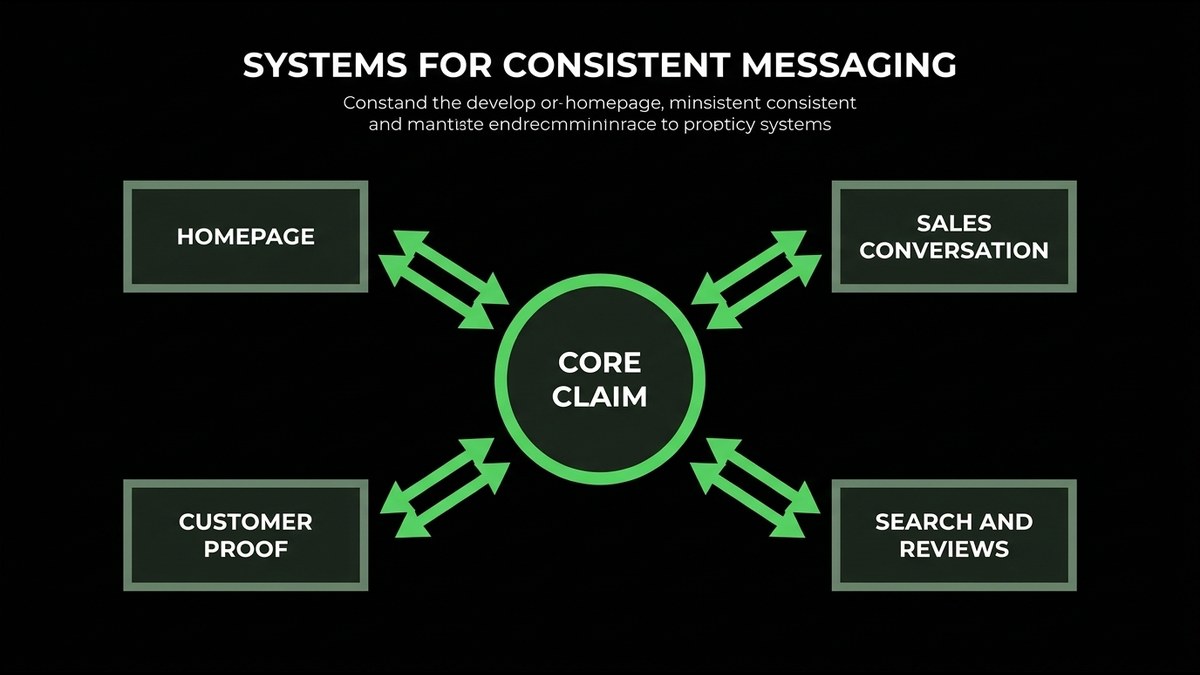
Four layers have to tell one story: the homepage, the sales conversation, the customer proof and the external search results. Positioning is only real when the website, the sales call and the proof all say the same thing.
The positioning reset checklist: eight checks
These are operational health checks, not creative prompts. Answer each with yes or no. When the answer is no, name the gap.
One rule keeps it honest: a check you cannot answer from real sales material is a fail. Use call recordings, deal notes, lost-deal reasons and live pages. Not memory, not opinion. If your CRM cannot tell you why deals were lost, that is gap zero, and it will recur in most of the checks below.
1. Can a rep state your positioning in one sentence without the deck?
Ask three reps, separately. Three different sentences means buyers hear three different companies. Marketing writes for differentiation. Sales needs a plain wedge that works in the first minute of a cold conversation. Those are different jobs, and a claim built only for the first rarely survives the second.
The fix is a single claim both teams can say aloud, tested on the people who say it most. If a rep needs the slide to explain what you do, the claim is too long or too abstract. For the wider mechanics, read Sales and Marketing Alignment: Past the Poster on the Wall.
2. Do late-stage objections contradict your homepage?
Pull the last ten lost or stalled deals and read the objections. A buyer who says "this sounds like everyone else" or "I thought you did something different" is telling you the narrative is generic or out of date.
This is the costliest failure on the list, because it surfaces after the acquisition spend is gone. The buyer arrives with a picture of your product built from the homepage, then meets a different product in the demo. More leads won't fix that. A narrative that matches the language that closes will.
Sort the objections into two piles: gaps in the claim, and gaps in the product. Only the first pile is a positioning problem.
3. Does your ICP match the accounts that close fastest?
Compare the persona on your website with the accounts in your best pipeline. If marketing generates volume and sales complains about fit, the narrative is aimed at the wrong segment. Look at deal velocity and retention by segment, not only lead volume. Volume flatters the segment that is easiest to attract.
Rewrite the story for the segment that closes fast and stays. Enforce ICP discipline in the copy itself, not only in lead scoring. A score filters leads after they arrive. Only the message decides who arrives in the first place.
4. Does your messaging hierarchy reflect today's product?
Product moves faster than copy. If your lead message stresses a capability you have since commoditized, or hides one you now do better than anyone, demos will feel disconnected from the deck.
A quick test: have a product lead rank your top five capabilities by strength, then rank the claims on your homepage by prominence. Where the two lists diverge, you have found the gap.
Rank your claims by what the product does best today, then reorder the page to match. To see how customers' own wording can shape that lead claim, read SaaS Positioning: The Sentence Your Customers Already Use.
5. Do your case studies prove the same claim as your homepage?
Customer proof is the strongest signal of your real positioning. If the homepage leads with cost savings but every case study celebrates speed, that is a narrative split. Buyers trust the stories over the tagline, so the stories win the argument.
Retitle and reframe each case study around the one claim you want to own. If a story cannot be reframed honestly, pull it off the main path and keep it for the segment where it does fit.
6. Does the story work for both the signer and the user?
Multi-stakeholder cycles need two messages under one claim. The economic buyer cares about risk, return and scale. The end user cares about workflow and time saved. Speak to only one and you win the champion and lose finance, or the reverse.
Check the sales material for each role. Does the champion have something to forward to the signer? If all they can forward is a feature list, the claim stops at their desk. Our sales and marketing alignment tactics cover how to build that shared material.
7. Does the narrative hold in every market you sell into?
Expanding across the UK, DACH or Benelux exposes inconsistency fast. What landed in one market confuses buyers in another. A new story per country is not the answer. That path multiplies maintenance and guarantees drift.
Build one positioning framework, then localize proof, examples and tone without touching the core claim. If a local team had to invent its own pitch to get traction, treat that as data. Either the framework is missing something, or the local version is quietly diverging from it.
8. Does the outside world describe you the way you intend?
Search your brand plus your category. Read the top results, review profiles and community threads. Then ask an AI assistant to describe your product and shortlist vendors for your use case.
If the outside description is off, your narrative has not left the building. Write down the gap between what is said about you and what you want said.
How to read the results
Count the noes. A few noes: refine the specific pages or scripts the checks pointed to. Several noes, especially on checks 1, 2 and 3: the claim itself has not been agreed, so settle it before touching any asset.
Checks 1 to 4 test whether the claim is clear and current. Checks 5 to 8 test whether it holds where buyers verify it. Fix the first group first. Proof and consistency cannot repair a claim that is wrong.
Every "no" in these eight checks points to a specific page, script or proof asset you can fix.
Fixing sales enablement messaging when positioning is unclear
Unclear positioning shows up in sales first. Reps improvise because the official story does not help in the room. That is a sales enablement messaging problem, but the root is upstream. Fix the story before you rewrite the deck.
Mechanics matter more than wording here. A claim agreed in a meeting and never wired into the sales process disappears within a quarter. It has to live where work happens: outbound sequences, discovery questions, demo flow, proposal templates and the CRM fields reps fill in after every call. If your team needs help wiring the claim into sequences and CRM workflows, a B2B marketing automation agency can build that plumbing.
Start with brand narrative alignment, in this order:
- Agree the one claim. Sales and marketing sign off on a single sentence about who you serve and why you win. Name one owner for it.
- Map it to the sales motion. Check where the claim appears in outbound sequences, discovery questions, demos and proposals.
- Replace, don't add. Retire old slides and scripts. A new narrative sitting beside the old one makes the split worse.
- Feed objections back. Make lost-deal reasons a required, standardized field in the CRM so objections can be searched and counted, not reconstructed from memory. Late-stage objections go to marketing every month, and they change the copy.
How do you know the alignment is working?
Most teams skip the last step above, and it decides whether the system closes or stays open. Without a clean record of what buyers said, marketing defends the messaging as "on strategy," sales dismisses it as out of touch, and neither side has evidence. With the record, the argument becomes a review of the data.
If a refreshed story is not reflected in deal conversations, the reset has not happened. Teams that want a structured way to close this gap can look at Effiqs' Sales Marketing Alignment service. The goal is a story that supports outbound, web and demand execution from one source.
Measure it by what buyers say back to you. If prospects repeat your claim in their own words on a first call, the alignment is working. If they describe a competitor's claim, it is not. Align the one claim first, then rebuild the sales material around it.
What can you fix in one week?
You can fix the claim, the homepage hero and the one-line pitch. You cannot fix the product, the pricing or multi-market adaptation. Aim at the right pain first: a website or message suppressing conversion, or a gap between brand narrative and sales reality. Without either, a week of rewriting moves nothing.
A reset does not need a rebrand or a two-quarter project. Diagnosis comes first, and useful fixes can ship in days. Here is a realistic one-week sequence:
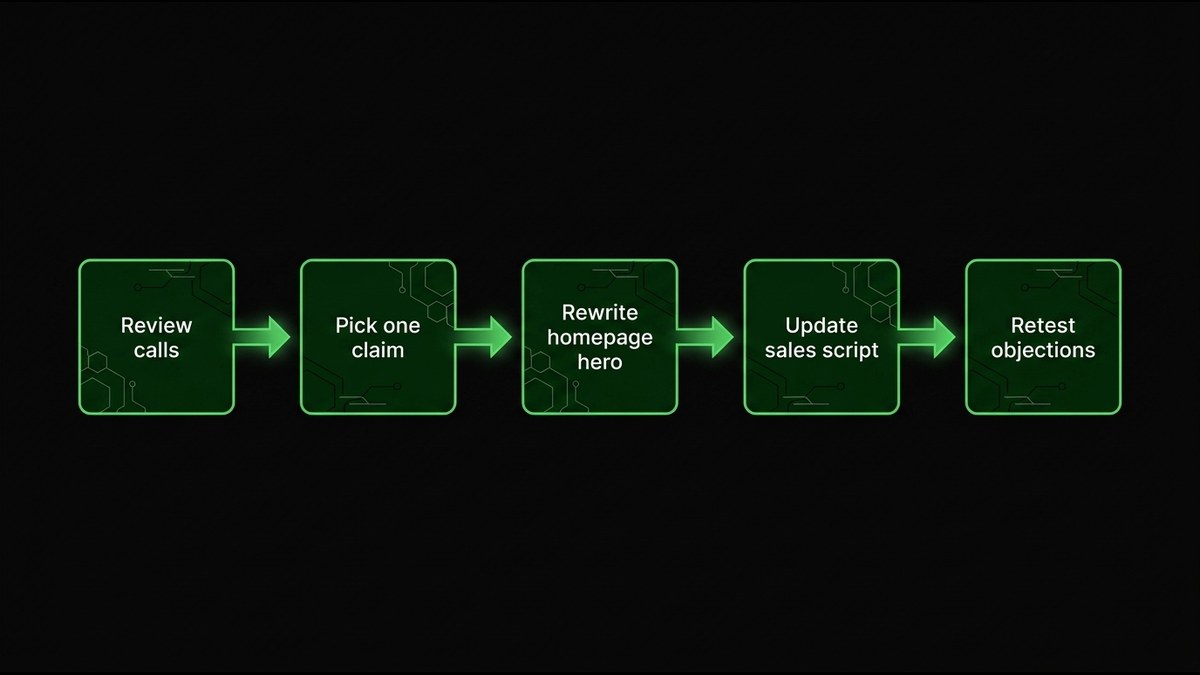
- Review calls and lost deals. Pull recent notes and recordings and note the exact words buyers use. Mark the phrases that repeat. That is your raw material.
- Pick one claim. Choose the sentence that best matches the segment you close fastest. Write it so a rep can say it in one breath.
- Rewrite the homepage hero and the first screen. Keep the claim plain enough to read in seconds. Cut anything that competes with it above the fold.
- Update the one-line pitch and discovery questions. Give reps wording they can use today, and retire the old version in the same move.
- Retest. Listen for the claim coming back from prospects over the following weeks, and log the objections in the standard CRM field.
What will a one-week reset not fix?
For ideas on turning the claim into pages that earn organic visibility, see our work on content and organic positioning.
Be clear about what a week will not fix. It will not repair a broken product or a mismatched pricing model. It will not persuade a sales team that does not believe the value proposition. It will not finish the work of adapting one framework across several markets. Those need a longer brand positioning project, scoped after the diagnosis.
The principle behind all of it is diagnosis before delivery. The most expensive mistake is executing fast on the wrong narrative. The checklist is the diagnostic, and the one-week sequence is the first repair. Anything larger should be justified by what the checks found, not by what feels overdue.
Where to go from here
Run the eight checks against real call notes before you change a word of copy. Name an owner for the claim and fix the handoff before the wording.
If the results point to a bigger brand positioning project, or you want a second set of eyes on the diagnosis, Effiqs can help. You can book a strategy call with the team.
- ✓ Positioning is only real when the website, the sales call and the proof all say the same thing.
- ✓ Every "no" in the eight checks points to a specific page, script or proof asset you can fix.
- ✓ Align the one claim first, then rebuild the sales material around it, and log lost-deal reasons in a standard CRM field.
- ✓ One week is enough to fix the claim, the homepage hero and the one-line pitch, but not the product or the pricing.
- ✓ Diagnose before you deliver: executing fast on the wrong narrative is the most expensive mistake.
FAQ
What is a positioning reset for a B2B SaaS company?+
A positioning reset aligns your brand narrative with the language your sales team uses, the objections buyers raise in late-stage calls, and the accounts that actually close. It is a systems audit, not a rebrand, and it closes the gap between what you say you sell and what your market hears.
What are the main ways B2B SaaS positioning fails?+
There are three common patterns. Messaging-market misfit means the story does not separate you from rivals in your segment. Brand-sales disconnect means sales and marketing tell different stories. Stale narratives mean messaging was refreshed internally but deal conversations still run on the old story. Each needs a different fix, so diagnose which one you have first.
How do I know if my homepage contradicts what buyers experience in sales?+
Pull the last ten lost or stalled deals and read the objections. Comments such as "this sounds like everyone else" or "I thought you did something different" signal a generic or outdated narrative. Sort the objections into gaps in the claim and gaps in the product. Only the claim gaps are positioning problems.
What can a one-week positioning reset realistically fix?+
In a week you can fix the core claim, the homepage hero and the one-line pitch, including the discovery questions reps use. You cannot fix a broken product, a mismatched pricing model, a sales team that does not believe the value proposition, or the adaptation of one framework across several markets.
How do I get sales to actually use the new positioning?+
Wire the claim into where work happens: outbound sequences, discovery questions, demo flow, proposal templates and CRM fields. Name one owner, retire old slides and scripts instead of adding new ones, and feed late-stage objections back to marketing every month through a standardized lost-deal reason field.
How should I interpret the results of the eight checks?+
A few noes mean you should refine the specific pages or scripts the checks flagged. Several noes, especially on checks 1, 2 and 3, mean the claim itself has not been agreed and should be settled before touching any asset. Checks 1 to 4 test whether the claim is clear and current, and checks 5 to 8 test whether it holds where buyers verify it, so fix the first group first.