
The earliest scope creep warning signs on a retainer are requests with no owner, revision rounds that keep multiplying, senior hours drifting into routine delivery, and expansion that follows requests instead of results. Each one shows up in utilization and margin before the invoice changes, so catch them in the quarterly review, not at renewal.
The invoice stays flat. The hours do not. That gap is where retainer margin goes.
We treat scope creep as a system failure, not a client behavior problem. Clients ask for more because nothing tells them where the edge is. Most scope creep warning signs that retainer teams overlook trace back to missing scope boundaries and a missing review cadence. The fix starts with a standing quarterly scope review that puts scope and price on the agenda every time.
You may worry that policing requests will hurt the relationship. We see it the other way. Unmanaged extras are not goodwill. They are unpriced expansion that the client will come to expect for free. This list covers the warning signs retainer owners tend to miss, and what to check on each.
Seven scope creep warning signs on a retainer
Watch for requests that arrive without an owner, revision rounds beyond plan, blurred ownership between your team and the client's, senior time leaking into routine delivery, expansion by request, quarterly reviews that become status updates, and scope language that is open-ended.
Scope creep rarely arrives as one big ask. It shows up first as small, unowned requests and rising senior hours. The retainer looks flat on paper while delivery absorbs the extra work. The warning signs that retainer leaders can track sit in delivery data well before the invoice moves. We monitor scope creep as a standing risk next to margin erosion, not as something to discover after the fact.
Read the signs in three groups. Signs 1 to 3 are about requests. Signs 4 and 5 are about capacity and money. Signs 6 and 7 are about governance.
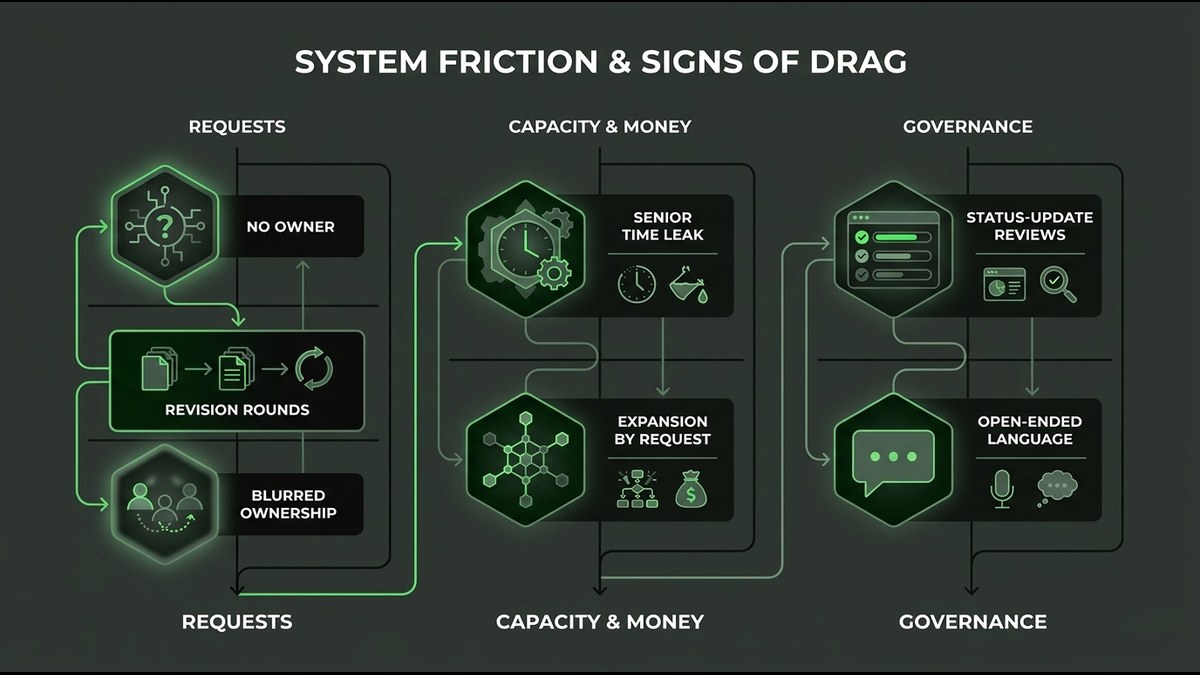
- Requests. Requests arrive as favors with no owner, revision rounds multiply, and ownership boundaries blur.
- Capacity and money. Senior time leaks into routine delivery, and expansion follows requests instead of performance.
- Governance. The quarterly review turns into a status update, and the scope document uses open-ended language.
Sign 1: Requests arrive as favors with no owner
In practice: A client contact drops a "quick tweak" into chat on Thursday afternoon. Someone on your team says yes. There is no ticket, no scope check, and no name against the task.
Why it costs margin: Each yes is small. Together they become a second workload that nobody planned or priced.
Check this week: Pull last month's chat and email threads. Count the requests that never reached your tracker. Then name one owner for intake.
Sign 2: Revision rounds multiply, especially on content and design
In practice: A landing page draft goes through another pass, then another. Each round is reasonable. None of them is counted.
In our work with clients, content and design requests are where scope pressure shows first. These deliverables are subjective, so "one more pass" never feels like a big ask.
Why it costs margin: Revision effort spreads across the writer, the designer, the reviewer, and the account lead. No single person sees the total.
Check this week: Compare the revision rounds on your last three deliverables with the number the scope allows. If the scope states no number, that is your finding.
Sign 3: Ownership boundaries blur
In practice: Your team starts fixing the client's CMS settings, chasing their other vendors, or finishing tasks that sit on the client's side.
Clean boundaries are the point of white-label delivery on fixed scope. The work is defined, owned, and handed over, with no gray zone.
Why it costs margin: You inherit accountability for outcomes you do not control. Delivery slows because you wait on work that was never yours.
Check this week: List every task your team did last month that appears in nobody's scope. Assign each one to your side, the client, or another vendor.
Sign 4: Senior time leaks into routine delivery
In practice: Your strategy lead is fixing formatting and joining routine working calls. Utilization climbs while the invoice stays flat.
Why it costs margin: Senior hours are your most expensive hours. When they go into routine work, they stop going into the work that grows the account.
Check this week: Compare senior hours with the plan for last quarter. Do it by reading margin, utilization, and capacity side by side, because any one of the three can look fine on its own.
Sign 5: Expansion follows requests, not performance
In practice: An extra report, a second asset set, and another channel get added on a call because someone asked. None of them connects to a result.
Why it costs margin: The retainer grows in volume but not in value. Team overload follows, and quality drops on the work that matters.
Check this week: For each addition in the last two quarters, write down the result that justified it. A blank line means creep.
Sign 6: The quarterly review turns into a status update
In practice: The review is a deck of what shipped. Nobody talks about scope or pricing. Nobody records a decision.
Why it costs margin: This is the one meeting built to reset boundaries. When it becomes reporting, creep goes unchecked for another quarter.
Check this week: Open the last review agenda. Did it include a scope item and a pricing item? If not, add both to the next one.
Sign 7: The scope document uses open-ended language
In practice: The document says "ongoing support," "as needed," or "and related tasks." Every reader interprets those phrases differently.
Our documented position is simple: engagements are fixed-scope and fixed-fee, with the controls handed to the client. That is the opposite of an open sentence. It is also why fixed scope removes the incentive for ambiguity.
Why it costs margin: Ambiguity pays the wrong party. Whoever reads the sentence loosely wins, and that is rarely the party carrying the cost.
Check this week: Highlight every phrase without a defined deliverable, quantity, or owner. Rewrite each one before the next review.
If three or more of these signs are present, you have a boundary problem, not a client problem.
How do you tell creep from expansion?
Healthy expansion is tied to a performance result, scoped, and priced before work starts. Scope creep is tied to a request, arrives informally, and gets absorbed. If nobody can say what it costs and who owns it, it is creep.
Run every new ask through four questions. A "no" on any one of them means the ask needs a conversation before anyone starts work.
- Tied to a result?. Healthy expansion has a performance reason. Creep has a requester.
- Written down?. Healthy expansion is in the scope document before work begins. Creep lives in chat.
- Priced?. Healthy expansion carries a cost the client has seen. Creep carries none.
- Owned?. Healthy expansion has a named owner on both sides. Creep has nobody.
Why expansion should be earned, not granted
Our view is that expansion should be earned by performance, not granted by request. When results justify more work, we add it on purpose. We judge a retainer on trajectory, not isolated wins. Are the growth systems stable and improving? Are strategy, content, design, and execution aligned? Can the client see which results come from which work? Expansion that serves those goals is healthy. Expansion that only answers the loudest voice is not.
This is also why scope has to be priced as structure. Our fixed-scope pricing follows what gets built, not effort nobody can see. That keeps the client in control of what they buy and what it costs.
The objection that boundaries damage relationships gets this wrong. A defined scope is what makes saying yes sustainable, because every yes has a place to land and a price attached.
Expansion is healthy when a result justifies it and both sides can name its cost and owner.
What should you do at the first sign?
Act while the engagement is open. Name the request, check it against the written scope, and respond in one of three ways: decline, schedule it into the next review, or price it as an addition. Do not wait for renewal.
The logic is the same one that protects any account: the intervention that works is the one that happens months before renewal, not at it. By the time the renewal call arrives, the extra work is already the baseline.
Here are the three responses, with one example of each.
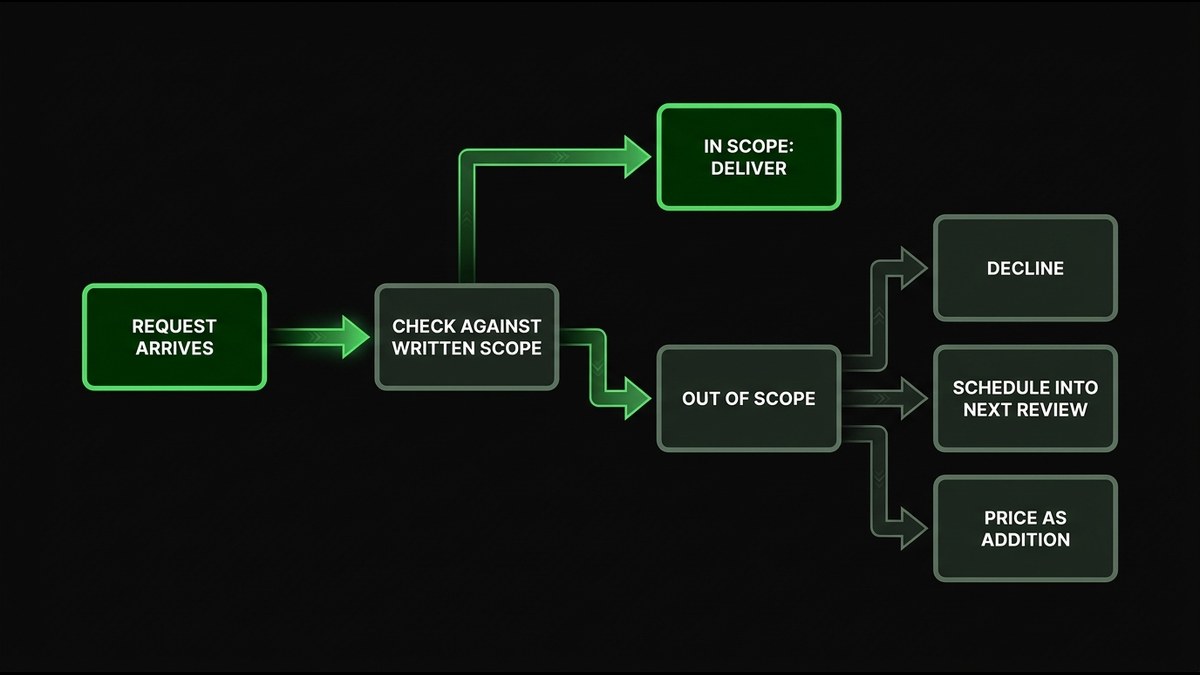
- Decline. A request falls outside the scope and has no link to a result. "We can't take that on within the current scope. Here is what it would displace."
- Schedule. A request has merit but no urgency. "We'll put it on the agenda for the quarterly review and decide there."
- Price. A request is valuable and clearly outside scope. "We can add it. Here is the scope and the cost, and here is the owner."
A short checklist for this week
Scope realignment and pricing adjustment are the first-line responses. Neither is a punishment. Both are routine corrections, made on a regular cadence through a quarterly scope and pricing review. In a diagnostic-first scope with outcome gates, the boundary is set before work starts and the client keeps ownership of it. That is what engagement control looks like in practice: the client knows where the edge is, and so do you.
Responding early, in plain terms, keeps a small request from becoming the client's baseline.
- Pick the one sign you recognize most.
- Find the last request that matches it.
- Check it against the written scope.
- Choose decline, schedule, or price, and tell the client.
- Put a scope item and a pricing item on the next review agenda.
When does scope creep mean reprice or exit?
When the same signs repeat after a scope conversation, the issue is no longer process. Reprice if the client's real need has outgrown the scope. Exit or restructure if the client will not accept boundaries and scope risk outweighs the account's value.
Use this decision logic.
Not every account is worth retaining. Concentrate effort where fit and value are real. We decline work when scope risk outweighs strategic value, and we end engagements on purpose when strategic fit degrades. Saying no protects the model, and it protects the clients who stay.
Repeated signs after a clear conversation are a decision point, not a reason to try harder.
- The need has grown. The client now wants more because the work is succeeding. Reprice and rescope. This is healthy expansion that was never formalized.
- The need has changed shape. The client really wants someone to run this for them indefinitely. Compare an in-house hire, a retainer, and a client-owned build. The right answer may not be a retainer at all.
- The boundaries are refused. The client accepts none of the above and keeps pushing past scope. Restructure the engagement or end it.
Retainer risk management starts with the review
Retainer risk management is not a one-off audit. It is a habit: a named owner for every request, a number of revision rounds written into scope, senior time tracked against plan, expansion tied to results, a review that covers scope and price, and language that says exactly what is included.
To recap the seven signs: requests with no owner, multiplying revisions, blurred ownership, senior time leaking in, expansion by request, status-update reviews, and open-ended scope language. Each one is a governance gap you can close.
If you recognize three or more of these signs, bring us the scope document and we will show you where the boundary should sit.
- ✓ Scope creep starts as small, unowned requests, extra revision rounds, and senior hours drifting into routine work.
- ✓ Treat creep as a system failure: missing boundaries and a missing review cadence, not a difficult client.
- ✓ Test every new ask: is it tied to a result, written down, priced, and owned? A "no" means talk before work starts.
- ✓ At the first sign, decline, schedule it into the next review, or price it as an addition. Do not wait for renewal.
- ✓ If the signs repeat after a clear scope conversation, reprice, restructure, or exit.
FAQ
What are the earliest warning signs of scope creep on a retainer?+
The earliest signs are requests that arrive as favors with no owner, revision rounds that exceed plan, and senior hours drifting into routine delivery. They show up in utilization and margin before they show up on the invoice.
How do you tell scope creep from healthy expansion?+
Healthy expansion is tied to a performance result, written into the scope, priced before work starts, and owned on both sides. Scope creep is tied to a request, arrives informally in chat or on calls, and gets absorbed without a price or an owner.
What should you do when a client asks for something out of scope?+
Name the request and check it against the written scope. Then respond in one of three ways: decline it, schedule it for the next quarterly review, or price it as an addition with a defined scope, cost, and owner.
When should you reprice or end a retainer because of scope creep?+
Reprice and rescope when the client's need has genuinely outgrown the scope because the work is succeeding. Restructure or end the engagement when the same signs repeat after a clear scope conversation and the client will not accept boundaries.