
Fixed scope project pricing means the deliverables, price and timeline are agreed before work starts, so the buyer knows the total cost up front and the vendor carries the risk of overruns. Time-and-materials bills for hours instead, so cost rises when work takes longer. For budget owners, fixed scope makes spend predictable and accountability clear.
What is fixed scope project pricing? Fixed scope project pricing means the deliverables, price and timeline are agreed before work starts. The buyer knows the total cost up front, and the vendor carries the risk of overruns. Time-and-materials bills for hours instead, so cost rises when work takes longer. For budget owners, fixed scope makes spend predictable and accountability clear.
Most outside spend on growth work arrives as an invoice that follows hours. Your board wants outcomes. That gap is where forecasts break, where arguments about "what was in scope" begin, and where a finance lead ends up defending a number they never agreed to.
What is fixed scope project pricing?
Fixed scope project pricing is a contract with four fixed parts: what gets delivered, what it costs, when it lands, and how everyone will know it worked. Change any one of them and you are not buying a fixed-scope project anymore. You are buying effort and hoping it adds up.
Time-and-materials works the other way. The vendor logs hours and expenses as they accrue, and the buyer pays the total. The rate is visible. The quantity is not. Cost depends on how long the work takes, and the vendor, not the buyer, controls most of that. The difference comes down to who holds the risk. That is the whole structural argument, and everything else in this piece follows from it.
A scoped deliverable is something you can point at. For strategy work, it is a diagnosis with a written output: which revenue layers are broken, in what order to repair them, and what each repair should change. For build work, it is a working system, such as a CRM configured to a stated design or a website delivered against agreed milestones. For brand work, it is a defined set of assets with an agreed timeline.
At Effiqs, branding, website and systems work is scoped this way. Systems engagements are standardized and fixed in scope. Each one repairs or installs a specific growth capability, and customization stays inside configuration rather than growing the scope. A request beyond the agreed deliverables is a new conversation, not a quiet addition to the bill.
The common objection is that fixed scope is rigid, and that you do not fully know what you need yet. Fixed scope is not a way to skip discovery. Diagnosis comes first, and scope gets locked after it. If the problem is truly unknown, the honest move is to price the diagnostic as its own piece, not to leave the build open-ended. The same logic applies to a SaaS project pricing model: SaaS buyers already expect to know what they are buying and what it costs each period. Fixed scope gives one-time work the same clarity: a defined thing, a defined price, a defined date.
- Fixed scope. The buyer's cost is capped, and overrun risk sits with the vendor.
- Time-and-materials. The vendor's revenue is protected, and overrun risk sits with the buyer.
Why does time-and-materials make budgets unpredictable?
Because the invoice follows effort, not outcomes. The vendor sets the hours, and the buyer sees them after the fact. A finance team cannot forecast a number that depends on how long someone else takes.
Think about how a finance lead actually plans growth spend. You start from a revenue goal, work back through customer acquisition cost and lifetime value to a budget, then allocate it across programs. That method only works if each line is a known amount. An hourly engagement gives you an estimate, a rate and a hope. It does not give you a line you can lock into a plan.
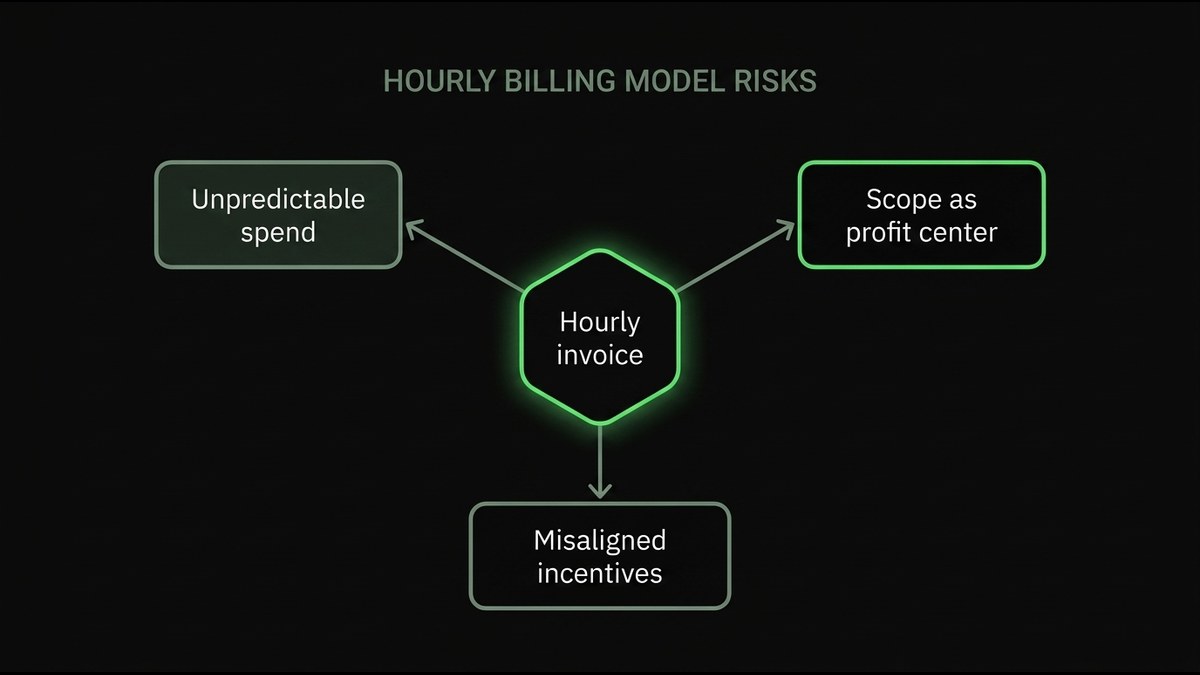
Three things go wrong when a project line is open-ended. First, the forecast carries a range where the model needs a point. Finance teams cope by padding the line, which ties up budget that could fund other work, or by leaving it unpadded and re-forecasting every month as hours land.
Second, you learn the real cost late. Hours are reported weekly or monthly, so by the time a trend is visible the money is spent. The only lever left is stopping the work, which usually leaves a half-built system behind.
Third, the cost is hard to tie to a result. Spend shows up as effort, such as hours of design or hours of configuration. Your board does not ask how many hours went into a funnel rebuild. It asks what the rebuild did to pipeline and acquisition cost. When the bill is written in hours, the link from spend to outcome has to be rebuilt by hand.
Some buyers ask for an hourly engagement with a not-to-exceed cap. That helps, but it only tells you the worst case, not what is delivered at that price. If the cap is reached before the work is done, you either raise it or accept an unfinished system. Either way, the outcome gets negotiated after the money was committed. Fixed scope project pricing ties the price to the deliverable from the start, and if the work takes longer than planned, the vendor absorbs it.
Open-ended billing is also often a symptom of a problem upstream of the invoice. When a company does not know which part of its revenue system is broken, nobody can write a tight scope, so the work stays vague and the bill stays open. Your pipeline is rarely the problem, and your go-to-market architecture usually is. Until someone diagnoses which layers of the revenue system are failing, any quote, hourly or fixed, is a guess.
How does scope creep become a profit center?
Under hourly billing, every unclear requirement, extra revision or "quick addition" adds billable hours. When revenue grows with ambiguity, the vendor has little reason to remove it.
This is a structural point, not an accusation. Most vendors act in good faith, but good faith does not change the incentive. An hourly contract rewards work that takes longer, and it does not reward finishing early or forcing clarity before work begins.
Scope creep rarely arrives as one big change. It arrives as small, reasonable requests, each easy to approve on its own. Under hourly billing, each also adds cost, so nobody has to act in bad faith for the total to grow far beyond what the buyer expected.
Design work shows the mechanism best. When success is defined as "it should feel right," there is no point at which the work is done. Each round of feedback is subjective, and each round is billable. The loop ends when the buyer runs out of budget or patience, not when the work meets a standard. Contrast that with UX/UI work that has defined research, journey mapping and design system deliverables. When the deliverables are listed, both sides know what "done" looks like, and a revision is a correction against the agreed list, not an open invitation to redirect.
Under a fixed price, an unplanned addition costs the vendor margin. That changes behavior on both sides. The vendor pushes for clarity early, because ambiguity now costs money. The buyer is pushed to decide early too, because a late change means a new conversation about price.
Effiqs entry engagements follow this logic, with fixed scope, fixed milestones and defined success criteria. Design and build work is tied to a growth capability that has to perform afterward, so there is always a standard to test against. None of this means change is forbidden. It means change is visible: when something genuinely new comes up, it is priced and approved as new scope, and nothing grows quietly on the invoice.
- Late stakeholders. A stakeholder joins late and wants a different direction.
- Vague requirements. A requirement turns out to be vague, so it gets reinterpreted.
- Mid-build additions. A "small" integration is added mid-build.
- Review rounds. A review round becomes three rounds, then five.
Do hourly engagements misalign incentives?
Yes. The unit a vendor charges for decides who benefits when things go well and who pays when they go badly. Charge for hours, and the vendor's revenue tracks effort. Charge for a deliverable, and it tracks completion. The idea applies to services as much as to software: a vendor choosing between hours and deliverables faces the same pricing-metric question a software company does.
Consider two outcomes. In the first, the vendor finds a faster path and the work takes half the estimated time. Under hourly billing, the vendor earns less for a better result. Under fixed scope, the vendor keeps the gain and the buyer gets the deliverable sooner. In the second, the work turns out harder than expected. Under hourly billing, the buyer pays for the difficulty. Under fixed scope, the vendor absorbs it. Hourly billing rewards time spent. Fixed scope rewards getting to done, and your board cares about done.
There is a deeper version of this problem. An hourly vendor benefits when the problem stays fuzzy, because fuzzy problems need more hours to investigate. A vendor that commits to a price has to understand the problem first. That is why diagnosis comes ahead of delivery: executing quickly on the wrong system is the most expensive mistake in growth work. Hours are an input, and buyers pay for outputs such as a repaired funnel, an installed system or a launched site.
A skeptical buyer will say that vendors who quote fixed prices just pad them. Sometimes they do. A fixed price puts the overrun risk on the vendor, but a vendor can still price in a generous cushion. Three safeguards deal with this. First, a written list of deliverables, so you can see what the price covers and compare it against other proposals. Second, defined success criteria, so the vendor cannot ship less and call it done. Third, a change-control rule, so scope moves only through a visible, agreed step. With those in place, padding is something you can see and challenge. Without them, a fixed price just hides the same ambiguity an hourly bill would show.
A fixed price can also fail the other way: a vendor squeezed on price may cut corners on quality. Acceptance criteria exist to prevent that, because they define what "complete" means in terms the buyer can verify.
What makes a fixed-scope project work?
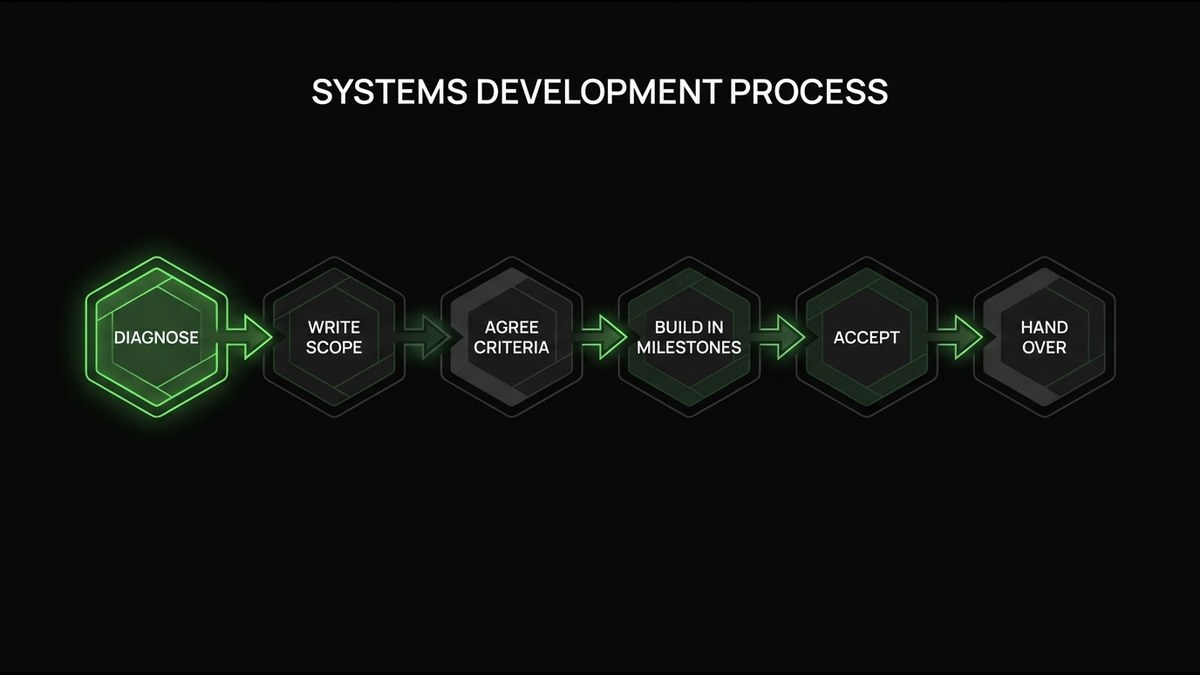
Four things: a diagnosis before the quote, deliverables written so both sides can verify them, success criteria defined up front, and a change-control rule for anything outside scope. Without these, fixed scope project pricing only moves the ambiguity somewhere less visible.
A quote is only as good as the understanding behind it. If nobody has looked closely at the current system, the scope is a guess, and a guess with a fixed price attached is a risk the vendor has priced in or will regret. Effiqs diagnoses first, looking at which parts of the revenue system are failing and in what order they should be repaired. That diagnosis is what makes a scope tight enough to price. It also answers the "we don't know what we need yet" objection: if you do not know, the first deliverable is the diagnosis, and it can be a fixed-scope piece of its own.
Some Effiqs programs show the shape. Fix Your Funnel is a time-boxed engagement with a stated target for sales funnel efficiency. Generate ICP Leads is a time-boxed engagement built around a guaranteed volume of leads that fit the ideal customer profile. Both are defined by an outcome and a fixed duration, not by a count of hours, and their exact terms are on the public program pages.
A deliverable is verifiable if someone who did not do the work can check it. "Improved CRM" is not verifiable. "A CRM configured with these pipelines, these properties and these automations, documented and tested" is. A useful CRM scope names the objects and pipelines to be configured, the integrations to be connected, the reports to be built and the documentation to be delivered, and it states what the buyer must provide, such as access and data. A useful website scope lists page templates, content responsibilities, integrations, review rounds and launch criteria, tied to milestones, so the buyer can see progress at each stage instead of waiting for a single reveal. In both cases, ownership matters. If you cannot run the thing after the vendor leaves, you have bought dependency, not a deliverable.
Success criteria say how everyone will know the work met its goal. They should be specific enough to test: a system performing a defined function, a site passing agreed checks, a funnel measured against a stated baseline. Without them, "done" becomes a negotiation at the end.
Change control is the rule for what happens when something falls outside scope. Anyone can raise a change. The vendor states the effect on price and timeline. The buyer approves or declines before work begins. Nothing is added by default, and every fixed-scope contract should state this in writing.
- Exclusions and client responsibilities. List what is not included, and what the buyer must supply, such as content, approvals, system access and third-party tools. These drive more overruns than most buyers expect, because a delayed approval or a missing login stalls work as surely as a technical problem.
- Milestone payments. Tie payments to accepted milestones, not to the calendar. A deposit to start, payments as milestones are accepted, and a final payment on acceptance keep both sides motivated to finish.
When is time-and-materials still right?
When the problem itself is unknown and cannot be diagnosed cheaply first, or when the work is exploratory by nature. In those cases, a fixed scope would be a fiction. It is better to say this plainly than to oversell fixed scope.
Even then, there is a better move than open-ended hours: scope the discovery step as its own fixed piece. Define what it will produce, such as a diagnosis, a recommendation or a written scope, and price it. Then, with that output in hand, fix the scope of what follows. This keeps the exploratory part contained, puts a ceiling on how much uncertainty you buy, and gives you something to take to a board: a priced diagnosis and a priced build, instead of an open line. If the open question is your go-to-market itself, diagnosing it before scoping the build is the sensible first step.
Sometimes hourly is the right call and the buyer accepts it. Then add structure: a cap with a stated review point before it is reached, regular reporting that ties hours to outputs, an approval threshold so no large block of work starts without a decision, and a planned exit so the engagement either converts into a fixed scope or ends. The principle is the same one that applies throughout: hours are an input, so keep your eye on what they produce.
- Genuine research and exploration. If the question is "what is possible?", the output cannot be defined in advance.
- Emergent, unpredictable work. Support after an incident, or work that depends on decisions nobody can predict.
- Ongoing capacity. Continuous work with no natural end is better priced as capacity than as a project.
How do you run an engagement model comparison?
Compare proposals on five questions, and rank them on those, not on hourly rate. An hourly rate tells you the price of a unit. It tells you nothing about the cost of the result. The five questions are cost certainty, overrun risk, verification, ownership and board link. Two extra rows matter in practice: incentive when work gets harder, and fit for unknown problems.
Procurement teams often need to compare several proposals side by side. That is hard when proposals describe effort differently: one vendor quotes hours by role, another quotes a monthly figure, a third will only quote after a discovery call. Quote-only pricing, with no stated deliverables or assumptions, makes proposals close to impossible to compare. A fixed-fee B2B services proposal that lists deliverables, exclusions, milestones and acceptance criteria can be put next to another and scored. If a vendor cannot tell you what you are buying before you sign, that is itself information.
Ask for five things in every proposal: a written deliverables list, a list of assumptions and exclusions, the change-control rule, the milestone and payment schedule, and a statement of who owns what at handover.
Founders need to move fast and avoid being locked in, and finance needs to forecast and report. Both are served by the same structure: a priced deliverable can be planned, approved and defended, while an open-ended line cannot.
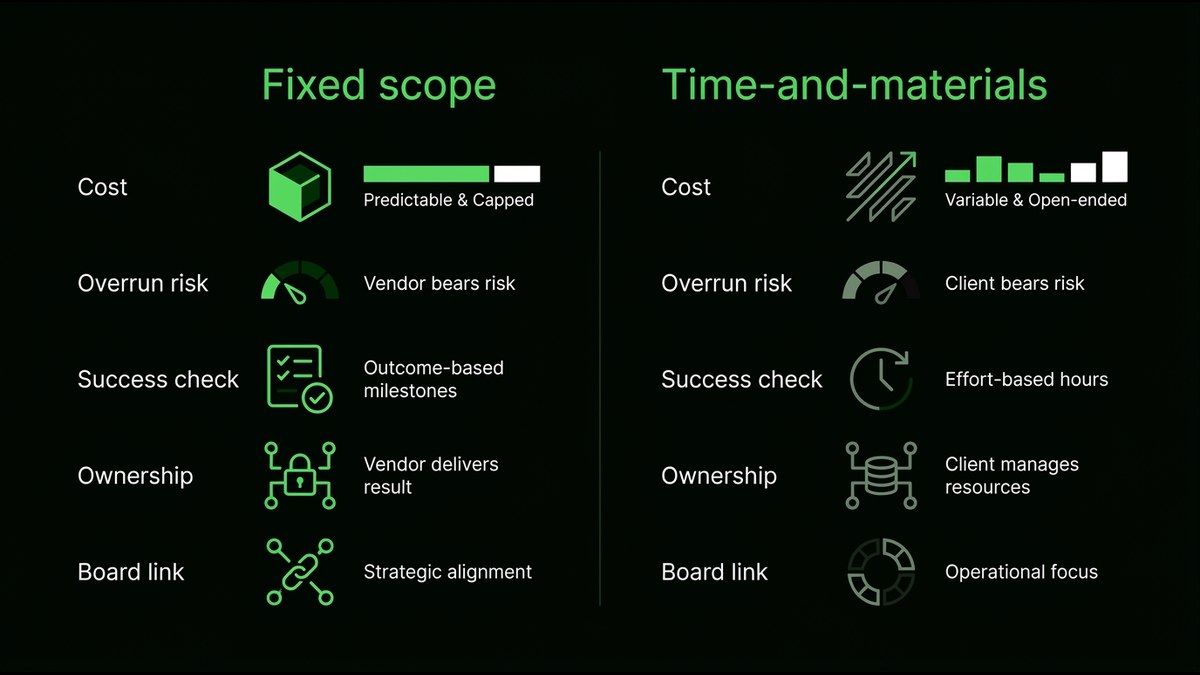
- Cost certainty. Fixed scope gives a known total before work starts. Time-and-materials gives an estimate that moves as hours land.
- Who carries overrun risk. Under fixed scope, the vendor. Under time-and-materials, the buyer.
- How success is verified. Fixed scope uses written criteria and acceptance of defined deliverables. Time-and-materials usually relies on reports of hours and activity.
- Who owns the output. Fixed scope can state ownership and handover in the contract. Time-and-materials often leaves it unstated unless the buyer insists.
- Ties to board metrics. Fixed scope links a priced deliverable to a stated outcome. Time-and-materials links spend to effort, and the buyer must rebuild the link to outcomes.
- Incentive when work gets harder. Fixed scope pushes the vendor to solve the problem efficiently. Time-and-materials pays the vendor more for the added difficulty.
- Fit for unknown problems. Fixed scope fits well once the problem is diagnosed, and poorly before. Time-and-materials fits exploratory work, with guardrails.
How does fixed scope fit with Growth Operations?
Fixed scope ends where the work becomes continuous, and capacity-based operations begin there. The two are not rivals. They are two stages of the same relationship.
A fixed-scope project is a clean way to start. It has a defined goal, a defined price and a defined end, and it proves a system works before anyone commits to a longer arrangement. If the system performs, you have evidence. If it does not, you have lost a bounded amount, not an open one.
Once a system is installed, it needs running. Funnels need tuning, attribution needs maintenance, and content, demand and RevOps work all continue after launch. That is where capacity-based Growth Operations makes sense, covering strategy, demand, content, design and RevOps under one owner, with a fixed scope, a fixed price and regular reviews. Predictable revenue comes from the system underneath being consistent, and a fixed-scope project is often what makes it consistent in the first place: it repairs or installs one capability so that ongoing work has something stable to build on.
Each Effiqs project ends with a clear view of what should come next, so the buyer can decide on evidence. Effiqs only takes on a project when it can plausibly lead to something worth running. Work that would end in a one-off artifact with no system behind it is rarely what a buyer needs.
Early-stage companies often need a defined starting point. A defined-scope program for MVP-stage companies offers one: a bounded piece of work with a clear outcome, after which the company decides what to do next.
Moving from project to operations should not change the discipline. Ongoing work should still have defined scope, a stated price and reviews against outcomes. If a vendor shifts to open-ended hours the moment the project ends, the three structural risks come back, so ask for the same clarity at every stage.
What should finance ask before signing?
Three risks sit inside every hourly bill: spend you cannot forecast, scope that grows because ambiguity pays, and incentives that reward effort over results. Fixed scope project pricing removes all three by committing the vendor to a deliverable, a price and a date before the work starts.
That is not rigidity. It is accountability. A vendor who will put a price and a date on a defined deliverable has done the diagnosis, understood the problem and accepted the risk. A vendor who will not has handed that risk to you.
Before you sign, ask whether the proposal has a diagnosis behind it, a written list of deliverables, success criteria you can test, and a change-control rule. If it has all four, you can defend the spend. If it lacks them, you will end up defending the invoice.
- ✓ Fixed scope moves the risk of "how long will this take" from the buyer to the vendor, and that single shift drives every benefit.
- ✓ Under hourly billing, ambiguity earns the vendor revenue, while under fixed scope it becomes a cost the vendor wants to remove.
- ✓ Fixed scope works only when diagnosis, verifiable deliverables, success criteria and change control are written down before the first invoice.
- ✓ Use time-and-materials only for work that cannot yet be defined, and convert it to fixed scope the moment it can.
- ✓ Rank proposals on cost certainty, overrun risk, verification, ownership and board link, not on hourly rate.
FAQ
What is fixed scope project pricing?+
Fixed scope project pricing is a contract in which what gets delivered, what it costs, when it lands and how success is verified are all agreed before work starts. The buyer's cost is capped, and the vendor carries the risk of overruns.
What is the difference between fixed scope and time-and-materials?+
Under fixed scope, the buyer pays an agreed price for defined deliverables, so overrun risk sits with the vendor. Under time-and-materials, the vendor bills for hours and expenses as they accrue, so cost rises when work takes longer and overrun risk sits with the buyer.
Does fixed scope pricing mean vendors just pad their quotes?+
It can, since a vendor can still price in a cushion. Three safeguards make padding visible and challengeable: a written list of deliverables, defined success criteria, and a change-control rule so scope only moves through a visible, agreed step.
What if we don't know exactly what we need yet?+
Price the diagnostic or discovery step as its own fixed piece, with a defined output such as a diagnosis, recommendation or written scope. Then fix the scope of the build that follows. This contains the uncertainty instead of leaving the whole engagement open-ended.
When is time-and-materials the right choice?+
When the problem is unknown and cannot be diagnosed cheaply first, or when the work is exploratory or emergent by nature. If you choose hourly, add a cap with a review point, reporting that ties hours to outputs, an approval threshold and a planned exit.
What should a fixed-scope proposal include?+
A written deliverables list, a list of assumptions and exclusions, the change-control rule, the milestone and payment schedule, and a statement of who owns what at handover.