
Quarterly scope reviews are the most reliable structural defense against scope creep and margin erosion on B2B retainers. A diagnostic session every 90 days compares delivered work with the original capacity assumptions, surfaces hidden scope expansion, and lets you recalibrate pricing or deliverables before margin compresses. Framed as client-value optimization rather than cost control, the review keeps the relationship healthy while protecting profitability.
A fixed-capacity engagement needs a fixed rhythm for checking itself. That is the core of SaaS retainer management, and it is how we run our own retainers.
A retainer that is priced to what we build, not hours you can't see, only stays profitable if someone compares what was promised with what was delivered. Without that comparison, small extras accumulate and nobody notices until margin is gone.
Below is how we run that comparison without making clients feel nickel-and-dimed. In practice, SaaS retainer management is a calendar habit, not a clever tactic.
Why does SaaS retainer management break down after quarter one?
Retainers rarely fail on day one. They start with a clean scope, a fair price and a team with room to spare. Then small asks arrive. One more landing page. One more round of design changes. One more report for the board.
Picture month five. Nobody on your team decided to over-deliver. It happened one "sure, we can squeeze that in" at a time. Each ask looks harmless. Together they turn a defined engagement into an open-ended one. Your team absorbs the extra work quietly. Leadership sees healthy revenue while the real margin shrinks underneath.
Retainers that span many service lines are the most exposed. Strategy, execution, creative and systems work give small requests many ways in. Content and design are where scope creep shows up first in our accounts. Quality is subjective, "done" is hard to define, and revision loops have no natural end.
The damage is not only financial. Overloaded teams slow down. Quality slips, and the client feels it. B2B customer retention is decided long before renewal, and unmanaged scope drift is one of the quiet reasons it goes wrong.
Margin loss is a slow structural leak, not a sudden event. You will not catch it by feel. It needs a scheduled check.
- Scope drift. Small unlogged requests turn a defined engagement into an open-ended one.
- Margin erosion. The team absorbs extra work while revenue looks healthy.
- Senior-person reliance. Too much of the delivery depends on a few experienced people.
- Revenue concentration. Too much revenue sits in too few accounts.
What is a quarterly scope review?
A quarterly scope review is a diagnostic session. You compare contracted scope with delivered scope and decide what to do about the gap. It is not a pricing renegotiation. It is not a performance review of your own team.
Our rule is simple: the review is part of the deal from the start. We put it in the commercial terms next to the minimum engagement period and the success metrics. Then the client never experiences it as a surprise. This mirrors the diagnostic-first scope and outcome gates in our retainer framework, where the boundaries of the work are agreed before it begins.
Bring three inputs to the call
If one of the three inputs is missing, we would not hold the call. You will end up arguing from memory.
- A deliverable log. Everything shipped, including the "small favors."
- Effort by service line. Where the team's time actually went.
- A client satisfaction signal. Approval speed, response times and tone.
Frame it as value optimization
Language decides how the review lands. Compare two openings. The weak one: "We are over-delivering and need to cut scope." The strong one: "Let's make sure your retainer budget goes to the highest-impact work."
Both describe the same facts. Only the second invites the client into the decision.
The review is a shared look at where the budget goes. Clients accept it when they agreed to it upfront.
What agenda delivers retainer scope creep prevention?
Retainer scope creep prevention depends on a short, repeatable agenda. We keep it to one hour and use the same order every quarter. Predictability makes the conversation feel fair.
The same logic applies to how an engagement starts. A good entry offer is tightly bounded, with clear success criteria and a view on what the retainer could become. The quarterly agenda applies that same discipline to the ongoing work.
A fixed agenda turns scope control from a debate into a routine.
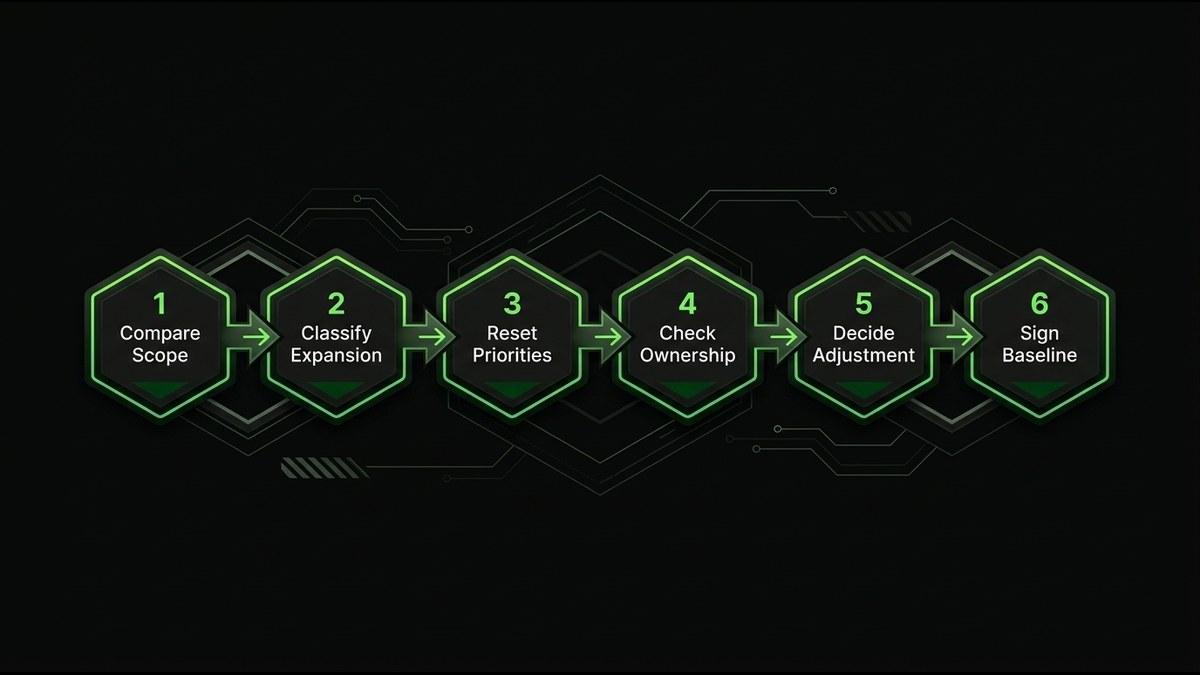
- 1. Delivered versus contracted scope. Pull the logs. Show the data. No blame.
- 2. Classify the expansion. Did the client's business change and require more work? Or did the team say yes without checking capacity?
- 3. Reset priorities. Walk through the current go-to-market direction, channels, experiments and roadmap. Decide what moves up and what drops off.
- 4. Check ownership boundaries. Unclear ownership of the CRM, tracking and automation is a quiet source of unpriced work. If you also run RevOps and revenue operations work, name who owns each system.
- 5. Decide the adjustment. Reduce lower-priority deliverables, add a fee for new scope, or move it to a project. Any discount needs a stated reason.
- 6. Document the new baseline. Both sides sign a revised scope appendix. The next review goes on the calendar before the call ends.
How do you handle out-of-scope requests?
Out-of-scope requests are normal. The problem is answering them inconsistently. We use three standard responses so every account manager says the same thing.
Here is a scene you will recognize. A client asks for a fourth case study in a month where three were planned. You can do it once and log it. You can swap it for a lower-priority blog post. Or you can quote it as an add-on. Any of the three is fine. Saying yes with no record is not.
Trust survives because the client always gets a clear answer and a real choice. Nothing is refused. Nothing is free by default.
Good customer success B2B services teams already work this way. They treat the conversation as part of account health, not a billing dispute. Professional services firms show why. They often have clear marketing operations needs and recurring-revenue potential. They also send a steady stream of "can you just also..." requests that need a standard response.
Sometimes the answer is realignment. Scope gets reset, or pricing gets adjusted. If a client keeps refusing transparency and strategic fit keeps degrading, an intentional exit is a legitimate outcome. Resistance to a scope review is a leading indicator of misalignment, so address it early.
When every request maps to one of three responses, the relationship and the budget are both protected.
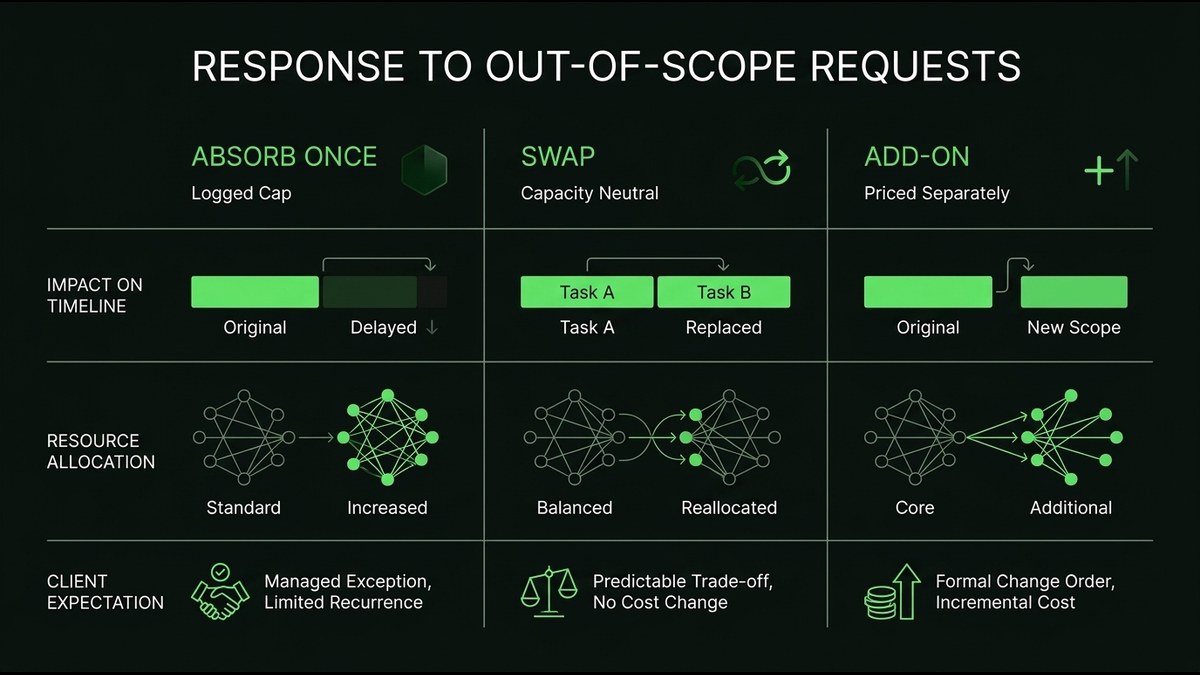
- Absorb once, with a logged cap. Do the small favor, record it, and say it is a one-time courtesy.
- Swap for in-scope work. "We can do that. Which planned item should move down?"
- Price as an add-on. Quote it as a separate, clearly scoped piece.
How do you expand a retainer without upselling?
Expansion feels like an upsell when it follows a request. It feels like a plan when it follows performance and capacity.
We tie growth in scope to two things: agreed results and available team capacity. Say the work is hitting the success metrics set at the start, and the team can take on more without a drop in quality. Then expansion is a logical next step. If a client simply asks for more, the answer goes back through the three standard responses.
The quarterly review is the natural place to raise it. You already have the delivered-scope data. You can show what moved, what it produced and where the next lever sits. The conversation starts from evidence, not a pitch. Good SaaS retainer management makes that sequence routine.
Track the right numbers too. Net revenue retention and expansion revenue per client belong on a quarterly dashboard. Expansion that arrives without a request is a sign the retainer is working.
Before proposing new scope, test the economics. A build vs. retainer cost calculator helps both sides see where added work belongs. It might sit in the monthly fee, in a project, or with the client's own team. That clarity is engagement margin protection in practice. Every new deliverable has a price and an owner before work starts.
Expansion tied to performance and capacity feels like progress to the client. It keeps margin intact for you.
Where should you start this quarter?
Pick your three highest-risk retainers, usually the ones heavy on content and design. Pull the deliverable log for each. Compare it with the contracted scope. Then book the review.
Discipline is a feature of a good retainer, not a penalty on the client. Clear scope, clear pricing and a steady review rhythm give both sides a plain view of the value delivered. That is the practical heart of SaaS retainer management. It is also what separates a profitable, long-term engagement from a slow-bleed one.
If you want a second set of eyes on your retainer structure, we can start with a diagnostic.
- ✓ Scope creep on retainers is a slow structural leak, so it needs a scheduled check every 90 days, not a gut feel.
- ✓ Write the quarterly review into the commercial terms at signing so it never feels like a surprise.
- ✓ Run the same one-hour agenda each quarter and end by signing a revised scope baseline.
- ✓ Answer every out-of-scope request with one of three responses: absorb once with a log, swap for in-scope work, or price as an add-on.
- ✓ Tie scope expansion to agreed results and team capacity so growth feels like a plan, not an upsell.
FAQ
How do you prevent scope creep on B2B retainers?+
Schedule a quarterly scope review that compares delivered work with contracted scope. The review surfaces hidden expansion and lets you adjust pricing or deliverables before margin compresses. Framing it as client-value optimization keeps it collaborative rather than defensive.
What should a quarterly retainer scope review cover?+
A one-hour agenda in a fixed order: delivered versus contracted scope, classification of any expansion, a reset of priorities, a check of ownership boundaries for systems like the CRM, a decision on the adjustment, and a signed revised scope appendix. Bring a deliverable log, effort by service line, and a client satisfaction signal.
How should an agency respond to out-of-scope client requests?+
Use three standard responses so every account manager answers consistently. Absorb the request once with a logged cap, swap it for planned in-scope work, or price it as a separate add-on. The client always gets a clear answer and a real choice.
How do you expand a retainer without it feeling like an upsell?+
Tie expansion to agreed results and available team capacity, and raise it during the quarterly review using the delivered-scope data. When the work is hitting its success metrics and the team can absorb more without a drop in quality, added scope reads as a logical next step rather than a pitch.
What if a client resists a scope review?+
Treat resistance as a leading indicator of misalignment and address it early. Sometimes the answer is realigning scope or adjusting pricing. If the client keeps refusing transparency and strategic fit keeps degrading, an intentional exit is a legitimate outcome.