
A scalable RevOps team starts with clear ownership boundaries, not headcount. Name one owner for each of three capabilities: attribution and reporting, CRM and automation, and process governance. One person can hold two of them at first. As you grow, centralize the rules, embed the execution, and split roles by revenue motion (demand, pipeline, and expand) once one motion starts starving another.
Most growth-stage teams treat org design as an HR task. They copy a best-practice chart and hire for titles. Six months and three hires later, pipeline visibility is still a problem.
A different view works better: fix the bottleneck that costs you revenue today. That starts by naming who owns each capability, even when two people split six jobs.
Revenue Operations Team Structure Org Design: The Short Answer
A RevOps team needs three owned capabilities: attribution and reporting, CRM and automation, and process governance. Start with one named owner for each, even if one person holds two.
Hire first for the bottleneck blocking the most revenue. Centralize the rules and embed the execution. Split roles by motion once one motion starts starving another.
Why Most RevOps Orgs Fail Before They Scale
The failure mode is always the same: ownership gaps across revenue motions. Marketing ops owns attribution in HubSpot. Sales ops owns forecasting in Salesforce. No one owns the data layer that connects them.
Picture a campaign that drives 200 MQLs while sales contacts 40. Whose SLA broke? Or a deal that stalls in stage three for fourteen days. Who escalates?
Many founders solve this with a hero. That person knows where every number lives and which Slack channel to ping when attribution breaks. They become the bottleneck.
The same pattern shows up at the top. The founder is still the highest-paid SDR in the company, closing deals because the team can't replicate the pitch. That is the founder-led revenue ceiling. Growth becomes a hiring treadmill instead of a compounding capability.
In our experience, this is not a people problem. It is a structure problem. When three people all say they "do RevOps" but none owns CRM governance end to end, you don't have a team. You have adjacent specialists and handoff risk at every stage.
The Three Core Capabilities Every RevOps Team Must Own
Before you draw an org chart, define what RevOps does. These three capabilities are capabilities, not job titles. One person can hold two today. A mature team can split each one by motion.
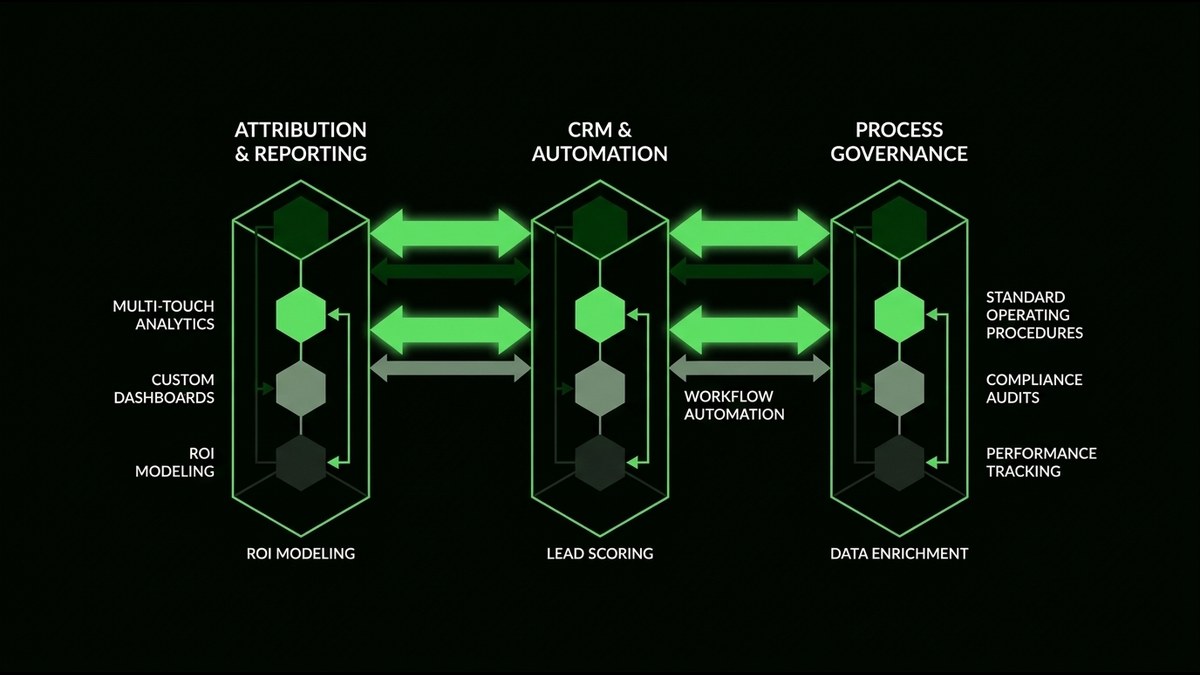
- Attribution and Reporting. Someone owns the logic that links marketing spend to revenue. That means deciding what counts as pipeline, which channels get credit, and whether CAC includes partner referrals. Attribution breaks when no one can answer "how did we generate last quarter's new pipeline?" without five exports. The owner builds unified reporting dashboards the entire revenue team can trust and enforces one data taxonomy across systems.
- CRM and Automation. Someone owns data integrity, lead routing, workflow logic, and the tech stack. CRM governance is not IT work. It defines what a qualified lead is, what moves a deal forward, and which fields reps must fill in first. Reps marking deals closed-won without a deal size, or inbound leads sitting unrouted for 72 hours, are CRM ownership failures. This owner keeps data accurate and enforces deal stage rules so forecasts can be trusted.
- Process Governance. Someone owns stage definitions, handoff SLAs, and the agreements between teams. Governance is where attribution and CRM logic meet reality. It decides what qualifies a lead for outreach, what drops a deal from the forecast, and the escalation path when a commit-stage deal goes ten days without activity. The governance owner doesn't just write the process. They enforce it, measure it, and flag where it breaks under load.
Keep the Ownership Line Clear
Sales ops, for example, owns process integrity, not revenue outcomes. Keep that line clear. Ownership starts with knowing who answers when a capability fails. Name the owner first, then grow the team around them.
Hiring Sequence: Which Role to Fill First (and Why)
Your RevOps hiring sequence should follow the failure mode, not the org chart you want in 18 months. The first hire solves the bottleneck blocking the most revenue right now.
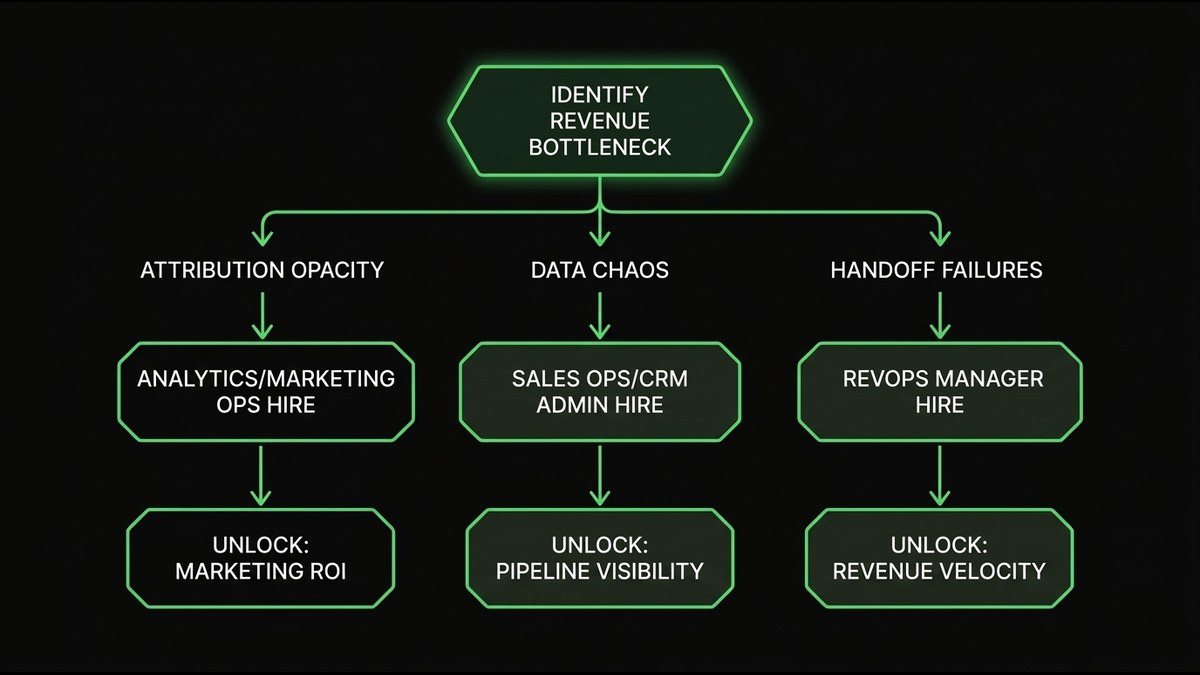
- If attribution is a black hole and the CFO can't model CAC. Hire for attribution and reporting. This person defines pipeline sources, builds the attribution model, and creates reporting leadership trusts. The role is usually an Analytics Manager or Marketing Operations lead. The unlock: executives stop debating which channels work and allocate budget from one source of truth.
- If pipeline leaks because CRM data is chaos. Hire for CRM and automation. This person owns data hygiene, lead routing, and workflow rules. Whether you run Salesforce or HubSpot, the goal is a system your reps believe. The role is usually Sales Operations or a CRM Administrator. The unlock: reps drop their side spreadsheets, and forecasts improve because stage definitions are enforced, not suggested.
- If handoffs are where deals die. Marketing generates leads sales never touches, or sales marks deals "qualified" that don't fit the ICP. Hire for process governance. This person defines stage gates, enforces SLAs, and builds escalation paths. The role is usually a RevOps Manager. The unlock: handoff failures surface in real time, and the revenue motion becomes auditable instead of intuition-based.
Three Quick Tests to Find Your Constraint
If you can't say your true CAC by channel, you have an attribution problem. If sales says the CRM is wrong more often than right, you have a data problem. If leads sit for days or deals stall with no escalation, you have a governance problem.
Solve that constraint, then build the next layer.
Centralized vs. Embedded: How to Structure RevOps Without Creating Silos
Should RevOps report to sales, marketing, or the CEO? That matters less than a better question: what do you centralize, and what do you embed?
Centralize strategy and governance. Attribution models, tech stack choices, process definitions, and reporting standards need one source of truth. If marketing ops and sales ops each define "qualified," you get attribution gaps and double-counted pipeline. Central governance doesn't mean one team does all the work. It means the rules and the system of record are unified. The Head of RevOps sets stage gates, SLA thresholds, and data taxonomy, and every function works inside that design.
Embed execution where the expertise lives. Campaign operations belong with demand gen. Deal desk belongs with sales. Customer health scoring belongs with CS. Embedded roles run inside the central framework. They don't redefine it.
Full decentralization is the anti-pattern. Marketing ops and sales ops become separate fiefdoms. You get measurement gaps, tool sprawl where nothing integrates, and attribution theater where every function claims credit for the same pipeline.
Over-centralization fails too. A central team with no embedded context can't support three motions at once. Requests queue, and teams build workarounds that bypass the system.
The durable model is central architecture, embedded execution, and clear escalation when the two conflict.
When to Split Roles by Motion (Demand, Pipeline, Expand)
At some point, one generalist can't serve three revenue motions without becoming the bottleneck. The trigger isn't headcount or ARR. It is complexity. You split when one motion's demands in volume, tools, or process variance block support for the others.
Before the split, one RevOps generalist owns attribution, CRM governance, and process integrity across all motions. This works while one person can hold the whole system in their head. As a rough guide, that means a small GTM leadership team and a tech stack that fits on one whiteboard.
The trigger looks like this: demand campaigns need daily tuning, and that work stops you from diagnosing why pipeline conversion dropped. Or expansion needs health scoring, but building it delays the sales automation project that blocks forecast accuracy. One motion's needs starve another's.
After the split, each motion gets its own ops owner:
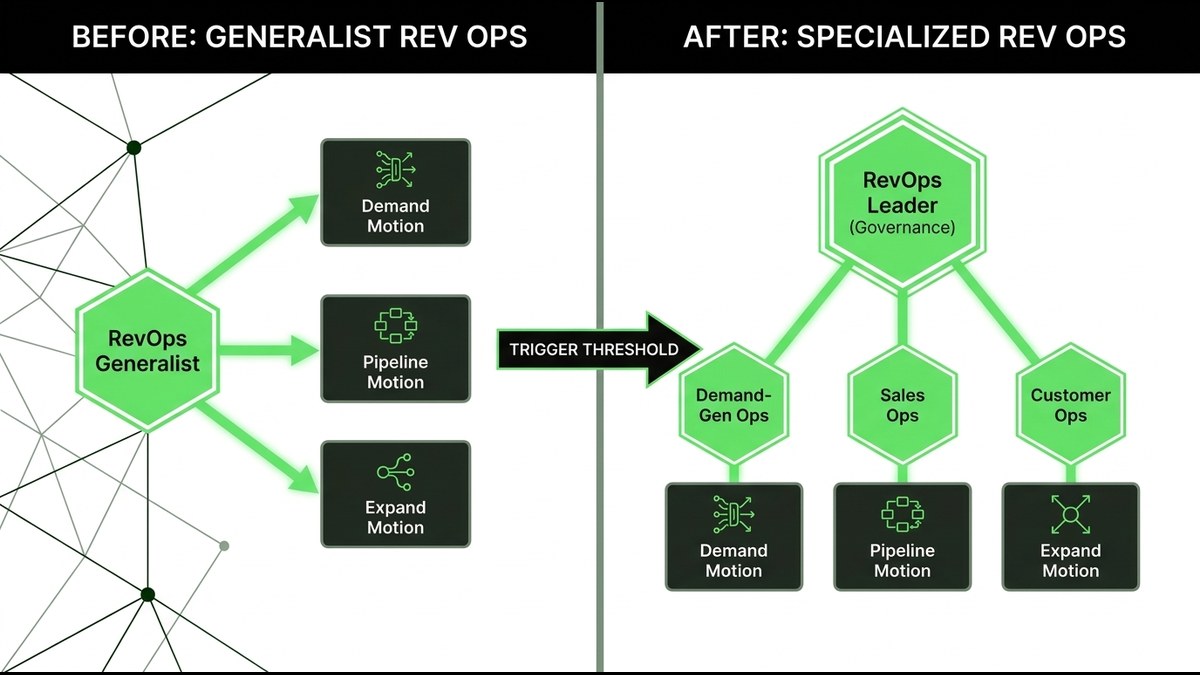
- Demand ops. Owns campaign performance, lead attribution, and the systems linking marketing activity to pipeline.
- Sales ops. Owns CRM hygiene, pipeline reporting, deal-stage governance, and the forecast model.
- Customer ops. Owns retention metrics, expansion scoring, and the workflows that surface churn or upsell signals.
What the Leader Above the Split Owns
A RevOps leader sits above the motion owners. They own the unified attribution model, the tech roadmap, and the SLAs that stop silos from returning.
This mirrors how revenue works. Demand creates pipeline, pipeline becomes bookings, and expansion grows account value. Each motion has end-to-end systems ownership, and handoff accountability is explicit.
Build the Structure That Eliminates the Bottleneck, Not the One That Looks Right on Paper
Revenue operations team structure org design is a revenue decision, not an aesthetic one. The question isn't "what does a best-practice team look like?" It is "which gap blocks the most revenue now, and which ownership boundary fixes it?"
Stop being the person who knows where every number lives. Build a structure where the system is the source of truth, give named roles discrete capabilities, and let failures show up as process gaps, not people problems. Centralize governance. Embed execution. Split by motion when one stream's complexity starves the others.
Ready to map your ownership boundaries and your first hire? Effiqs will review your current structure, find the bottleneck blocking the most revenue, and shape the hiring sequence that removes it.
- ✓ Define ownership boundaries before headcount: one named owner each for attribution and reporting, CRM and automation, and process governance.
- ✓ Hire first for the bottleneck blocking the most revenue, not the org chart you want in 18 months.
- ✓ Centralize strategy and governance, and embed execution where the expertise lives.
- ✓ Split roles by motion (demand, sales, customer ops) when one motion's complexity starves the others.
- ✓ Treat failures as process gaps, not people problems, and let the system be the source of truth.
FAQ
What are the three core capabilities a RevOps team must own?+
A RevOps team must own attribution and reporting, CRM and automation, and process governance. These are capabilities, not job titles, so one person can hold two of them early on and a mature team can split each by revenue motion.
Which RevOps role should I hire first?+
Hire for the bottleneck blocking the most revenue. If you can't state true CAC by channel, hire for attribution and reporting. If reps distrust CRM data, hire for CRM and automation. If leads sit untouched or deals stall without escalation, hire for process governance.
Should RevOps report to sales, marketing, or the CEO?+
Reporting line matters less than deciding what to centralize and what to embed. Centralize attribution models, tech stack choices, process definitions, and reporting standards. Embed execution, such as campaign operations, deal desk, and customer health scoring, within the functions that have the expertise.
When should I split RevOps roles by revenue motion?+
Split when complexity, not headcount or ARR, causes one motion's needs to block support for the others. For example, daily campaign tuning may prevent diagnosing a pipeline conversion drop. At that point, assign separate demand ops, sales ops, and customer ops owners under a RevOps leader.
What is the difference between centralized and embedded RevOps?+
Centralized RevOps unifies the rules and the system of record, including stage gates, SLA thresholds, and data taxonomy. Embedded RevOps places execution roles inside functions like demand gen, sales, and CS, working within the central framework without redefining it.