
Multi-touch attribution models split credit across the touchpoints that precede a B2B opportunity, so you can see which channels assist deals. First-click attribution gives all credit to the first tracked interaction, so it shows what creates awareness. Long, multi-stakeholder sales cycles favor multi-touch, while immature tracking favors first-click until the data is clean.
You already know a default model hides things. The question is which replacement your CRM, your sales cycle and your CRO can support. This piece compares multi-touch and first-click attribution, then gives you decision logic for choosing between them.
Before you pick one, check what your CRM can actually record. A model is only as good as the fields beneath it. Attribution is plumbing first and analysis second.
Multi-Touch vs. First-Click: What Differs?
First-click attribution answers one question: where did this account first meet us? Multi-touch answers a different one: which interactions helped move it toward a deal? Neither is wrong. They measure different things, and mixing them up is how budget fights start.
Think of one opportunity with four recorded touches: a webinar, a partner intro, a pricing-page visit and a sales call. First-click hands the webinar everything. A linear multi-touch model gives each touch an equal share. A time-decay model leans toward the sales call. Same deal, three different stories about what worked.
Baselines matter when you compare. Nielsen's 2019 guide to multi-touch attribution notes that a model with a long history as the default measurement method often serves as the baseline against which marketers compare multi-touch alternatives. Use first-click the same way: as a reference point, not a verdict. The multi-touch attribution B2B teams actually trust is usually a reporting layer on top of clean CRM records, not a replacement for them.
The two models also reach different readers. A CMO wants to know which channels earn budget. A CRO wants to know whether pipeline quality is real. Each needs a view of the model that answers their question, which is why multi-channel attribution should be tied to the decision each person owns. No model is correct. Some are useful.
The difference is also easier to show than to describe. Watching a senior operator diagnose an attribution stack live, then rebuild the funnel logic around it, makes the trade-offs obvious in a way a definition does not.
Here is the matrix we use to frame the choice:
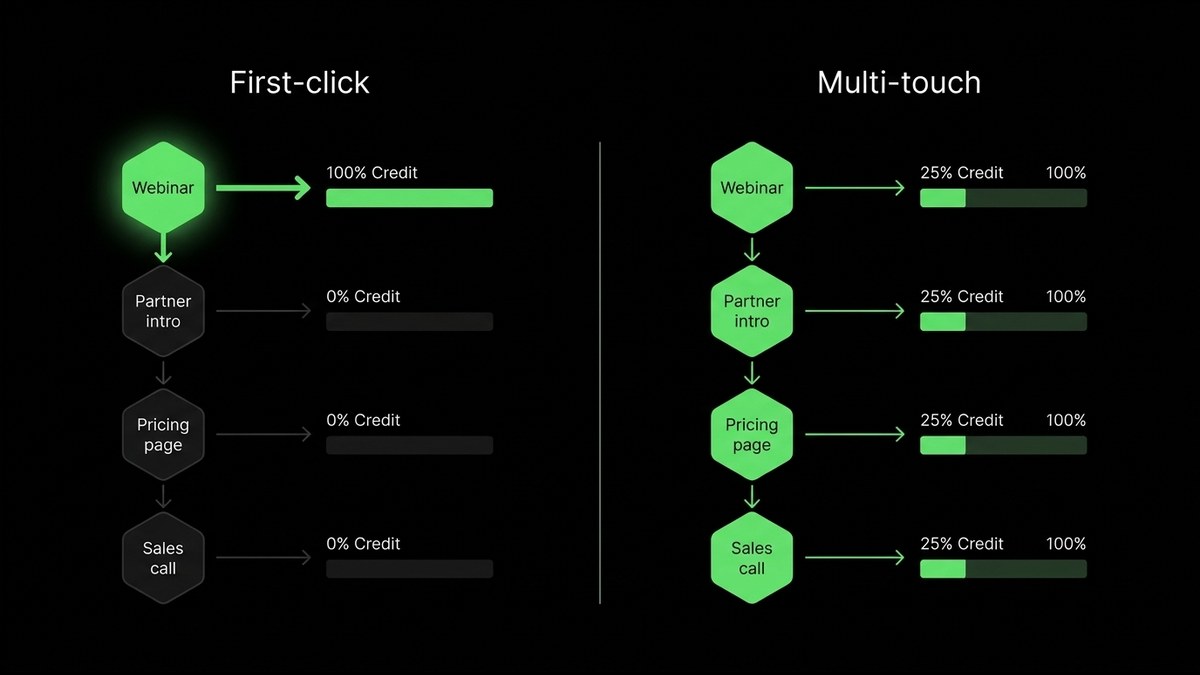
- Credit logic. First-click assigns all credit to the first tracked interaction. Multi-touch spreads credit across several touches by a rule or an algorithm.
- Data required. First-click needs a reliable source field at creation. Multi-touch needs a full touch history tied to accounts and contacts.
- Sales-cycle fit. First-click suits short, simple funnels. Multi-touch suits long cycles with buying committees.
- Reporting effort. First-click is a single field and a simple report. Multi-touch needs reconciliation and regular review.
- Stakeholder trust. First-click is easy to audit but easy to dismiss. Multi-touch is richer but harder to defend if the data is weak.
- Main blind spot. First-click ignores nurture and close activity. Multi-touch can invent precision the data does not support.
Attribution Model Comparison: When Does Multi-Touch Win?
Multi-touch attribution B2B setups beat first-click when the deal is shaped by many people over a long time. A buying committee does not decide after one interaction. A founder reads a post, a technical evaluator attends a session, procurement joins late. First-click sees only the first of those events.
The best attribution model comparison starts with the decision you need to make, not the model's name. Use multi-touch when you must decide between channels that play different roles. Content and events often open doors. Outbound, sales calls and proof assets often close them. First-click rewards the opener and ignores the closer. Last-click does the reverse. Multi-touch is the only one of the three that can show both.
This matters most to the CMO, who is accountable for demand performance and feels it first when a channel underperforms. If paid search looks weak under first-click, the instinct is to cut it. Multi-touch reporting may show that it quietly assists deals other channels opened. Cutting it on single-touch evidence is how teams starve the middle of the funnel.
It also matters to the CRO, who owns pipeline quality and conversion. Revenue leaders care less about who got the lead and more about which sequences of touches produce deals that close. That is an account-level question. If you sell to committees, measure at the account level.
One caution. Multi-touch shows association, not proof. A channel that appears in many winning paths may simply be where good prospects already were. Pair multi-touch with a lift or holdout view when you can, so influence and correlation are not treated as the same thing. That does not need a data science team. A simple holdout on one channel, run for one cycle, tells you more than a more elaborate credit rule.
Multi-touch is worth the lift when three things are true. If one of those is missing, fix it first. That is the point of diagnosis before delivery. Revenue attribution B2B work fails more often from missing ownership than from the wrong formula.
- Deals involve several stakeholders and many interactions.
- Your CRM stores touches against accounts, not just contacts.
- Someone owns the model and reviews it every quarter.
When Does First-Click Still Make Sense?
First-click is simple, hard to game and easy to audit. You can trace any number back to one field on one record. For a team with a short funnel, a young CRM or no agreed source rules, that is a real strength. It tells you what fills the top of the funnel, and it does so in a way finance will accept.
It also forces a useful discipline. To run first-click honestly, every record needs a source at creation. Many teams have never enforced that. If your source field is blank on a large share of records, a multi-touch model built on top will produce confident-looking nonsense. Starting with first-click exposes the gap quickly.
The cost is what it ignores. First-click undervalues nurture and close activity. A prospect may come in through a webinar, spend months in nurture, then convert after a sales conversation. First-click credits the webinar and nothing else. If you use it to cut mid-funnel spend, you will probably cut the activity that turned interest into pipeline. Treat it as one input for sourcing decisions, never the only basis for budget cuts.
Before trusting any single-touch number, check how conversions are counted. If several conversion events fire on one action, that action is counted more than once and the report looks better than reality. This kind of inflation happens in setups that grew over time, with overlapping events added by different people. A single clean definition of conversion beats any model refinement. Any attribution audit should start here before it touches a model.
Use first-click when:
- The sales cycle is short and the buyer is usually one person.
- Source tracking is new and you need a clean baseline.
- You need a defensible sourcing view for a board or finance review.
- Nobody owns attribution yet and you need a starting point.
What Creates Blind Spots in Long Cycles?
Blind spots rarely come from the model. They come from what never reached the model. In long B2B cycles, three gaps appear again and again.
Missing or late source data: Contacts created by hand, forms that drop UTM parameters and imports without a source all leave holes. In diagnostic work, the first step is not choosing a model. It is checking whether the CRM captures first-touch data at all. If it does not, no model will give you the truth.
Unclear ownership rules: The demand-to-sales handoff is where attribution tends to break. Partner-sourced leads are the classic case. If they are not tagged when the record is created, nobody can tell later whether the partner or marketing opened the deal. Good governance, built through sales and marketing alignment, sets a fixed ownership window, bans retroactive changes and avoids shared ownership. Without those rules, credit gets renegotiated after the deal closes, and every report becomes an argument.
Touches nobody records: Dark social, private communities, word of mouth and peer recommendations shape B2B decisions, yet they leave no click trail. Buyers say they heard about you in a group chat and the CRM says direct. Self-reported source fields on forms are one way to capture that influence.
There is a fourth, quieter source of error: double counting. Duplicate or overlapping conversion events firing on one action count that action more than once, which inflates its credit before any model runs. Fix this at the event level, not the model level.
Notice what these problems share. They are system problems, not marketing problems. They sit between marketing, sales ops and the CRM. A team with clear ownership of revenue targets and real pressure to improve attribution will fix them. A team without both will keep switching models and getting the same confusing answer.
That is why we call it an attribution black hole. Pipeline is generated, revenue arrives, and nobody can explain the path between them. Moving to multi-touch reporting does not close the hole. Repairing the capture points does.
Which Model Should a B2B Team Start With?
Start with the model your data can support today, not the one your slides promise. For most teams that means two steps. First, run first-click for sourcing, plus an opportunity-level conversion view. That shows where accounts come from and how they progress. Then add multi-touch once tracking and CRM source fields are clean. Multi-touch comes second, not first. Running it on dirty data creates false confidence, which is worse than no attribution at all.
Use three questions to decide where you sit. First, how long is your sales cycle, and how many people buy? Short cycles with one buyer lean toward first-click. Long cycles with committees lean toward multi-touch.
Second, how mature are your tools and fields? If source data is incomplete, begin with first-click. If touches are logged against accounts and reviewed, move to multi-touch.
Third, who must trust the output? If finance and sales are skeptical, begin with the model they can audit. Move to richer models once trust exists.
The CRO is the person who most often pushes for this work. They own pipeline quality and tend to have strong interest in RevOps and attribution. They will also ask the hardest questions about your numbers. Build for that audience. If your answer is that the model says so, you will lose the room. If your answer is here is the field, here is the rule, here is the reconciliation, you will keep it.
Treat attribution as a RevOps system rather than a marketing dashboard. The model has to fit your CRM configuration, your sales process and your reporting cadence. A W-shaped model your CRM cannot support is wasted effort. Diagnose the system first, then choose the model.
A practical sequence looks like this:
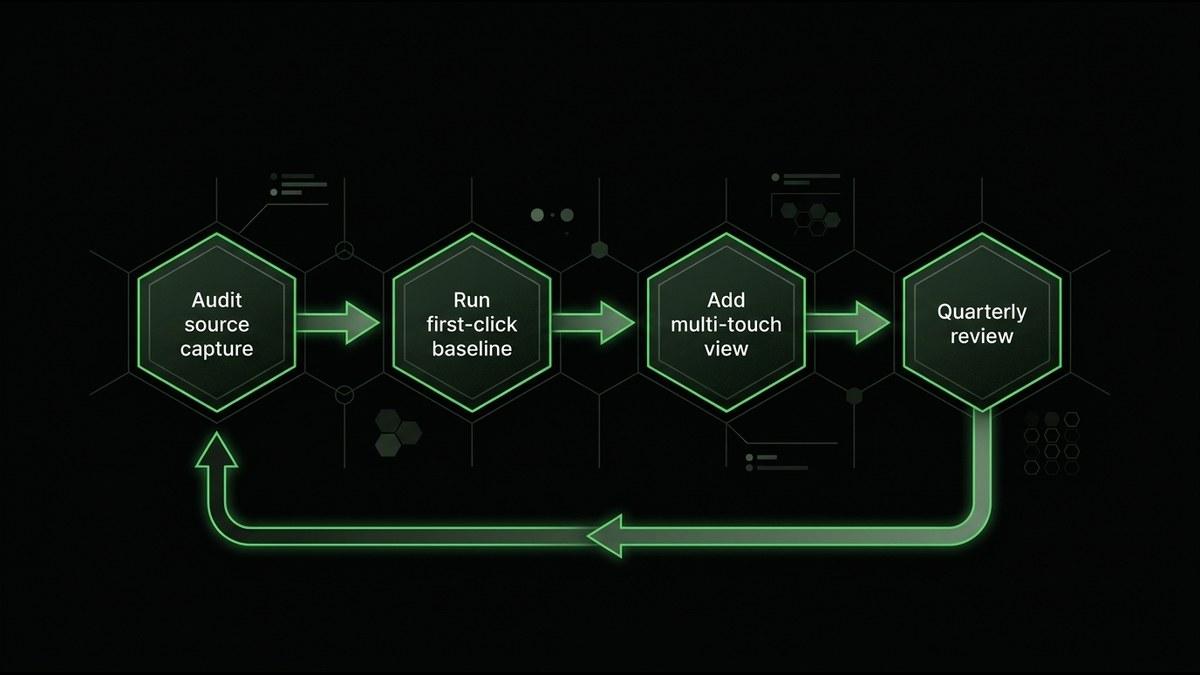
- Audit source capture and conversion events.
- Run first-click and compare it against opportunity outcomes.
- Add one multi-touch model, such as linear, as a second view.
- Review both each quarter and adjust the rules.
A Marketing Attribution Framework You Can Trust
A marketing attribution framework earns trust through checks, not through sophistication. The people reading your report, whether founder, CMO, CRO or RevOps lead, will each test it differently. Give them tests they can run themselves.
Reconcile the totals: Total credit assigned across channels should match pipeline and closed-won revenue in your marketing reporting. If your channel view adds up to more than finance reports, something is double counted. If it adds up to less, records are missing a source. Either result is a diagnosis, not a failure.
Compare two models: Good decisions should hold across two different models. If a channel looks strong under both first-click and a multi-touch view, act on it. If it looks strong under one and weak under the other, you have found a question to investigate, not a budget decision.
Check the inputs: Confirm that source fields are populated at creation, that conversion events are defined once, and that partner and offline touches follow written tagging rules. Also watch for the traps that make a marketing ROI report look better than it is.
Name the owner: Someone must be accountable for the model, the rules and the review. Attribution is an owned system, not a one-off setup task. Teams with a defined sales motion, a marketing function (internal or fractional) and clear ownership of revenue targets tend to keep attribution healthy. Teams without that ownership tend to drift back to defaults.
Set a review rhythm: Review attribution every quarter. Look at outliers first, because small samples make any model unreliable. Do not scale spend on a result you have not tested.
These checks also settle the objection we hear most: that multi-touch attribution is too expensive and complicated. It is not, if you stage it. The reconciliation and the two-model comparison cost little. They simply require discipline, and discipline is the real differentiator in revenue attribution B2B work.
Pipeline source tracking: what data comes first?
Before any model works, you need records that tell the same story about every deal. The foundation is operational, not analytical. Your CRM has to know where each opportunity came from, who was involved and when each stage changed.
We build this as a RevOps architecture in HubSpot that visualizes the complete customer lifecycle, from prospecting to post-sale. The goal is clear tracking of where each customer originated and what happened next. We treat it as architecture, not as a tool choice, and I regularly combine SEO, paid media, CRM, analytics and automation into one integrated operating model instead of treating them as separate projects.
Start with CRM-connected conversion tracking with QA, which stops duplicate or phantom events from inflating your counts. The return path is where most B2B paid programs leak: sending offline conversions back to your ad platforms lets the platform learn from deals, not clicks. For GA4, map events to your funnel on purpose so the web layer stays consistent with the CRM layer, and remember GA4's limits: don't expect position-based reporting from it.
The CRO owns pipeline quality and conversion, so the CRO should sign off on stage definitions. Once the data is live, review it by channel on a cadence: outbound, partnerships, events and podcasts, marketplaces. Look at pipeline created, SQL quality and conversion rates, plus time spent versus leverage. If quality drops, adjust.
- First-touch persistence. Store the original source on the contact record and never overwrite it.
- UTM governance. One naming convention, one owner. Inconsistent tags splinter one channel into six.
- Contact-to-opportunity roles. Attach every buying-committee member to the deal, with a role.
- Lifecycle timestamps. Stamp each stage change. W-shaped models depend on them.
- Offline conversion return. Send closed-won and qualified outcomes back to your ad platforms, so paid media optimizes to pipeline instead of form fills.
- Server-side events. Collect key events on your server so ad blockers and browser limits don't erase them.
How do you validate attribution before moving budget?
Treat attribution as a directional signal. Compare at least two model views plus self-reported "how did you hear about us" data. For large budget shifts, run a holdout or geo test. Move budget only when the views agree directionally or a test confirms it.
Remember that attribution shows association, not causation. A model tells you which touches sit near revenue. Only a test tells you what happens if you remove one. Check platform thresholds before relying on automated models, since data-driven options often carry conversion-volume requirements. Read your platform's current documentation for the exact numbers.
After 15 years in B2B marketing and more than 250 companies, I've seen the same pattern. Teams burned by an over-promising vendor often never asked the dashboard to disagree with anything. A validation step protects you, and any vendor or model worth using should survive it.
Keep a log of what you tested and what happened. Platform tweaks, paid media experiments and their results become your own evidence over time.
- 1. Compare views. Pull the W-shaped view, a first-touch view and last touch for the same period. Note where channels rise or fall between them.
- 2. Add self-reported data. Ask buyers how they heard about you, in a form field, on calls, or both. Software sees clicks. Buyers remember conversations. The gap between them is information.
- 3. Test the big moves. A holdout test pauses a channel for a random slice of your audience and compares results with the rest. A geo test does the same by region. Both separate cause from coincidence.
- 4. Apply a decision rule. If the views agree on direction, move a measured share of budget. If they conflict and the move is large, test first. If they conflict and the move is small, wait a cycle.
What Should You Do Next?
Run the three questions on your own stack this week: cycle length, data maturity and audience trust. Then reconcile last quarter's credit totals against closed-won revenue. If they do not match, start there, before you touch the model. If you want a second pair of eyes on the diagnosis, Effiqs will walk through it with you.
- ✓ First-click tells you where accounts begin, multi-touch tells you what helped, and you should not ask either to do the other's job.
- ✓ Multi-touch wins when many people and many interactions shape the deal, and only when the data and the owner are in place.
- ✓ Most blind spots are data and governance failures, so repair capture, ownership and event definitions before you debate models.
- ✓ Begin with first-click and clean data, add multi-touch when fields and ownership are ready, and let the system decide the model.
- ✓ Trust comes from reconciling totals, comparing a second model, checking inputs, naming an owner and reviewing quarterly.
FAQ
What is the difference between multi-touch and first-click attribution?+
First-click attribution gives all credit to the first tracked interaction, so it shows where accounts begin. Multi-touch attribution splits credit across several touches by a rule or algorithm, so it shows which interactions helped move an account toward a deal. They answer different questions and should not be used interchangeably.
When does multi-touch attribution work better for B2B?+
Multi-touch works better when deals involve several stakeholders and many interactions over a long cycle, when your CRM stores touches against accounts rather than just contacts, and when someone owns the model and reviews it every quarter. If any of those is missing, fix it before adopting multi-touch.
When does first-click attribution still make sense?+
First-click makes sense when the sales cycle is short and the buyer is usually one person, when source tracking is new and you need a clean baseline, when you need a defensible sourcing view for finance or a board, or when nobody owns attribution yet. It should not be the only basis for cutting mid-funnel spend.
Why do B2B attribution models have blind spots?+
Blind spots usually come from data that never reached the model, not from the model itself. Common causes are missing or late source data, unclear ownership rules at the handoff between marketing and sales, touches nobody records such as dark social and word of mouth, and double-counted conversion events.
Which attribution model should a B2B team start with?+
Start with the model your data can support today. For most teams that is first-click for sourcing plus an opportunity-level conversion view. Add one multi-touch model, such as linear, once tracking and CRM source fields are clean, then review both each quarter.
How can I check whether my attribution reporting is trustworthy?+
Reconcile total credit across channels against pipeline and closed-won revenue, compare results across two different models, confirm that source fields and conversion events are defined once, name an owner for the model, and review it every quarter. A channel that looks strong under both models is safer to act on than one that looks strong under only one.
How do you validate attribution before moving budget?+
Compare at least two model views plus self-reported "how did you hear about us" data. For large budget shifts, run a holdout or geo test. Move budget only when the views agree directionally or a test confirms the move.
Sources
- [1]A model with a long history as the default measurement method often serves as the baseline against which marketers compare multi-touch alternatives.. Nielsen, Methods & Models: A Guide to Multi-Touch Attribution, 2019.