
A CRM data quality audit tests whether the records behind your sales forecast are complete, consistent, current and unique. Stage, close date, amount and source fields feed every roll-up, so when they are blank, stale or duplicated, the forecast reflects data habits rather than buyer intent. Fixing the rules that let bad data in, not just the records, is what improves forecast accuracy.
Here is the scene. The forecast moved overnight and nobody can say why. The weekly pipeline review becomes a reconciliation exercise: whose data is right, which deals are real, which stage is honest. The leadership call goes on arguing about numbers instead of deciding what to do with them. If that sounds familiar, you will probably recognise a few of the seven signals that a revenue engine is leaking.
I come to this from the paid media side. I have spent four years in digital marketing across PPC, tracking and reporting insights, and the first question I ask of any campaign report is whether the tracking underneath can be trusted. A pipeline forecast deserves the same question.
This guide argues one point. Forecast variance is a data design problem. It is not a rep attitude problem. Below you get the definition of the audit, seven structural failures, a method to run it and a way to make the fix last. We treat CRM data quality audit and forecast accuracy as one topic, not two.
What is a CRM data quality audit, and how does it improve forecast accuracy?
A CRM data quality audit checks the fields your forecast reads: stage, close date, amount, owner and source. It scores each one for completeness, consistency, freshness and uniqueness. Fixing the gaps removes noise from the forecast, so variance reflects real buyer behavior.
The order matters. Most data cleanups start with the database and work outward. A forecast-first audit starts with the number your CEO or board sees, then works backward to the fields that produce it. That keeps the work tied to a decision, not to tidiness for its own sake.
Each quality dimension has a forecast consequence. This is CRM data quality audit and forecast accuracy in practice: you cannot improve the second without testing the first.
A one-off cleanup is not an audit. Cleanup fixes records. An audit finds why the records were wrong and changes the rule that allowed it. It also explains why healthy-looking coverage can mislead you. Pipeline coverage is not the same as pipeline health, and a big pipeline built on vague stages is vanity pipeline: volume without true buying intent. It is the forecasting twin of the vanity metric.
My view is simple. Paid media strategy must focus on tracking, reporting insights and true buying intent rather than vanity metrics. The CRM is where that discipline either holds or breaks, because it is the last place a number is read before it reaches the board.
- Accuracy. A wrong amount or stage puts false value into the roll-up.
- Completeness. A missing close date or owner means the deal cannot be placed or chased.
- Consistency. The same stage meaning different things breaks conversion math.
- Timeliness. A stale record describes a deal that no longer exists.
- Uniqueness. A duplicate counts one buyer twice.
Why are your pipeline forecasts wrong? Seven CRM data failures
Forecasts miss when the CRM lets unreliable data into the roll-up. Seven CRM data failures cause most of it. Each one is a design flaw, not a rep flaw. When a number looks wrong, I look for the missing structure first (entry rules, stage criteria, ownership) and rep effort last.
Fixing records one by one rarely helps. The aim is a data hygiene pipeline: a flow where bad data is stopped at entry instead of found at the review. Each failure below follows the same pattern: what breaks, how it distorts the forecast, and the structural fix.
- 1. Stage definitions that mean different things to different reps. What breaks: one rep moves a deal to "Proposal" after a first call, another waits for a signed scope, stages get skipped, and nothing defines exit criteria. Forecast distortion: stage-based conversion rates blend two meanings into one number, and late-stage pipeline looks bigger than it is. Structural fix: write exit criteria for every stage in buyer terms, and block stage changes that skip them.
- 2. Close dates nobody maintains. What breaks: the close date is set once, at creation, and never touched again. Forecast distortion: a close date is a forecast input, so a stale one is a false signal that pushes deals into a month where nothing is happening. Structural fix: deals without a defined close window do not belong in the forecast. Flag any date that has passed or has not moved with the deal.
- 3. Duplicate contacts, companies and deals. What breaks: the same buyer exists two or three times, created by forms, imports and manual entry. Forecast distortion: one opportunity is counted twice, and rep time is wasted chasing a record someone else already owns. Structural fix: match on company domain and deal key at creation, and merge on a schedule you can see.
- 4. Required fields that are not actually required. What breaks: the field is called "required" in the playbook but optional in the tool, so reps move a deal forward with amount, owner or next step left blank. Forecast distortion: the roll-up treats a blank amount as zero or guesses, and partial records produce partial forecasts. Structural fix: enforce required properties at stage change inside the CRM, so the system refuses the move. A rule written in a playbook is a hope. A rule written in the tool is a standard.
- 5. Inconsistent values across teams and tools. What breaks: free-text fields, mismatched picklists and regional variants, so "UK", "United Kingdom" and "U.K." sit side by side. Forecast distortion: roll-ups by region, segment or product split into fragments, and totals disagree between teams. Structural fix: replace free text with controlled picklists, and standardize values once, at the source system.
- 6. Zombie deals with no aging rule. What breaks: deals that stalled months ago stay open because closing them feels like admitting a loss. Forecast distortion: pipeline inflates and coverage looks comfortable, but that inflation is a risk signal, not a comfort. Structural fix: track stage aging as a metric, set an aging rule per stage, then force a decision when a deal breaches it: advance, re-qualify or close.
- 7. Pipeline you cannot trace to a source. What breaks: opportunities with no verified origin and no buying intent signal, and offline conversions, such as a deal closed after a call, never sync back to the system that created the lead. Forecast distortion: you cannot tell which pipeline is real, channel decisions rest on guesses, and vanity pipeline passes for demand. Structural fix: require a source on every opportunity and close the loop on offline conversions. This is the failure I see most clearly from the paid media side, because campaign tracking foundations are exactly what make a source trustworthy. Start by mapping the data flows between your revenue tools.
How do you run a CRM data quality audit?
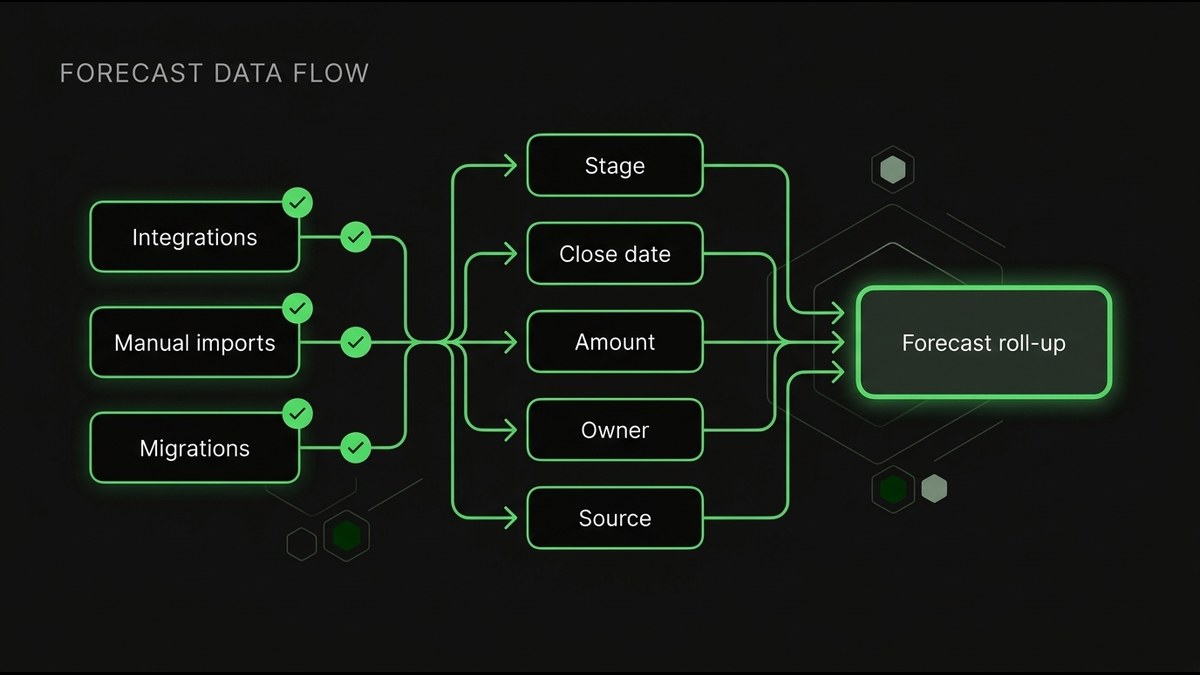
Start with the forecast, not the database. List the fields it reads. Score each for fill rate, freshness and duplication. Trace every failure to where the bad record entered, then assign an owner and a threshold. Audit the entry point, not just the symptom.
In practice, a CRM data quality audit and forecast accuracy review runs in six steps, listed below.
The scorecard stays simple, with three views. Correctness covers field completeness and duplicate rate, and tells you whether each record is usable. Cross-system consistency covers field standardization and sync errors between the CRM and marketing tools, and tells you whether your systems agree. Actionability covers fill rate on forecast-critical fields and source coverage, and tells you whether a leader can act on the roll-up.
Close with a single data-health view per owner, with a baseline and a trend. A one-time grade tells you little. A trend tells you whether the rules are working.
Reporting insights should simplify complex data into practical, visual takeaways. That is the principle behind the scorecard. Put it on one screen where the weekly review can read it. Dashboards that unify marketing and pipeline data make the health of each field visible without a manual pull. A leader who can read the page in a minute will use it. A leader who needs an analyst to translate it will not.
If you also want a wider check on the tools that feed those fields, a step-by-step revenue stack audit is a useful companion.
- Name the forecast. Pick the number leadership reviews each week.
- List the critical fields. Stage, close date, amount, owner, source and next step.
- Score each field. Check fill rate, freshness and duplication, using a sample of open deals.
- Trace to the entry point. Bad records usually arrive through integrations, manual imports and migrations, even where validation exists. Fixing the record without fixing the door means the error comes back.
- Assign an owner and a threshold. A field with no owner has no standard.
- Re-run on a schedule. Compare against your baseline, not against perfection.
Who owns CRM governance, and how do you stop errors coming back?
Sales Ops owns process integrity, and the VP Sales owns the outcome. CRM governance means rules enforced inside the CRM: required fields at stage change, validation at entry, and automated checks for aging and duplicates. Periodic cleanup lets errors return. Continuous monitoring catches them early.
This answers the usual objection: "This is a Sales Ops cleanup task. We cleaned the CRM before and it drifted back." It drifted because nothing enforced the rules. That makes it a governance problem, and governance sits with leadership. The VP Sales cannot delegate the forecast outcome, even when the process belongs to someone else.
Cleanup is periodic and reactive. Monitoring is proactive and automated. A team that only cleans will find the same errors again after each cycle. A team that monitors sees them as they appear. CRM data quality audit and forecast accuracy gains only last when the rules behind them are enforced in the tool. If your team runs HubSpot, required fields, validation rules and alerts can be built into the portal itself.
Three habits make governance hold. If you want a second pair of eyes on the setup, a data and measurement review covers how the metrics are defined, who owns each one and where the checks run.
- Validate at entry. Reject or flag a record that breaks a rule when it is created, not three weeks later. The rules sit in the system, not in someone's memory.
- Automate the checks. Aging, duplicates and missing fields should raise alerts without anyone running a report.
- Review weekly. Track operating metrics such as CRM completeness rate and stage aging in the same weekly review as pipeline. Forecast reliability improves when data health is a standing agenda item, not an annual project.
What should you do first?
Pick the forecast number your leadership team trusts least. If you are unsure what that number should be, a pipeline and revenue goal calculator gives you a target to test it against. List the fields behind it. Score them, trace the worst failure to its entry point and put one enforced rule in front of it. Then repeat. A CRM data quality audit and forecast accuracy check does not need a big project. It needs one number and one honest question.
The goal of a CRM data quality audit and forecast accuracy program is not a clean CRM for its own sake. It is a weekly review that decides instead of reconciles, a forecast variance you can explain, and a pipeline you can trace to real buying intent.
If the weekly pipeline review is still a reconciliation exercise, start with a conversation with effiqs.
- ✓ Start the audit with the fields the forecast reads, before you touch anything else.
- ✓ Every one of the seven failures is a missing rule, so every one has a rule-shaped fix.
- ✓ An audit that ends at the record fixes today's forecast, while one that ends at the entry point fixes next quarter's.
- ✓ Assign each rule an owner, enforce it in the tool, and review it every week.
- ✓ Begin with the one forecast number you trust least and put one enforced rule in front of its worst failure.
FAQ
What does a CRM data quality audit do for forecast accuracy?+
It tests whether the records behind your forecast are complete, consistent, current and unique. Stage, close date, amount and source fields feed every roll-up. When they are blank, stale or duplicated, the forecast reflects data habits, not buyer intent.
Why are my pipeline forecasts wrong?+
Forecasts miss when the CRM lets unreliable data into the roll-up. Seven structural failures cause most of it: inconsistent stage definitions, unmaintained close dates, duplicates, required fields that are not enforced, inconsistent values, zombie deals with no aging rule, and pipeline with no traceable source. Each is a design flaw, not a rep effort problem.
How do you run a CRM data quality audit?+
Start with the forecast number leadership reviews, list the fields it reads, and score each for fill rate, freshness and duplication using a sample of open deals. Trace failures to the entry point where bad records arrived, assign an owner and threshold to each field, and re-run the audit on a schedule against your baseline.
Who owns CRM governance?+
Sales Ops owns process integrity, and the VP Sales owns the forecast outcome. Governance means rules enforced inside the CRM, such as required fields at stage change, validation at entry, and automated checks for aging and duplicates. The VP Sales cannot delegate the outcome, even when the process belongs to someone else.
Why does CRM data drift back after a cleanup?+
Cleanup fixes records but not the rules that let bad data in, so the same errors return after each cycle. Continuous monitoring and rules enforced in the tool catch errors as they appear, which is why governance holds where periodic cleanup does not.