
Sales marketing handoff automation replaces manual lead transfers with rules that run on their own. When a lead hits an agreed MQL-to-SQL threshold, the CRM routes it to the right rep, creates a task, and starts an SLA clock. Marketing stops forwarding spreadsheets, and sales stops guessing which leads deserve a call.
Most teams do not have a tooling problem. They have a trust problem, which is why we treat sales and marketing alignment as a definition exercise before a tooling one. Marketing generates MQLs, sales ignores them, and nobody can prove who is right, because lead quality and handoff definitions were never agreed. In our work with clients, the handoff breaks at the definition, not the tool.
The common objection is that sales marketing handoff automation will just move bad leads faster. That is correct. So we start with the contract, then wire it in.
What is sales marketing handoff automation?
It is the set of rules in your CRM that moves a lead from marketing to sales without a person forwarding it. Criteria, routing, task creation, alerts and follow-up timers all fire on their own. Humans stay in the loop for judgment, not transport. It is the working end of alignment, where an agreement between two teams becomes something the system enforces.
Manual handoffs leak in predictable places:
- Spreadsheets exported on a schedule, already stale on arrival
- Slack pings that nobody owns or logs
- Status changes made by one team and unseen by the other
- Follow-up that happens, but never gets recorded
Why speed and policy matter more than the workflow
Speed is the first cost. Harvard Business Review's 2011 study of online sales leads found that firms contacting a lead within an hour were nearly seven times as likely to qualify it as firms that waited longer.
"Isn't this just a workflow?" No. A workflow is a tool. A handoff is a policy, and the workflow enforces it. Workflow efficiency is an outcome of clear policy, not a feature you switch on. We design strategy, infrastructure and demand as one engine for this reason: the policy and the automation have to be built together. The symptom we see most often sounds like this: your pipeline exists, your attribution doesn't.
Takeaway: automation is the enforcement layer, and the policy it enforces is the real work.
What makes a handoff complete
A lead is ready to move when four conditions hold:
A transfer without these exit conditions is not a handoff. It is a hope.
- The agreed criteria are met
- The CRM record is clean and complete
- The problem is documented in plain words
- The next step is named
Why sales must be able to say no
A good handoff also lets sales decline a lead fast. A lead with no explicit growth pain, such as unclear attribution or unpredictable pipeline, should be disqualified early with a reason code. That keeps the queue honest.
Takeaway: the MQL-to-SQL line is a written agreement with exit conditions and a fast way to decline.
What should you fix before automating a handoff?
Fix the definitions: ICP fit, MQL and SQL thresholds, lead ownership, and what "complete" means on a CRM record. Sales marketing handoff automation enforces whatever rules you give it. If the rules are vague, you scale the confusion.
Strategic clarity comes before execution. Use this short checklist:
- ICP definition. Who qualifies, in writing.
- MQL and SQL thresholds. Fit and engagement signals, agreed by both teams.
- Ownership rules. One owner at each stage, because shared ownership means no ownership.
- Required CRM fields. What must be filled before a record can move.
- Rejection reasons. A fixed list, so feedback can be counted.
Turn the definitions into scores and stages
Once these definitions exist, a scoring model can encode them. Lead scoring built around your ICP turns the written criteria into numbers a workflow can act on. If you work in marketing ops, treat this as systems validation: check the definitions before you build.
Lifecycle stages need the same care. They are only as useful as the definitions behind them, and stage changes can only be tracked once you decide what each one means.
This also repairs the trust gap. Marketing earns credibility through attribution and data quality that sales cannot dispute. Give sales no reason to ignore your leads, and they will stop re-qualifying them.
Takeaway: definitions, ownership and clean data come first, because automation only repeats them at speed.
How do you set up lead routing automation?
Route on fit and intent signals, not on form submissions alone. Assign by territory, segment or account owner, create a task with an SLA, and escalate automatically if no one acts. Add a recycle path so rejected leads return to nurture with a reason code.
Lead routing automation runs in this order:
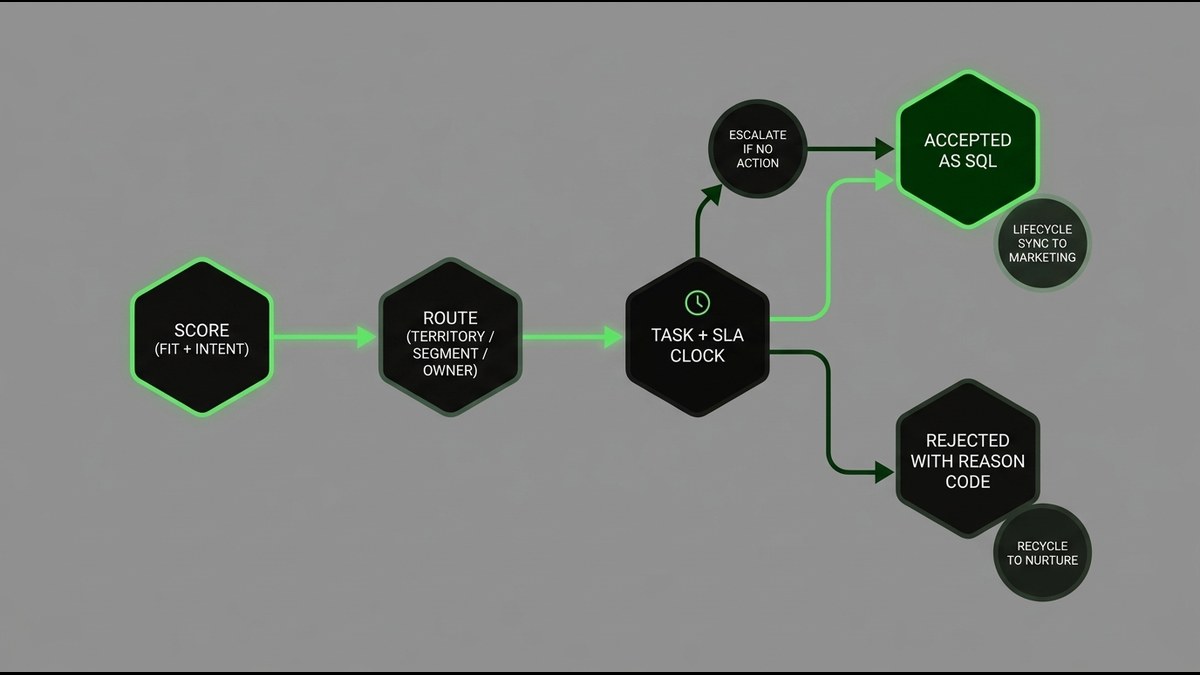
- 1. Score. Combine fit and engagement so a single form fill does not trigger a call.
- 2. Route. Apply territory, segment or account-owner rules, with one owner per lead.
- 3. Create the task. Attach an SLA clock that both teams can see.
- 4. Escalate. Reassign or alert a manager when the clock runs out.
- 5. Recycle. Return rejected leads to nurture with a coded reason.
- 6. Sync. Push lifecycle stage changes back to marketing.
Keep every channel on one routing path
Scoring is where most teams stall. Build fit and engagement models that match your ICP. The same logic works in any CRM.
Common advice says to audit the process, pick a CRM, then automate in small steps. That is sound, but it skips the two items that matter most: written criteria and exit conditions. We build the CRM architecture, automation and tracking inside the tools that run revenue. We do not hand over a blueprint and walk away.
Keep every channel on one path. Paid, outbound, referral and inbound should all feed the same routing logic. Parallel motions create parallel arguments about lead quality.
Sales marketing handoff automation also protects selling time. Salesforce's State of Sales research keeps showing that selling is a minority of a rep's week, so every manual transfer costs time that should go to buyers.
Takeaway: route on signals, attach a visible clock, and give every rejected lead somewhere to go.
How do you know sales marketing handoff automation works?
Track speed to first touch, MQL-to-SQL acceptance rate, rejection reasons, and SQL-to-pipeline conversion by source. If acceptance rises and rejection reasons shrink, the handoff contract is working. If volume rises and acceptance falls, tighten the criteria.
- Speed to first touch. Time from routing to the first logged sales activity. It shows whether the SLA is real.
- Acceptance rate. The share of MQLs that sales accepts as SQLs. It shows whether criteria match reality.
- Rejection reasons. Coded and counted. It shows what marketing should change.
- SQL-to-pipeline conversion by source. It shows which channels earn budget.
- Attribution coverage. The share of pipeline with a traceable source. It is the proof layer sales cannot dispute.
Review weekly and benchmark against yourself
Review these metrics on a weekly cadence and let them govern channel and offer decisions. We run our own sales motion this way, and our B2B marketing automation work is built around the same loop.
Benchmark against your own trend line first. Annual industry surveys give useful context, but your own acceptance and conversion history is the better yardstick.
Takeaway: a handoff you do not measure weekly will drift back to manual.
Define, automate, measure
Define the handoff as a written contract with criteria, exit conditions and an SLA. Automate it so the CRM enforces that contract. Measure acceptance, rejection reasons and conversion every week, and tighten the rules when the numbers slip.
We scope this kind of work as a fixed-price system, so the handoff has a defined owner and a defined end state. If your MQLs keep stalling between teams, we can map the handoff and wire it into your CRM.
- ✓ Automation is the enforcement layer, and the policy it enforces is the real work.
- ✓ The MQL-to-SQL line is a written agreement with exit conditions and a fast way to decline.
- ✓ Definitions, ownership and clean data come first, because automation only repeats them at speed.
- ✓ Route on signals, attach a visible SLA clock, and give every rejected lead somewhere to go.
- ✓ A handoff you do not measure weekly will drift back to manual.
FAQ
What is sales marketing handoff automation?+
It is the set of CRM rules that moves a lead from marketing to sales without a person forwarding it. Criteria, routing, task creation, alerts and follow-up timers all fire automatically, so humans handle judgment rather than transport.
What should you fix before automating a handoff?+
Fix the definitions first: ICP fit, MQL and SQL thresholds, lead ownership, required CRM fields and a fixed list of rejection reasons. Automation enforces whatever rules you give it, so vague rules just scale the confusion.
How do you set up lead routing automation?+
Score leads on fit and engagement, route by territory, segment or account owner with one owner per lead, create a task with a visible SLA clock, escalate when the clock runs out, recycle rejected leads to nurture with a reason code, and sync lifecycle stage changes back to marketing.
How do you know a handoff automation is working?+
Track speed to first touch, MQL-to-SQL acceptance rate, rejection reasons, SQL-to-pipeline conversion by source, and attribution coverage. If acceptance rises and rejection reasons shrink, the contract is working. If volume rises while acceptance falls, tighten the criteria.
Sources
- [1]Firms contacting a lead within an hour were nearly seven times as likely to qualify it as firms that waited longer. Harvard Business Review, The Short Life of Online Sales Leads, 2011.
- [2]Selling is a minority of a rep's week. Salesforce, State of Sales.
- [3]Multi-stakeholder buying groups shape what marketing and sales need to deliver. Gartner, Gartner marketing research.