
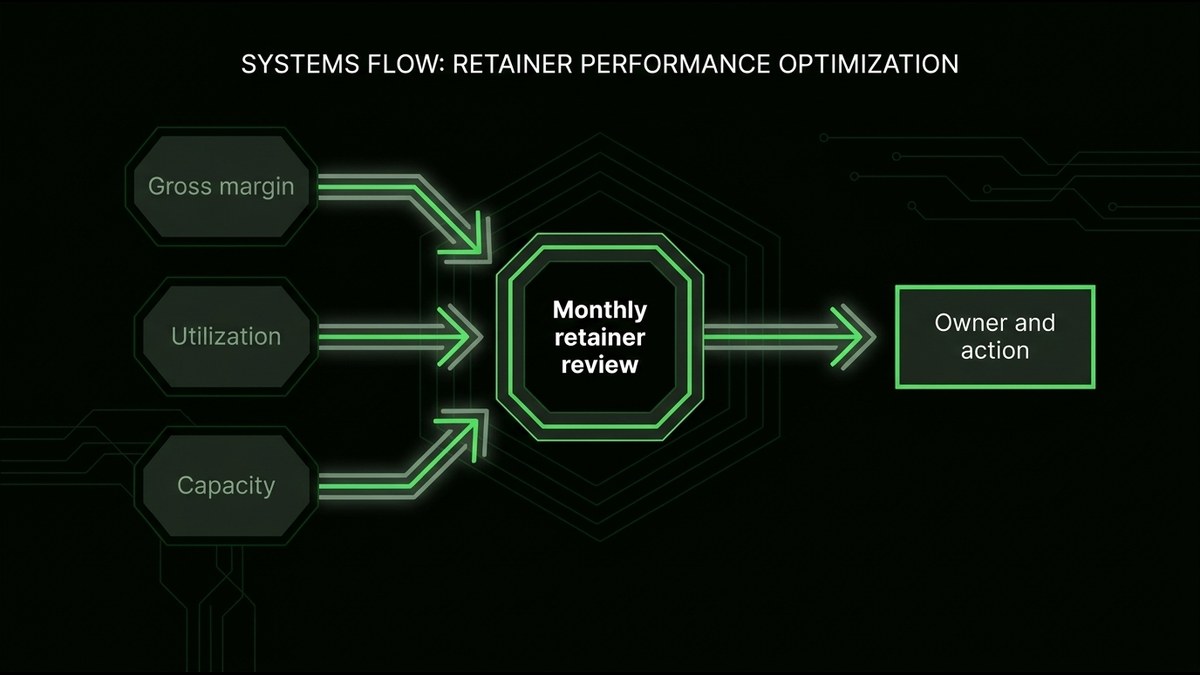
Retainer profitability comes down to three metrics read together: gross margin (revenue minus delivery cost, tracked monthly), utilization (the share of team time that goes to scoped work), and capacity (how much committed work your team can carry before margin slips). Track all three per retainer, not only in aggregate, and give each one an owner and a defined response.
Revenue per retainer is easy to see. Profit per retainer is not. On growth operations retainers, billed revenue holds steady while delivery cost climbs. Scope expands one small request at a time, and the team gets stretched. The problem shows up at quarter-end, when it is already late.
Here is the stance behind this piece: margin is a design outcome of defined scope. You do not recover it by working more hours. If the number is wrong, the retainer was built wrong, and the fix is structural.
Most guides on this topic measure the client's campaign results. This one measures your side of the contract: what the retainer costs to deliver and whether you can keep delivering it. It is for engagement managers who run strategy, content, design and RevOps services under one fee, and who need retainer profitability metrics they can act on this month.
Which retainer profitability metrics matter?
Three metrics matter most: gross margin per retainer, utilization against scoped work, and committed capacity versus available capacity. Revenue alone hides cost, so a retainer can look healthy on the invoice while losing money in delivery. Read the three together each month, per retainer, and give each one an owner and an action.
Each metric needs one definition, one owner, and one response when it misses. Without that, a review turns into commentary. With it, the review changes something: a scope, a staffing plan, a price. Run margin as a monthly decision meeting, not a status update.
The same rule works on the revenue side, where one definition, one owner and one decision for each executive metric keeps reporting honest.
Judge a retainer on trajectory, not on one good month. A healthy retainer is stable and improving. Its performance is visible and attributable. The client leans less on a spread of fragmented vendors. One strong month proves little. Three months of falling margin proves a lot.
Retainer economics: how to calculate gross margin
Gross margin is monthly retainer revenue minus the direct cost of delivering it (people, contractors, tools), divided by revenue. Load the cost with real time and real rates. Then track it monthly per retainer so a slow slide shows up early.
Margin is the metric most teams skip, because it feels too fuzzy to measure. Here is a short worksheet you can copy for each retainer:
The fuzziness has a cause. One retainer bundles strategy, execution, content, design, and systems ownership, so cost sits across all five. The fix is to log cost by role against the retainer, not by project. Margin then becomes measurable, not a feeling.
Set a margin floor before you sign. Do not wait for the first review to decide what "too low" means. Defined deliverables and a fixed fee, with no open-ended scope, are what make that floor defensible. When scope is open, margin is a hope. When scope is defined, margin is a design outcome. Run your own numbers through a build vs retainer calculator before you commit to a fee.
To test the floor, compare delivery options with a cost comparison of a hire, a retainer and a client-owned build. It shows where each model strains margin. Then connect the floor to your price. Fixed-fee pricing logic for capacity-based work keeps cost and fee in the same conversation.
- Revenue. The fixed monthly fee for the retainer.
- Direct labor. Time spent by each role on this retainer, at a loaded rate that includes the real cost of that person.
- Contractors. Freelancers or partners who delivered work for this retainer.
- Tools. Software and data costs used only for this client's delivery.
- Gross margin. Revenue minus the three cost lines, divided by revenue.
How does utilization tracking avoid hourly billing?
Track utilization as time spent on scoped deliverables against the time that scope should take. It is an internal check on scope and staffing, not a billing basis. The client still buys defined outcomes at a fixed fee. In one line: utilization is the share of your team's time that goes to work the retainer actually covers.
The common objection is fair. Utilization tracking can turn a strategic engagement into timesheet policing, and clients buy outcomes, not hours. That only happens if the number leaves the building or drives pay. Keep it internal. Use it like a load gauge: to see strain before something breaks.
Read the gap between planned and actual scoped time:
Scope creep is the main source of silent margin loss, and utilization against scoped work is the early warning. Watch content and design first. Those two areas absorb "can you just add this" requests more than any other, because each request feels small.
None of this changes how the work is sold. Defined deliverables and a fixed fee, with no open-ended retainers, remain the commercial model. Utilization simply tells you whether delivery still matches that definition.
- Time above plan on a deliverable. Scope is creeping inside the deliverable, or the scope was underpriced.
- Time on unscoped requests. The team is overservicing. Small favors add up.
- Time below plan. The scope may be padded, or you have free capacity to redeploy.
How does capacity planning work across retainers?
Capacity planning compares the work you have committed to against the people and hours available to do it. Plan by role, not by headcount, and keep a buffer, so one new request does not push every retainer into overload.
Roles matter because a team with spare strategy time can still be out of design time. Build a simple grid. List roles down the side and retainers across the top. Fill in committed time per role, then compare it with available time. Where a role is full, you have found your constraint. A white-label agency partner can cover that gap while you decide whether to hire.
Capacity is the metric that moves first. Margin only drops after the team is already stretched.
Keep a buffer on each role. A team planned to its limit has no room for a client emergency, a hiring gap, or a new retainer coming off an entry offer. Entry offers are designed to convert into retainers within 90 days, so pipeline is a capacity input. Plan for the conversions you expect, not only for the retainers you have.
Uncapped retainer load will overload the team. Two controls help. First, set clear ownership boundaries so each retainer has defined roles and nobody becomes the default fixer. Second, tie expansion to performance, not requests. A client who asks for more earns it by showing the existing work is moving results, and the scope and fee are reset together.
A well-built retainer also installs capacity the client keeps after the engagement. If part of the job is transferring ownership, your load should fall over time, and that freed time is room for the next retainer.
When a role is full and hiring is slow, a white-label delivery partner working under your own brand is one way to add fixed-scope capacity without a permanent hire.
What if a retainer's margin slips?
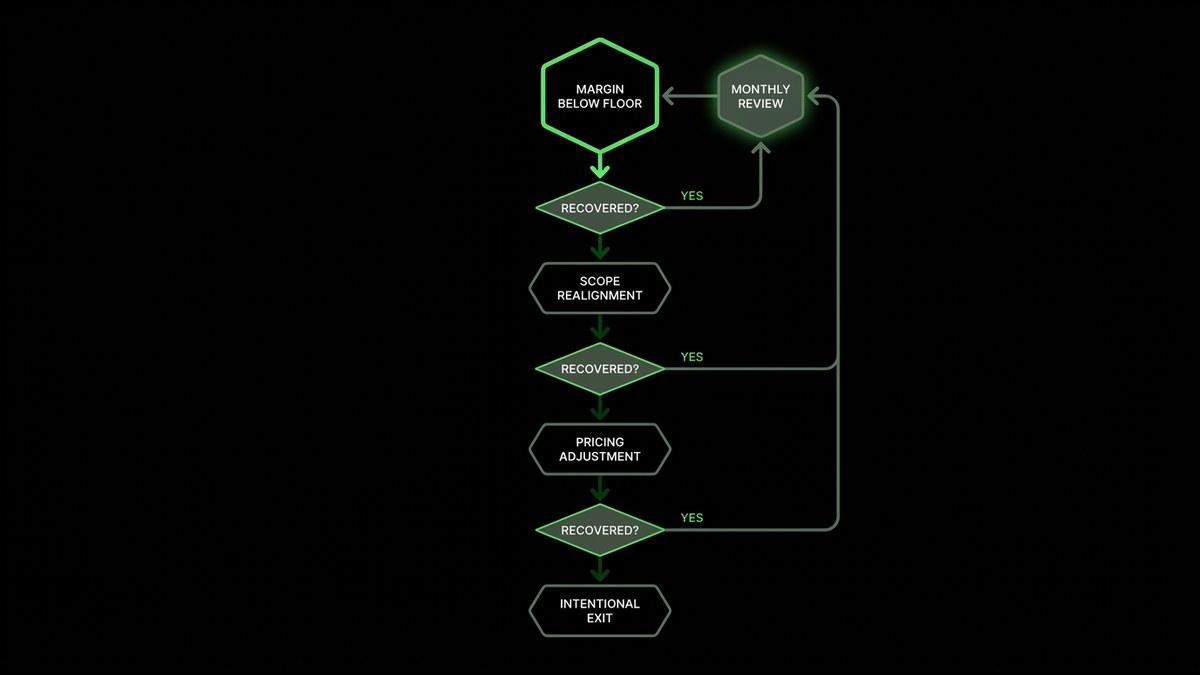
Act on a fixed rule, not a feeling. Check scope first, then pricing, then fit. The usual order is scope realignment, a pricing adjustment at the next review, and, if strategic fit has degraded, an intentional exit.
Start with scope because it is the cheapest fix. Compare what the team is doing with what the retainer defines. If the gap is unscoped work, realign: bring the work back inside the definition, or agree to price it separately. Do not absorb it quietly.
If scope is clean and margin still sits below the floor, the price is wrong for the work. Adjust it at the next review, with your monthly numbers in hand. Waiting for a better moment usually just costs another quarter of margin.
Fit is the last check. Some retainers keep slipping because the client's needs have moved away from what you deliver well. Concentration risk can make exit hard to consider, which is exactly why you decide the rule in advance. An intentional exit, handled well, protects both the client and the team.
Give scope and pricing a standing quarterly review. Margin is the monthly early alert, and the quarter is where the fix lands. A good agenda is short: what the retainer defines, what the team actually did, and three standard answers to extra requests.
Run the three-metric review this month
Here is the whole system in a few words:
Your next step is simple. Pick your largest retainer and build the worksheet this month. Log cost by role, compare actual scoped time with plan, and check the role grid for strain. Then name an owner and a response for each number.
That is the core of retainer profitability metrics: a system you read together, not a pile of separate reports. If you want a second pair of eyes on your worksheet or your margin floor, talk to effiqs.
- Gross margin. What the retainer earns after the real cost of delivery, against a floor.
- Utilization. Scoped time against planned time, never a billing basis.
- Capacity. Committed work against available role time, with a buffer.
- ✓ Pick three metrics (gross margin, utilization, capacity), give each an owner and a defined response, and read them as a trend.
- ✓ Set the margin floor before you sign, then watch where the monthly number sits against it.
- ✓ Use utilization as a private scope check against planned time, never as a billing basis.
- ✓ Plan capacity by role, hold a buffer, and cap retainer load before it caps your quality.
- ✓ When margin slips, work the ladder in order (scope, price, fit) and decide the rule before you need it.
FAQ
Which metrics show whether a retainer is profitable?+
Three metrics together: gross margin per retainer, utilization against scoped work, and committed capacity versus available capacity. Revenue alone hides delivery cost, so a retainer can look healthy on the invoice while losing money.
How do you calculate gross margin on a retainer?+
Take the monthly retainer fee, subtract direct labor at a loaded rate, contractor costs, and client-specific tool costs, then divide the result by the fee. Log cost by role against the retainer, not by project, so the number is measurable each month.
Does utilization tracking mean billing by the hour?+
No. Utilization compares time spent on scoped deliverables against the time that scope should take. It is an internal check on scope and staffing. The client still buys defined outcomes at a fixed fee, and the number should never leave the building or drive pay.
How do you plan capacity across multiple retainers?+
Build a grid with roles down the side and retainers across the top, fill in committed time per role, and compare it with available time. Plan by role rather than headcount, keep a buffer on each role, and include expected conversions from entry offers.
What should you do when a retainer's margin slips below the floor?+
Work a fixed order. First realign scope by bringing unscoped work back inside the definition or pricing it separately. Then adjust the price at the next review. If strategic fit has degraded, make an intentional exit.