
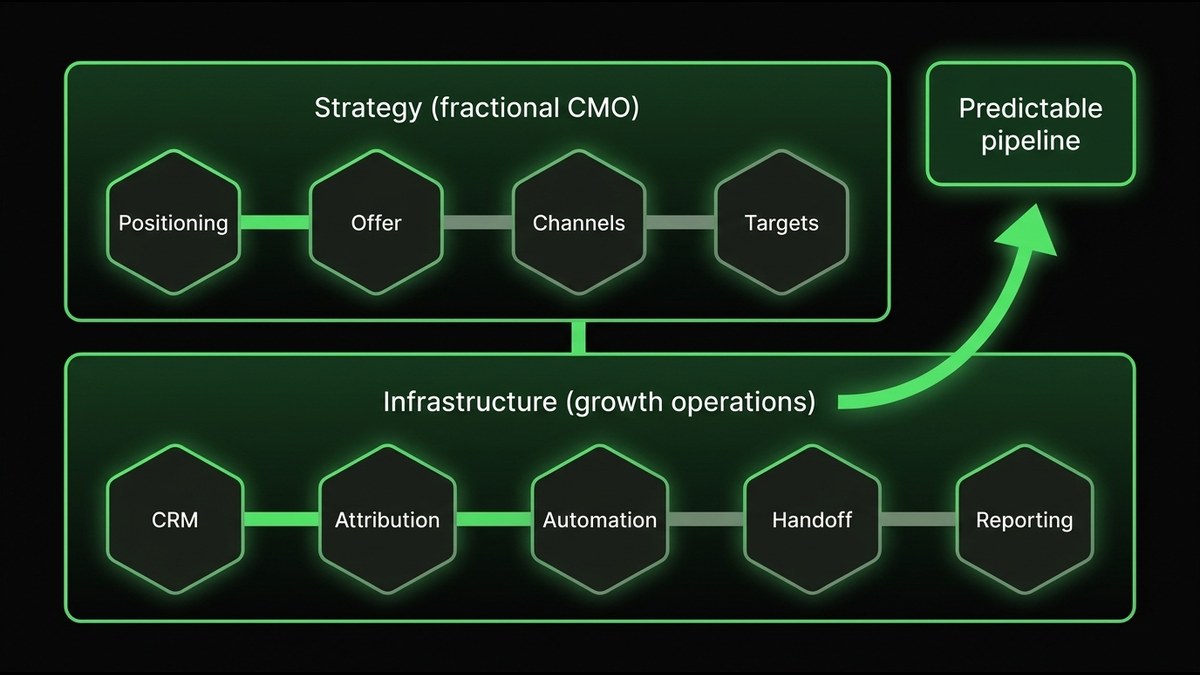
Growth operations and a fractional CMO do different jobs. A fractional CMO sets strategy: positioning, channel priorities, and targets. Growth operations builds and runs the systems that carry that strategy: CRM architecture, attribution, lead handoff, and reporting. Strategy without those systems produces decks, not predictable pipeline.
You hired a fractional CMO. The strategy deck was sharp. Three months later, the founder asks where the pipeline is, and nobody can prove anything. Workflows in the CRM are half-built. There is no attribution model. Marketing cannot show its contribution to revenue, so the conversation turns back to opinions.
That is not a strategy failure. It is an infrastructure failure under a sound strategy. The fix is an operating model built once and owned by the client, sitting beneath the CMO and doing the work the CMO's scope does not cover.
This piece is a growth operations vs fractional CMO breakdown, and a CMO agency comparison, for people who are accountable for pipeline but do not own the systems that produce it. It defines who owns what, shows why strategy stalls, and gives you a test you can run on any growth partner, including us.
Growth operations vs fractional CMO: who owns what?
The two roles are additive, not competing. Each answers a different question.
A fractional CMO owns direction. That means positioning, the offer, channel priorities, and targets. It also means the narrative the board hears. A good fractional CMO decides what the company should do and in what order.
Growth operations owns the machinery. That means tracking, automation, attribution, reporting, and the CRM that holds it together, built in the client's own tools. It decides nothing about strategy. It makes sure strategy can be run, measured, and repeated.
The gap between the two is where most fractional engagements quietly fail. A fractional scope covers direction but not build. The hours stop at the plan. Execution then gets sourced piecemeal from vendors who each own one slice: a paid specialist here, a freelancer for the CRM there. Nobody owns the connections between them, and the connections are where the plumbing breaks.
Revenue leaders describe the symptoms in remarkably similar terms. An attribution black hole. A founder-led ceiling, where the founder is still the highest-paid SDR in the company. MQL reports they spend their time defending when they would rather show pipeline contribution. Those are not strategy problems. They are symptoms of missing systems, and CRM architecture, lead scoring, and attribution built as client-owned infrastructure is what removes them.
Takeaway: the CMO decides what to do, and growth operations makes it runnable, measurable, and repeatable.
Why does fractional CMO strategy stall without systems?
Strategy needs something to execute through. A priority list is a hypothesis. It only becomes a result when it moves through a CRM, a handoff, and a reporting layer that tells you whether it worked.
Without those, the failure is structural, and the growth operations vs fractional CMO split explains why. Direction without a build layer has nowhere to land.
We call this the no-strategy execution trap. The company paid for direction, received direction, and still has nowhere to put it. The people most exposed are the ones the strategy was meant to help: a CMO or head of marketing evaluating partners under attribution pressure, a CRO who needs forecastable pipeline, and a founder who still carries the sales motion personally.
The pattern is consistent. The deck is rarely the problem. The missing connection between the deck and the revenue system is.
A caution, so this does not read as an attack on fractional leadership. The CMO did the job they were scoped to do. Hiring leadership before you can implement is wasteful, and so is expecting a part-time leader to also build the machine. Those are two different jobs with two different scopes.
Takeaway: when the failure is structural, a better strategy will not fix it, and a built system will.
- No attribution, no testing. If nobody can show which channels produce pipeline, priorities cannot be tested. The CMO recommends a channel shift, and the only evidence available is a lead count. The strategy stays a document because there is no way to prove or disprove it. Without attribution, every pipeline swing is also unexplained.
- No handoff, no continuity. Messaging gets written for marketing and never reaches sales. The positioning says one thing, the sales narrative says another, and prospects feel the gap. Leads leak in the space between teams. A clean lead handoff has to be designed as a system, with defined stages, owners, and timing, not requested in a meeting.
- No CRM architecture, no reporting. When lifecycle stages, ownership rules, and scoring are half-built, every report needs a manual rebuild. The CMO ends up defending numbers instead of presenting pipeline contribution, and a board-ready view of unit economics is impossible when the data underneath is unclean.
Growth operations model vs retainer agency
Here is the objection that comes up first: a growth operations partner is just another agency retainer. We sell an ongoing model ourselves, so the honest answer is not "retainers are bad." The question is what the recurring spend buys.
A retainer agency sells ongoing output: campaigns, assets, channel management. The work and the know-how usually live inside the agency. When the engagement ends, the output stops, and the client is left with whatever files were delivered.
A growth operations model installs permanent systems that the client owns, on fixed scope, and then operates them. When the engagement ends, the revenue system stays and keeps running.
The money also behaves differently. In an hours-and-output arrangement, you pay for capacity and hope it converts. With fixed scope, you pay for a defined build, and diagnostic-first scope and outcome gates decide what gets built and when. Diagnosis comes before delivery, because the most expensive mistake in growth is executing on the wrong system fast.
Takeaway: the difference is not whether the spend recurs, but whether the revenue system stays with you when it stops.
- Fractional CMO. Owns strategy and leadership, with limited hours and typically no build capacity. Output is direction, plans, and priorities. Dependency: the company must source execution elsewhere.
- Retainer agency. Owns channel execution or deliverables, often under open-ended scope. Output is campaigns and assets. Dependency: the work and know-how stay with the vendor.
- Growth operations. Owns the revenue systems (CRM, attribution, automation, handoff, reporting) on fixed scope, built inside the client's tools. Output is infrastructure the client owns and operates. Dependency: none after handover, by design.
The Handover Test
To keep this honest, we use a simple test on any growth partner. Apply it to us too.
If the answer to any of the three questions is no, you are renting output, not building infrastructure. That is a legitimate purchase sometimes. It is just not the same purchase, and it will not make pipeline predictable on its own.
- Question 1. Does the system live in your tools, under your admin access?
- Question 2. Can your team run it without the person who built it?
- Question 3. Does scope end with a working system, or just a time commitment?
What should a fractional CMO hand off?
Hand over everything that must exist and run daily but sits outside a fractional scope. Keep everything that requires strategic judgment. That is the practical line in growth operations vs fractional CMO.
The CMO remains the strategic owner. The partner builds what that strategy needs and keeps it running. This is the opposite of a replacement. It is the layer that makes the CMO's priorities testable, so the next board conversation is about pipeline contribution instead of a defended MQL report.
One practical rule: content and campaigns should be prioritized by conversion impact, not volume. When attribution exists, the CMO can see which messages move deals and cut the rest. Without it, volume is the only visible metric, and volume is the wrong one.
There is a sequencing question underneath this. Founders ask which order to fix positioning, funnel, CRM, and demand in. The answer is to diagnose first, then build in the order the diagnosis shows. Fixing demand before the CRM can capture it wastes spend. Fixing the CRM before positioning is settled bakes the wrong narrative into automation. The CMO settles the first and the partner builds the rest.
AI accelerates parts of this work, but it amplifies oversight rather than replacing it. Someone senior still decides what the system should do.
If you also have an in-house marketing team, the same split applies. The team runs campaigns inside the system. The partner owns the system itself. Nobody is displaced.
Takeaway: the CMO keeps judgment, and the partner takes everything that has to run every day.
- Hand off. The CRM build, including lifecycle stages, ownership rules, and data hygiene
- Hand off. Lifecycle automation and lead scoring
- Hand off. Attribution and tracking, including offline conversion tracking and GA4 and CRM data flow
- Hand off. Reporting that shows pipeline contribution without manual rebuilds
- Hand off. The demand-to-sales handoff mechanics
- Keep with the CMO. Positioning and the offer
- Keep with the CMO. Channel choices and sequencing
- Keep with the CMO. Targets and the board narrative
- Keep with the CMO. Messaging direction and what the market hears
Do you need infrastructure or another retainer?
Run this check in five minutes. If you answer yes to most of it, the gap is infrastructure.
If these describe your company, another retainer adds output on top of a missing foundation. More campaigns into an unmeasured funnel produce more noise, not more clarity. Fix the system first, then add volume.
If most answers are no, you may genuinely need more execution capacity, and that is a reasonable purchase. The point of the diagnostic is to tell the two cases apart before you spend. To size the decision, compare an in-house hire, an agency retainer, and a client-owned build over 24 months.
The question founders ask is usually some version of: what has to exist before pipeline scales without me? This checklist is the answer. Attribution, a built CRM, a working handoff, and reporting you trust.
Takeaway: if strategy is sound and pipeline is not, the missing piece is infrastructure, not output.
- Is the strategy sound, but pipeline still unpredictable?. If the plan makes sense and the results do not follow, the plan is not what is broken.
- Can you show which channels produce pipeline?. If the answer is a lead count or a platform report, attribution is missing.
- Are CRM workflows half-built?. Look for lifecycle stages nobody trusts, ownership rules that differ by rep, and reports that need a manual rebuild each month.
- Does the handoff between marketing and sales leak?. If sales ignores marketing-sourced leads or marketing cannot see what happened to them, the connection is missing.
- Does the pipeline depend on one person?. If the founder is still the highest-paid SDR, nothing exists that scales without them.
- Would the work stop if the vendor left?. Apply the Handover Test. If the answer is yes, you own output, not infrastructure.
Strategy plus owned infrastructure
The argument is simple. Strategy sets the direction, and infrastructure decides whether that direction ever turns into predictable pipeline. In growth operations vs fractional CMO, nobody is competing: one decides and the other builds and runs. The company that wins has both, with the systems living in its own tools.
If your strategy is sound and your pipeline is not, that is the conversation to have.
- ✓ The CMO decides what to do, and growth operations makes it runnable, measurable, and repeatable.
- ✓ When the failure is structural, a better strategy will not fix it, and a built system will.
- ✓ The difference from a retainer is not whether the spend recurs, but whether the revenue system stays with you when it stops.
- ✓ The CMO keeps strategic judgment, and the partner takes everything that has to run every day.
- ✓ If strategy is sound and pipeline is not, the missing piece is infrastructure, not output.
FAQ
What is the difference between growth operations and a fractional CMO?+
A fractional CMO owns direction: positioning, the offer, channel priorities, targets, and the board narrative. Growth operations owns the machinery that makes that direction runnable: CRM architecture, attribution, automation, lead handoff, and reporting, built in the client's own tools. The two roles are additive, not competing.
Why does a fractional CMO's strategy stall?+
A fractional scope usually covers direction but not build, so the strategy has no systems to run through. Without attribution, priorities cannot be tested. Without a designed handoff, messaging never reaches sales. Without CRM architecture, every report needs a manual rebuild. The failure is structural, not a flaw in the CMO or the plan.
Is a growth operations partner just another agency retainer?+
Not if it passes the Handover Test. A retainer agency sells ongoing output such as campaigns and assets, and the know-how usually stays with the agency. A growth operations model installs systems the client owns, on fixed scope, in the client's tools, and then operates them. When the engagement ends, the revenue system stays and keeps running.
What is the Handover Test?+
It is three questions for any growth partner. Does the system live in your tools under your admin access? Can your team run it without the person who built it? Does scope end with a working system rather than just a time commitment? A no to any of them means you are renting output, not building infrastructure.
What should a fractional CMO hand off to a growth operations partner?+
Hand off everything that must run daily but sits outside a fractional scope: the CRM build, lifecycle automation and lead scoring, attribution and tracking, reporting, and the demand-to-sales handoff mechanics. Keep positioning, the offer, channel choices and sequencing, targets, the board narrative, and messaging direction with the CMO.
In what order should positioning, funnel, CRM, and demand be fixed?+
Diagnose first, then build in the order the diagnosis shows. Fixing demand before the CRM can capture it wastes spend, and fixing the CRM before positioning is settled bakes the wrong narrative into automation. The CMO settles positioning and the growth operations partner builds the rest.
How do I know if I need infrastructure or another retainer?+
Check whether your strategy is sound but pipeline is unpredictable, whether you can show which channels produce pipeline, whether CRM workflows are half-built, whether the sales and marketing handoff leaks, whether the pipeline depends on one person, and whether the work would stop if the vendor left. Yes to most of these means the gap is infrastructure, and more output will not close it.