
GTM system design is the work of architecting a revenue engine where strategy, demand, content, conversion design, and revenue operations run as one accountable system. A GTM strategy is the plan and execution is the tactics. System design defines how the parts connect, who owns each handoff, and what data proves it works.
Most B2B SaaS teams don't have a pipeline problem. They have a structure problem that shows up as a pipeline problem. When pipeline softens, the usual response is to add a channel, buy a tool, or hire an agency to drive more leads, and each move adds volume to a system that already leaks in the middle.
This guide to GTM system design gives you the architecture, a diagnostic to find the broken layers, and a build order, so you can fix the system before you add another campaign, tool, or hire. If your ICP is still fuzzy, tighten that first, then come back.
What is GTM system design?
GTM system design sits between two things teams already do. The first is writing a go-to-market strategy B2B leaders can agree on: ICP, positioning, channels, offers. The second is running campaigns. The design layer is the connective work most companies skip. It decides how a signal from one channel becomes a record in the CRM, a message in a sequence, a conversation with sales, and a line in a monthly revenue review.
A launch plan ends. A system keeps running, keeps producing data, and keeps getting corrected. Here's how the three terms differ:
- GTM strategy. The plan. It answers who you sell to, what you say, and which channels you bet on. It lives in a document and goes stale the moment the market moves.
- GTM execution. The tactics. Sequences, ads, webinars, content, events. Execution can look busy and productive while revenue stays flat.
- GTM system design. The architecture. It defines shared definitions, data flows, handoff rules, decision rights, and the feedback loop that connects results back to strategy.
Why B2B SaaS GTM breaks: operations, not leads
Marketing doesn't have a lead generation problem. Most companies have an operations problem. A channel agency optimizes campaigns, while a business needs the whole operating model optimized, and those are different jobs. Good GTM system design starts by refusing the lead-volume diagnosis.
Look at what typically happens when pipeline softens. The founder adds a channel. Someone buys a new tool. An agency is hired to drive more leads. Leads then arrive faster than anyone can route, qualify, or follow up on them. Sales says the leads are poor. Marketing says sales doesn't follow up. Both are right, because the handoff between them was never designed.
Adding more channels rarely fixes growth. Better systems usually do. The biggest growth opportunities in a B2B SaaS company are usually hidden in process inefficiencies, not media budgets. Common examples include a lead scored one way in the marketing platform and another way in the CRM, two reps working the same account because nobody owns account definitions, reporting that counts form fills while the CFO asks about pipeline and payback, and software bought to solve what is actually an ownership problem.
Most marketing teams measure activity instead of business outcomes. Count the campaigns launched last quarter, then ask what changed in revenue. If the second number is harder to find than the first, that's the problem.
SEO, paid media, RevOps, automation, and conversion work also shouldn't live as separate departments. They are parts of one growth system. When each runs its own roadmap, each optimizes its own metric, and nobody owns the outcome between them. That is why the founder ends up as the highest-paid SDR in the company: the founder is the only person holding the whole picture, so the founder becomes the integration layer.
The fix isn't harder execution. Predictability comes from ownership, definitions, and feedback loops, not from heroic output.
How do you know your GTM system is broken?
Diagnosis comes before delivery. The most expensive mistake in growth is executing fast on the wrong system. Before you change anything, run a structural audit of your GTM system design. Answer each question yes or no. Anything you can't answer quickly counts as a no, because a leader who can't see it can't manage it.
- Strategy and positioning. Can you state your ICP in three sentences, and would sales and marketing give the same three sentences?
- Strategy and positioning. Is there a single ranked list of channels and offers, or does every team keep its own?
- Demand and acquisition. Do you know cost per qualified opportunity by channel, not just cost per lead?
- Demand and acquisition. Could you forecast next quarter's pipeline within a range you'd defend to your board?
- Content and messaging. Does your outbound message match your homepage, and does your homepage match what sales says on calls?
- Content and messaging. Do reps use the approved collateral, or did each build their own?
- Design and conversion. Can a buyer find proof of results within a few clicks of landing? Do you know which pages convert and which only collect traffic?
- RevOps and data. Can you trace a closed deal back to its first meaningful touch, and is there one source of truth for pipeline with no duplicate people or accounts?
- Attribution and review. Does your reporting change budget decisions, or does it sit in a dashboard nobody opens?
- Attribution and review. Does a monthly review lead to documented changes?
Reading the diagnostic results
Score it plainly. Mostly yes means the system holds and you may have a tactical problem. A mix means specific layers are broken. Mostly no means you're running campaigns, not operating a system.
Then look at the symptoms. A volatile pipeline, forecasts that miss, finger-pointing between sales and marketing, a founder still closing most deals, and dashboards nobody trusts are all structural signals.
Rank every gap by which downstream layers it blocks, not by how loud the complaint is. Data integrity problems usually sit at the top, because every other fix depends on trusting the numbers.
Revenue system architecture: six layers
Revenue system architecture is the structural map of a GTM system. Any GTM framework SaaS teams adopt should name its layers, say what each owns, and show how data and decisions move between them. These are the six layers used in GTM system design. Skip one and the loop stays open. The tools matter less than whether each layer has a clear job and a clear connection to the next.
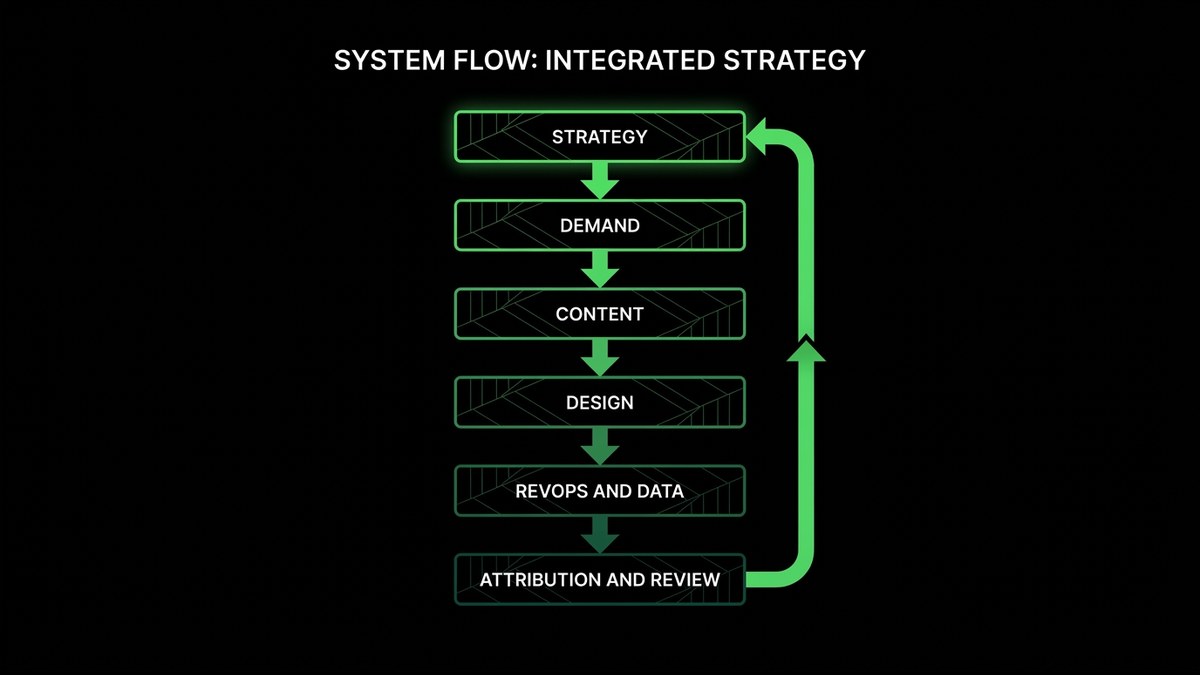
- Layer 1: Strategy and positioning. The decision layer: ICP, positioning, channel priorities, offer structure, and goals. It tells demand who to chase, content what to say, and attribution what counts as success. When it's missing, teams optimize tactics in isolation and messages drift.
- Layer 2: Demand and acquisition. Where accounts enter the system: outbound, paid, search, partnerships, authority channels, and marketplaces. The key design rule is that every source writes to the same record structure with the same definitions. Without that, you get high lead volume, weak conversion, and a sales team that stops trusting what marketing sends.
- Layer 3: Content and messaging. The narrative system: positioning statements, site copy, sequences, case studies, and sales collateral. Its job is consistency. If outbound, the website, and the sales deck each tell a different story, buyers sense the gap and delay decisions.
- Layer 4: Design and conversion experience. The interface layer: the website, landing pages, email templates, and demo flows. Conversion happens here. A sound strategy with a confusing site leaks revenue, and it often looks like a sales problem because the symptom is a long cycle.
- Layer 5: RevOps and data. The backbone: CRM architecture, automation, tech stack governance, and data integrity. It makes everything else measurable. Treat it as the integration architect, not the CRM admin.
- Layer 6: Attribution and review. The layer that closes the loop: attribution, funnel diagnostics, and a monthly review where results change the plan. Attribution isn't about giving credit, it's about making better investment decisions. Without it, the first five layers run open-loop and strategy never gets corrected by evidence.
Build a GTM system beyond founder selling
Founder-led sales is a legitimate motion. It's how most B2B SaaS companies find their first buyers. The trouble starts when it never graduates. If every deal still needs the founder, the company has a ceiling, and no amount of top-of-funnel spend lifts it.
The common thread in reducing CAC while improving lead quality is rarely a new channel. It is getting sales and marketing to share definitions, handoffs, and accountability. Sequence matters as much as components, so here is a build order that works:
- 1. Extract what the founder does. Record which questions the founder answers, which objections they handle, and which proof points close deals. That is the raw material for positioning, messaging, and collateral.
- 2. Define the shared language. Agree on what counts as a qualified lead, an opportunity, and a customer. Write it down and put it in the CRM, not in a slide.
- 3. Fix the data foundation. Clean the CRM structure, remove duplicates, and make sure every source writes to the same fields. Do this before building automation on top.
- 4. Design the handoffs. For each stage, define who owns it, what information must transfer, and how long a lead can wait.
- 5. Install attribution and a review cadence. Connect first touch to closed revenue, and hold a monthly review where numbers change decisions.
- 6. Then scale demand. Only now do you add volume, because the system can absorb it.
How do you design the revenue process first?
Start with the buyer path, then define each stage with entry and exit criteria, one shared ICP, and a handoff contract between teams. Only after these exist should you configure anything in the CRM. Process is the specification. Tools are the implementation.
Step one is one ICP and one buyer path. Write one ideal customer profile that marketing, sales and customer success all use. Then map the path a buyer actually takes, from first problem recognition to a signed contract and onboarding. Resist the urge to design around account tiers. Forrester makes the point sharply: revenue doesn't come from tiers, it comes from buyers connected to opportunities within accounts and segments. Your buyer path should name the people involved in a multi-stakeholder deal and the opportunity they're tied to. A static list of "strategic accounts" tells your reps nothing about who to call next.
Step two is stage definitions with entry and exit criteria. For every stage, write down the four items below. Keep a one-page definition inventory next to the stages. It lists every term your teams use, such as lead, qualified, opportunity, commit, closed-lost reason and churn event. Each term gets one meaning and one owner. Any change to a definition gets a date and a reason, so nobody has to guess why last quarter's numbers don't match this quarter's.
Step three is the handoff contract: a short agreement between two teams about what passes across the line. Write one for each boundary: marketing to SDR, SDR to AE, AE to customer success. The rejection reason matters most. It's the feedback loop that tells upstream teams what to fix. Without it, marketing keeps sending the same leads and sales keeps ignoring them.
When these three pieces exist, you're ready to configure.
- Entry criteria. What must be true for a deal to enter this stage.
- Exit criteria. What must be true for it to leave, forward or backward.
- Required data. Which fields must be filled before the exit is allowed.
- Owner. The one person who decides when the criteria are met.
- Handoff: what qualifies. The criteria a record must meet to be handed over.
- Handoff: what travels with it. The data and context the receiving team needs, including the reason it qualified.
- Handoff: response time. A stated response window, not a vague "promptly."
- Handoff: rejection. The record goes back with a coded reason, so marketing sees why leads fail.
- Handoff: who can change it. One owner, with a change log.
How does tool integration work without a rebuild?
Audit each tool against one question: which process decision does it support? Keep what maps to a stage, a definition or a metric. Merge or retire what duplicates it. Integration means one source of pipeline truth, not more connectors.
Most CROs dread this step because they picture a six-month migration. It usually isn't one. Once the process is written, you're not choosing new software. You're checking the software you have against a specification. Tool integration succeeds or fails on the process underneath it, not on the number of connectors.
Map every tool to a process decision. List every tool in the revenue stack and write the decision it supports. A routing tool supports the "who gets this lead" decision. A call-recording tool supports the "did this deal meet exit criteria" decision. An enrichment tool supports the "does this record have the data required to enter the next stage" decision. Then sort the list into three piles. The retire pile is usually bigger than expected: a tool nobody can connect to a decision is a cost center with a login. If you decide the CRM itself needs rebuilding around the new process, scope it as a defined job and implement it as owned infrastructure, so the logic belongs to you and not to a consultant's spreadsheet.
Pick one source of pipeline truth. Choose one system as the record for pipeline. Every other tool reads from it or writes to it by defined rules. If marketing's report and sales' report disagree, the question is not "whose number is right." It is "which field definition differs." That means field-level discipline: each critical field has one owner, one allowed set of values and one point in the process where it must be filled. Required fields tied to stage exits stop the most common data decay, records that move forward with half the information missing.
Capture the reason, not just the stage. Add the context fields from the handoff contract: why the deal qualified, why it moved, why it stalled, why it was lost. Make the closed-lost reason a controlled list, not free text. Also look hard at static lead scoring. A score that never learns from outcomes is a design flaw. If the model assigns points once and nobody checks whether high scorers actually close, it's a guess with a number attached. Feed win and loss data back to it on a defined cadence, and put someone in charge of the model.
Once the stack matches the process, keeping it clean is a recurring job that covers automation, reporting and field hygiene.
- Keep. The tool maps to a stage, a definition or a metric, and nothing else covers it.
- Merge. Two tools support the same decision. Pick one and migrate the logic.
- Retire. The tool supports no decision anyone can name.
Who should own each GTM stage and metric?
Every stage, definition, data field and metric needs one named owner with decision rights. Shared ownership means no ownership. The CRO owns pipeline quality and conversion, with RevOps owning the system's integrity and marketing and sales owning their side of each handoff.
Here's the CRO's version of the problem. You're accountable for the numbers, but you don't cleanly control the inputs. Lead quality comes from marketing. Data integrity depends on whoever last edited a workflow. Stage discipline depends on forty reps. You answer for outcomes that sit across four teams. Design fixes that by turning accountability into explicit decision rights. A revenue process without named owners is a diagram, not a system.
"Everyone is responsible for data quality" means nobody is. A decision right is more specific: who can change a stage definition, who approves a new field, who adjusts scoring logic, who signs off on an exception. Write these down as a short list of decisions, each with one owner and one escalation path. Clear ownership boundaries prevent scope creep, protect team capacity and stop the quiet drift where a definition changes because a loud stakeholder asked.
Keep the ownership map to one page. This is general advice, and your split will shift with your org. The rule that doesn't shift is that every line has one name next to it. In longer, multi-stakeholder buying cycles, with several teams touching the deal, that rule matters more. For most B2B teams the map looks like this:
- ICP and stage definitions. Owned by the CRO, with marketing and customer success consulted.
- Pipeline quality and conversion. Owned by the CRO.
- CRM configuration, field integrity and automation. Owned by RevOps.
- Lead quality into the handoff. Owned by marketing.
- Accept, reject and follow-up on handed-over leads. Owned by sales.
- Handoff to onboarding and renewal context. Owned by customer success.
- Attribution model and reporting rules. Owned by RevOps, reviewed by the CRO.
Fintech GTM for mid-market long sales cycles
Fintech shows why GTM system design matters most when cycles are long. A mid-market fintech deal often involves a buying committee, security and compliance review, procurement, and months of stop-start conversation. In that environment, a loose go-to-market strategy that lives only in a deck breaks quickly, because the deal outlasts the campaign. Three design requirements follow from long cycles.
Context has to survive time. Over a long cycle, people change roles, stakeholders join late, and notes go stale. The system has to keep one account record that shows who's involved, what they've seen, and what was promised. If that record lives in three tools, every handoff loses information.
Authority has to do the early work. Buyers in regulated categories research for a long time before they speak to anyone. That makes insight-led content and consistent, high-quality publishing part of the demand layer, not decoration. Useful insight, published consistently, with quality prioritized over volume, builds market authority that shortens later conversations. For fintech, credibility is a precondition to the meeting.
Every layer has to serve one commercial objective. A long-cycle company can drift into projects: a site refresh here, a content series there. A useful discipline is to subordinate everything to a single commercial goal and judge every initiative against it. If a project doesn't move that goal, it's a distraction with a budget.
Account-based motions fit long cycles because they put one account record, one message, and one owner around the committee. They only work if the shared definitions from the earlier build order exist. Otherwise ABM is just a more expensive way to create duplicate records.
Where AI fits in a GTM system
Everyone wants to add AI to the revenue stack. The first question isn't which model to use but what you'd be automating. AI amplifies the system underneath it. If that system is clean, AI speeds it up. If it's fragmented, AI spreads the fragmentation faster and makes it harder to spot. AI won't replace marketers, but it will replace marketers who don't know how to build repeatable systems. The skill that matters is designing the process the model operates inside.
Once foundations are in place, AI does the following well:
- Account and contact research that feeds a sales rep's preparation
- Data enrichment and duplicate detection
- Drafting first versions of sequences and summaries for human review
- Preparing reports and flagging anomalies in funnel data
- Routing suggestions with a person still approving edge cases
Build, hire, or partner?
At some point every leadership team asks whether to hire someone. It's a reasonable question with a hidden trap: hiring fills roles, but nobody ends up owning the architecture. You can hire a strong demand gen manager, a RevOps lead, and a content marketer and still have six layers that don't connect, because no one is accountable for the connections. There are three real options.
- Build in-house. This works when you can afford senior ownership across the layers and can wait while they integrate. The risk is over-hiring on tactics and under-resourcing integration. Someone has to be senior enough to say no to a good idea that breaks the system.
- Buy tools. Software solves execution problems, not design problems. A CRM, an enrichment tool, and a site builder won't integrate themselves. Companies often buy software to solve what is really an operational issue, and the stack grows while results don't.
- Partner. This works when you need senior system design plus execution depth, without the fixed cost and integration lag of assembling a full team. A good partner owns the architecture, orchestrates the layers, and reviews the numbers with you on a fixed rhythm.
What to do next
Start with the audit, not the roadmap. Run the diagnostic questions above against your current stack and be honest about the ones you can't answer. Rank the gaps by what they block downstream, fix data and definitions first, then design handoffs, then install the monthly review that makes the whole thing self-correcting.
The payoff of GTM system design is not a bigger pipeline in the short term. It's a pipeline you can predict, explain, and improve, and a revenue engine that no longer depends on one person's calendar. You can't fix what you can't see, so make the system visible first.
- ✓ GTM system design is the connective architecture that makes strategy executable and execution measurable.
- ✓ When pipeline stalls, look for broken operations and undesigned handoffs before you buy more lead volume.
- ✓ A GTM system is only as strong as its weakest layer across strategy, demand, content, design, RevOps, and attribution.
- ✓ Fix definitions, data, and handoffs first, then scale demand and layer in AI where errors are cheap to catch.
- ✓ Hire for roles only after someone owns the architecture that connects them.
FAQ
What is the difference between a GTM strategy and GTM system design?+
A GTM strategy is the plan: who you sell to, what you say, and which channels you bet on. GTM system design is the architecture that makes the plan work, covering shared definitions, data flows, handoff rules, decision rights, and the feedback loop that connects results back to strategy.
What are the six layers of a GTM system?+
The six layers are strategy and positioning, demand and acquisition, content and messaging, design and conversion experience, RevOps and data, and attribution and review. Together they form a closed loop where attribution feeds evidence back into strategy.
In what order should a B2B SaaS company build its GTM system?+
Extract what the founder does, define shared language for qualified lead, opportunity, and customer, fix the data foundation, design the handoffs, install attribution and a monthly review, and only then scale demand.
Where does AI help in a GTM system, and where does it fail?+
Once foundations are in place, AI helps with account research, data enrichment, duplicate detection, first-draft sequences, reporting, anomaly flagging, and routing suggestions. It fails when definitions are unclear, records are fragmented, strategic decisions are delegated to it, or governance is missing.
Should I hire, buy tools, or partner to fix my GTM system?+
If you can name an owner for every layer and every handoff today, build in-house. If you can't, you need architecture before headcount. Tools solve execution problems rather than design problems, and a partner makes sense when you need senior system design plus execution depth without the cost and lag of assembling a full team.
What is a handoff contract?+
A handoff contract is a short agreement between two teams about what passes across the line, such as marketing to SDR or AE to customer success. It states what qualifies, what data and context travels with the record, how fast the receiver must respond, how rejections are coded and returned, and who can change the contract.
Do I need to replace my tools to fix my revenue process?+
Usually not. Once the process is written, audit each tool against the process decision it supports. Keep tools that map to a stage, definition or metric, merge tools that duplicate a decision, and retire tools that support no decision anyone can name. The aim is one source of pipeline truth, not more connectors.
Sources
- [1]Revenue doesn't come from tiers, it comes from buyers connected to opportunities within accounts and segments. Forrester, ABM Tiers Were Made for Yesterday's World.