
A B2B pipeline is usually unpredictable because of structure, not the market. Loose stage definitions, inconsistent qualification, missing source attribution, irregular outbound and thin coverage each add variance. Fixing those five systems in order, before adding forecasting tools or sales training, is what produces predictable pipeline growth.
Most pipeline reviews feel like damage control. Someone explains why a deal slipped, someone else defends a number they stopped believing two weeks ago, and nobody leaves with a decision.
The usual excuse is that the market, the product or the sales cycle is simply volatile. That excuse is comfortable and almost always wrong. Predictable pipeline growth is possible, but it is built, not hoped for.
Why is a B2B sales pipeline unpredictable?
Unpredictability is a design outcome. When a team says "our pipeline is the problem," the pipeline is rarely the broken part. The GTM architecture underneath it is. Revenue is produced by layers (positioning, demand, qualification, the sales motion, CRM, attribution, forecasting), and when several layers are structurally broken, the output swings no matter how hard people work.
Five failures show up again and again:
- Stage definitions are loose.. Reps interpret "Qualified" and "Proposal" differently, so the same deal sits at different stages depending on who owns it.
- Qualification is inconsistent.. Marketing, SDRs and sales each use a different test for a sales-ready lead.
- Attribution is missing.. Nobody can say which channel produces closable pipeline, so budget decisions are guesses.
- Outbound is irregular.. It runs in bursts after a conference or a campaign, then goes quiet.
- Coverage is thin.. A handful of lost deals is enough to break the quarter.
How the failures compound
Each failure is manageable alone. Together they compound. Loose stages corrupt the conversion data, bad conversion data corrupts coverage math, and bad coverage math corrupts the forecast. By the time the number reaches the board, four weak assumptions are stacked inside it.
There is also a failure that lives between the stages. Qualified opportunities stall after the demo, reps lack the assets to keep the buying committee moving, and deal velocity becomes impossible to predict. Deals do not die at the demo. They die in the silence after it. If your win rate is sliding while activity looks healthy, look at the mid-funnel before you buy more leads.
For founders the same problem has a personal form. Many B2B SaaS founders are still the highest-paid SDR in the company, which means pipeline depends on one person's calendar. That is a founder-led ceiling, and no stage cleanup will lift it until outbound runs as a system.
Do your pipeline stages describe the buyer or the seller?
Open your CRM and read the stage names aloud. "Demo Completed." "Proposal Sent." "Negotiation." Each one describes something the seller did. None describes something the buyer has done, decided or committed to. That is why two reps can disagree about the same deal and both be technically correct.
A stage that describes the seller can be entered by sheer activity. A stage that describes the buyer can only be entered by evidence. The difference decides whether your forecast is a record of effort or a record of intent. The system should enforce definitions, so individual judgment stops being the control. Good sales pipeline management begins with stage names that a buyer would recognize.
Here is the contrast in practice:
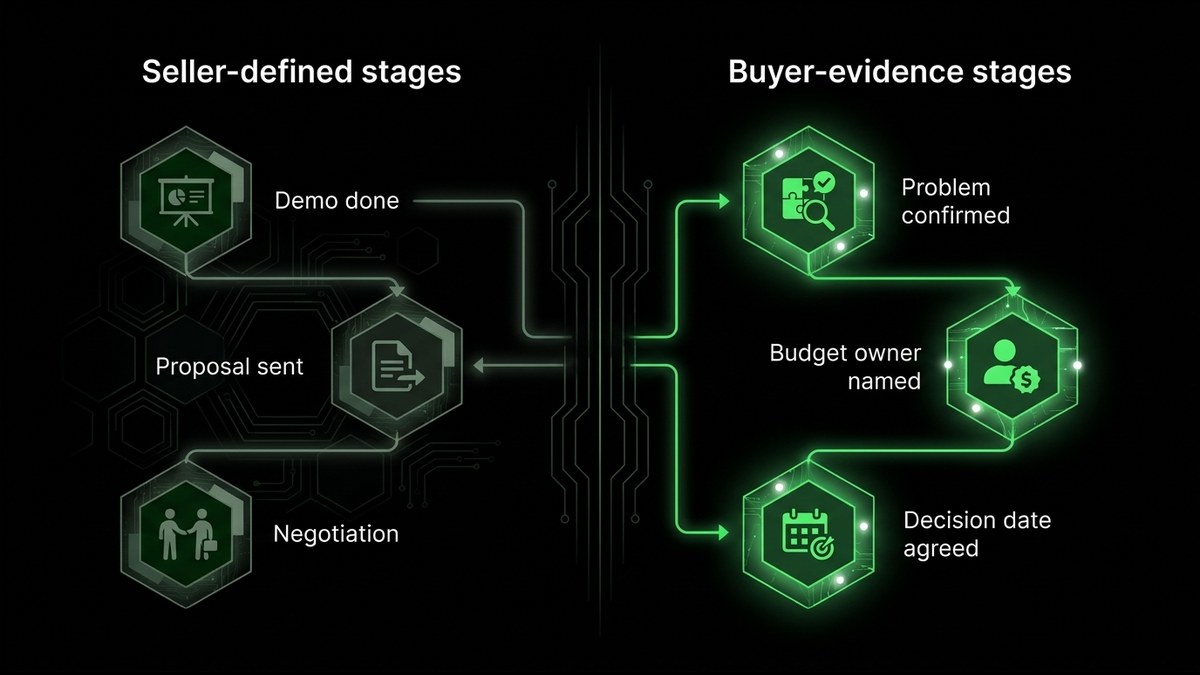
- Seller-defined stage. A proposal was sent. Exit criterion: the rep pressed send. Forecast value: unreliable, because sending says nothing about whether the buyer will act.
- Buyer-defined stage. The economic buyer has confirmed the problem, the budget owner is identified and a decision date is agreed. Exit criterion: observable buyer commitments recorded in the CRM. Forecast value: strong, because it reflects what the buyer actually did.
- Aging rule. Every stage carries a maximum age. A deal that exceeds it is reviewed or removed, not left to drift.
- Next-step requirement. Every open deal has a dated next step owned by a named person. A deal without one is a deal in silence.
One deal flow for every channel
Every channel should feed the same deal flow. When inbound, outbound and referrals each get their own parallel process with their own stage logic, you cannot compare conversion across sources, and early-stage engagements stay inconsistent. One flow, one set of stage definitions and one standard first conversation reduce friction for senior buyers and keep the data clean enough to forecast from.
A practical test: ask three reps to place the same five deals in your B2B sales pipeline without conferring. If they disagree on more than one, your stages are describing the seller.
How strict should lead qualification be?
Stricter than feels comfortable. Most teams treat volume as safety and qualification as friction. In practice, weak qualification is the fastest route to an unpredictable pipeline, because every unqualified opportunity enters the forecast with the same weight as a real one.
The principle is simple: more leads do not mean more revenue, and better leads do. Constraints protect predictability. Sales-qualified definitions are strict, outbound targets are capped, and the number of channels is limited. The cap is deliberate. A pipeline that grows only because the bar was lowered looks healthy in a dashboard and collapses at close.
Three steps make qualification enforceable:
- Write one SQL definition and sign it across teams.. Marketing, SDRs, sales and RevOps agree on firmographic fit, a confirmed problem, buying authority and a time frame. If a lead misses a criterion, it is not an SQL, whatever its score says.
- Test the ICP against closed-won data, not opinion.. When a stated ICP is compared with the accounts that actually closed, the best-fit set often includes a vertical nobody wrote down, such as professional services firms with clear marketing operations needs and recurring revenue potential. Qualification should follow demonstrated fit, so the definition needs a review loop.
- Make the handoff a contract.. Sales accepts or rejects every handed-over lead with a reason code. Rejections feed back to marketing weekly. Without that loop, marketing optimizes for MQL volume while sales quietly ignores half of it.
The qualification trade-off
Who sits in the room matters. A CMO or Head of Marketing in a pipeline-attribution pain state wants volume to prove channel value. A CRO or VP Revenue wants fewer, closable deals to protect the number. Founders are often both and neither at once. A shared definition is the only thing that lets those goals coexist, because it turns an argument about opinions into a check against criteria.
There is a real trade-off. Tightening qualification reduces lead volume in the short term, and some months your top-of-funnel chart will look worse. In exchange, stage conversion stabilizes, coverage math becomes honest and the forecast stops absorbing leads that were never going to close. If your board rewards the chart and not the conversion, reset that expectation before you tighten the standard.
Can you forecast pipeline you cannot attribute?
You can produce a number. You cannot defend it. Forecasting from pipeline whose origin is unknown means every conversion rate you apply is an average across sources that perform very differently. Outbound meetings, referrals, content-driven inbound and event leads convert and age at different speeds. Blend them together and you get an assumption, not a forecast.
This is the attribution black hole. Teams can see opportunities, but not the path that created them, so they cannot repeat the motions that work or cut the ones that do not. Budget is allocated on the loudest opinion in the room. The pain is sharpest for marketing leaders expected to prove pipeline contribution and for revenue leaders expected to forecast it.
Fixing it does not require a perfect multi-touch model on day one. It requires discipline in five places:
- Source is a required field at creation.. An opportunity cannot be saved without an original source and a creating motion.
- One system of record.. Source rules live in the CRM, enforced by workflow, not stored in a spreadsheet someone maintains. A well-governed CRM engagement typically spends its first weeks on properties, lifecycle stages and validation rules for this reason.
- Attribution logic is documented.. Decide how first touch, creating touch and influence are treated, write the rules down and do not change them mid-quarter.
- Imperfect beats absent.. A simple, consistent model that is 80 percent right in direction is more useful than a sophisticated one nobody trusts. Improve it over time.
- Forecast hygiene is explicit.. Deals with no defined close window should not be in the forecast at all. When pipeline inflates faster than the activity behind it, treat that as a risk signal, not good news.
Why attribution makes the forecast a forecast
Sales pipeline management as a discipline means maintaining coverage ratios and forecast accuracy as operating routines, with named owners. It is not a quarterly clean-up. Attribution feeds both: it tells you which sources earn a place in coverage math, and which sources inflate it.
A revenue leader who can say "this much of next quarter's pipeline comes from a motion with a stable conversion history" is making a different kind of statement than one who reports a total. The first is a forecast. The second is a hope.
How consistent does outbound need to be?
Consistent enough that you could predict next month's meeting count from last month's activity. Outbound is the one pipeline source you control directly, which makes it the natural foundation for predictable pipeline growth. It stops being a foundation the moment it runs in bursts.
Burst outbound looks like this: a conference ends, the follow-up sprint runs for two weeks, then attention returns to deals in flight. Six weeks later the pipeline thins, panic sets in and another sprint starts. The sawtooth in your pipeline creation chart is the sawtooth in your outbound calendar. The founder who carries outbound personally is the most extreme case, because pipeline now rises and falls with their travel schedule.
Consistency has four components:
- A defined purpose for every channel.. Outbound exists to create qualified first conversations with a specific ICP, not to "keep options open."
- A pipeline contribution target per channel.. If a channel has no target, nobody can say whether it is working.
- Clear KPIs.. Activity measures (accounts touched, sequences started) sit beside outcome measures (meetings held, SQLs created, pipeline value).
- No channel that exists just in case.. Every channel earns its place or is cut. Fewer channels, run with clear roles, outperform many channels run with no ownership.
Capacity discipline and the sales motion behind outbound
A capped outbound target tied to a strict SQL definition protects quality. If the target keeps rising while the standard stays fixed, the team starts bending the standard. Cap volume at what the ICP list and the team can serve properly, and treat the cap as a design choice, not a limitation.
The sales motion behind outbound needs the same standardization. A repeatable early-stage engagement reduces buying friction for senior buyers and protects the time of whoever is still selling personally. Infrastructure has to exist before volume does.
A quick self-check: plot weekly pipeline created for the last six months. If the shape is a flat line with small ripples, outbound is a system. If it is a series of peaks, it is a campaign habit.
How much pipeline coverage is enough?
Enough to absorb your real loss rate, and no more than your team can work properly. Coverage is the ratio of open qualified pipeline to the target you must hit. Many teams adopt a rule of thumb and never test it against their own conversion history. That is why the rule of thumb fails them.
Here is the math, with no hidden assumptions. If you close one deal for every N qualified opportunities that reach a given stage, you need roughly N times your target in pipeline at that stage, before adjusting for deal size and timing. A team with a strong win rate can run lean. A team with a weak win rate and long cycles needs far more, or needs to fix conversion first. Adding coverage to a leaky funnel only increases the cost of the leak.
A usable operating model has three numbers:
- A minimum coverage floor.. Below it, you escalate. This is the point where a few slipped deals break the quarter.
- A target coverage level.. The design standard you plan creation against, higher than the floor, so normal slippage does not become a crisis.
- A monthly creation target.. Coverage is a stock, but creation is a flow. If you do not create enough each month, coverage decays in the background even when today's ratio looks fine.
Coverage can lie: audit its health
Set these numbers from your own data. Pull stage-to-stage conversion by source, average cycle length and deal size for the last several quarters, then compute the floor from the worst stable quarter and the target from the median.
Coverage also needs a health check, because it can lie. A 5x ratio built from aged deals, unqualified leads and opportunities with no close window is worse than a 3x ratio built from buyer-confirmed deals. Measure the share of coverage that is aged, the share with a dated next step and the share that came from sources with stable conversion. Treat sudden inflation as a risk signal and investigate it before you celebrate it.
And watch for the opposite temptation. Once coverage looks thin, the instinct is to flood the top of the funnel. Resist it. If conversion is the bottleneck, more volume only widens the gap between pipeline and revenue.
How do you build predictable pipeline growth?
In sequence. Predictable pipeline growth is the result of fixing foundations in the right order, because each layer depends on the one beneath it. Founders often ask which to fix first: positioning, funnel, CRM or demand. The answer is almost never demand.
The sequence is diagnosis before delivery. The most expensive mistake in growth is executing fast on the wrong system, so each step begins with a diagnostic and ends with a rule that can be enforced.

- 1. Audit stage definitions and progression.. Rewrite stages around buyer evidence, add exit criteria and maximum ages. This is the fastest win, because it needs a workshop and a CRM change, not new tools.
- 2. Set one SQL definition.. Get every team to sign it and attach reason codes to rejections. Until this exists, downstream conversion data is noise.
- 3. Track source from creation.. Make source mandatory and document the attribution rules. Even a rough model changes budget conversations.
- 4. Build a repeatable outbound system.. Define the ICP, the channel roles, the capped targets and the weekly rhythm. This is where founder-led selling begins to hand off.
- 5. Enforce coverage discipline.. Set floor, target and creation levels, then review them weekly alongside forecast variance.
Why the order matters
Skipping ahead wastes money. Outbound built on loose stage definitions produces meetings you cannot measure. Coverage targets set before qualification is fixed give you a precise-looking number built on sand.
The questions founders ask in practice are really sequencing questions: what has to exist before pipeline scales without me, and should this be built in-house or with a partner who builds and then operates it. A fixed-scope diagnostic is a sensible first move in either case, followed by the build, followed by operation.
Only after these foundations are stable should you layer on the tactics that tend to get bought first: new tooling, new campaigns, sales training. Those amplify a working system. They do not create one.
How do you forecast B2B pipeline accurately?
By treating the forecast as the output of your system, not as a separate activity. Pipeline forecasting that B2B teams can trust starts from clean stages, strict qualification and known sources. If those exist, forecasting is mostly arithmetic and inspection. If they do not, no tool will rescue it.
Accuracy has three requirements:
- Ownership.. One named revenue leader owns the forecast and the quality of the pipeline behind it. Ownership cannot be split across sales, marketing and RevOps without someone holding the final call.
- A stated tolerance.. Decide what "accurate" means. Zero variance is a fantasy. A defined band, set tight enough that hiring and spend decisions are not paralyzed, is a standard you can manage to. Publish the band, measure against it monthly and explain every miss.
- Inclusion rules.. Only deals with a buyer-evidenced stage, a dated next step and a defined close window enter the forecast. Everything else is upside, not commitment.
What software and training can and cannot do
Software has a place in forecasting, but a limited one. Forecasting platforms surface patterns in the data you have. They cannot repair stage definitions or qualification standards, and applying them to a broken pipeline produces expensive reports on a broken pipeline.
The same is true of sales methodology training. A well-trained rep still cannot compensate for inconsistent stage logic or inadequate coverage. Fix structure first and these tools become amplifiers.
The measurement scorecard
Track a short list of metrics that indicate predictability rather than activity:
- Forecast variance. The gap between committed forecast and actual closed revenue, month over month.
- Stage conversion stability. How much each stage-to-stage rate moves quarter to quarter. Stable beats high.
- Pipeline creation versus target. Measured weekly, so a shortfall is visible within days.
- Slippage rate. The share of deals whose close date moves at least once.
- Aged pipeline share. The portion of open value sitting past its stage's maximum age.
Reading a gap
When the number is missed, diagnose before you react. A shortfall comes from one of four places: lead volume, lead quality, conversion or velocity. Volume problems show up in creation versus target. Quality problems show up as falling SQL acceptance. Conversion problems show up in stage rates. Velocity problems show up in aging and slippage.
Pulling the wrong lever, usually "more leads," is how teams spend a quarter making the real problem worse.
Revenue predictability is a system, not a goal
Revenue predictability is not something you declare in a planning deck. It is the by-product of definitions that hold, standards that are enforced and routines that run whether or not anyone is paying attention. Companies with steady pipelines did not get lucky with their market. They built infrastructure that makes inconsistency hard.
The sequence is short enough to remember. Describe the buyer in your stages. Hold one strict standard for qualification. Record where every opportunity came from. Run outbound as a continuous, capped, targeted system. Size coverage from your own conversion data and check its health. Then forecast from the result, inside a tolerance you have stated in advance.
Internal teams often stall at this point, not for lack of effort, but because no single person has the authority to enforce definitions across marketing, sales and RevOps, and the founder or CRO is too stretched to architect the system while still selling. That is a structural limit, not a talent one. An outside partner that diagnoses first, builds the system and operates it can remove the limit, and a diagnostic conversation is the lowest-risk way to find out which layers are actually broken.
- ✓ Pipeline variance is the visible symptom of hidden architectural faults, so diagnose the layers before blaming the reps.
- ✓ Rewrite every stage so only observable buyer commitments can move a deal forward, and hold one strict, shared SQL definition enforced with reason codes.
- ✓ Require source at creation and exclude any deal without a defined close window from the forecast.
- ✓ Run outbound continuously with a purpose, target and KPIs per channel, and derive coverage targets from your own win rates while auditing coverage quality.
- ✓ Fix stages, then qualification, then attribution, then outbound, then coverage, and add tools and training last.
FAQ
Why is a B2B sales pipeline unpredictable?+
Usually because of structure, not the market. Loose stage definitions, inconsistent qualification, missing source attribution, irregular outbound and thin coverage each add variance, and together they compound into a forecast built on weak assumptions.
How strict should lead qualification be?+
Stricter than feels comfortable. Use one SQL definition signed by marketing, SDRs, sales and RevOps that covers firmographic fit, a confirmed problem, buying authority and a time frame. Tighter qualification lowers lead volume in the short term, but it stabilizes stage conversion and makes coverage math honest.
Can you forecast pipeline you cannot attribute?+
You can produce a number, but you cannot defend it. Without known sources, every conversion rate is an average across channels that convert and age at different speeds. Make source a required field at creation and document your attribution rules, even if the model is simple.
How much pipeline coverage is enough?+
Enough to absorb your real loss rate. If you close one deal for every N qualified opportunities at a given stage, you need roughly N times your target in pipeline at that stage, adjusted for deal size and timing. Set a coverage floor, a target level and a monthly creation target from your own conversion history, and check that the coverage is not full of aged or unqualified deals.
What order should you fix pipeline problems in?+
Start with stage definitions, then set one SQL definition, then track source from creation, then build a repeatable outbound system, and finally enforce coverage discipline. Add new tooling, campaigns and sales training only after these foundations are stable, because those amplify a working system but do not create one.