
A B2B outbound email sequence converts when it fixes three structural problems: the wrong accounts (ICP misalignment), generic copy (message-value mismatch), and no rhythm or exit rule (cadence chaos). High-performing sequences start with qualification, deliver one clear value per touch, and use reply and meeting data to iterate rather than increasing send volume.
Your team sends plenty of email, yet SQL yield swings from month to month. That pattern points to structure, not copy.
Outbound email sequences B2B teams run deserve the same diagnosis as any revenue system: audit the inputs before you rewrite a subject line. Our guide to Cold Email Outreach for B2B Tech: Relevance Over Volume covers the tactics. This piece gives you the email sequence framework behind them.
What are outbound email sequences in B2B?
Outbound email sequences B2B teams run are planned series of messages sent to accounts that have not asked to hear from you. Treat them as infrastructure, not campaigns.
Three principles shape every message we write:
The pain themes that earn replies are consistent: pipeline volatility, attribution blind spots, outbound inefficiency, conversion drag on the website or in the messaging, and misalignment across go-to-market.
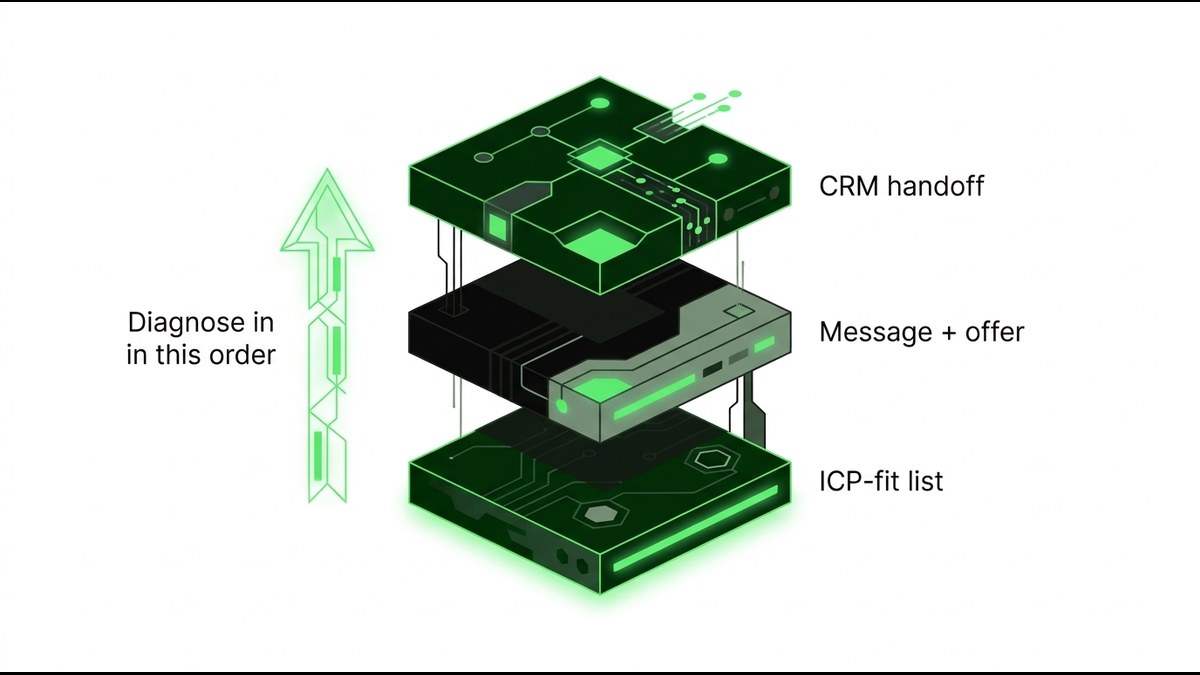
Diagnose a failing sequence in a fixed order. Check the list first: does it fit your ICP? Then check the offer and message. Then check the CRM handoff. Most teams start with the copy, which is the third thing to check.
The outbound function exists to create qualified pipeline, and the closer takes it from there. In practice that means disciplined targeting, qualifying against clear SQL criteria, passing meetings over cleanly, and adjusting the messaging from what the data says. A booked-meeting count means nothing if the buyer sits outside your ICP.
- Lead with the problem, don't assume it.. Surface an issue without asserting the buyer has it.
- Sell the system, not the service.. Offer ownership and structure, not a list of tasks.
- Talk outcomes, not features.. Tie the message to pipeline, revenue and predictability.
How long should a B2B outbound cadence be?
Long enough to earn a conversation, short enough to stay respectful. An outbound cadence B2B buyers tolerate is one where every touch adds something new. The cadence aims at a qualified conversation, not at volume. A nudge such as "just bumping this" adds nothing and trains buyers to ignore you.
A workable starting design looks like this:
Space the touches so the buyer has time to see each one. Add a LinkedIn touch between email steps when it fits. LinkedIn supports email in our work. It does not replace it.
Set the exit logic before you send. A reply, a booked meeting, an opt-out or a closed-won status stops the sequence everywhere. Without that rule, one prospect can receive three conflicting messages from three tools.
Cadence is also a discipline problem. If you send to accounts outside your ICP, a longer cadence only multiplies the waste. If you want a partner to own this design, a B2B email marketing agency can build it as a system.
- First touch:. the problem, framed as a question the buyer recognizes.
- Second touch:. a short proof point, such as a relevant case or system example.
- Third touch:. a different angle on the same pain, for example the cost of leaving it unsolved.
- Fourth touch:. a lightweight asset or insight the buyer can use without replying.
- Final touch:. a clear close-out that says you will stop, and why.
What goes into cold email templates B2B?
Good cold email templates B2B buyers answer share four parts. The template names a problem without asserting it. It ties that problem to an outcome the buyer cares about. It offers one proof point. It ends with a single, easy ask.
Here is how each part works:
Write for the system, not the service. Buyers do not want to hear about your tasks. They want to hear who owns the problem and how it stays fixed.
Personalization should be real. A mail-merged first name is not personalization. A line that references the buyer's motion, stage or role is. Build a short library of variants by persona and industry, and keep each variant tight. Our piece on B2B SaaS Email Marketing: Earning the Next Open shows how that thinking carries into follow-up messages.
A point of view helps too. A template that reflects a real stance on AI, SaaS or data trends in B2B tech reads like it came from a peer, not a mailing list.
- The problem line.. "Teams like yours often see..." beats "You have a problem with...". The first invites recognition. The second invites deletion.
- The outcome line.. Name pipeline, revenue or predictability. Skip the feature list.
- The proof point.. One case or system example, framed around structure. Do not stack three.
- The ask.. One question the buyer can answer in one line.
How do you multi-thread an outbound sequence?
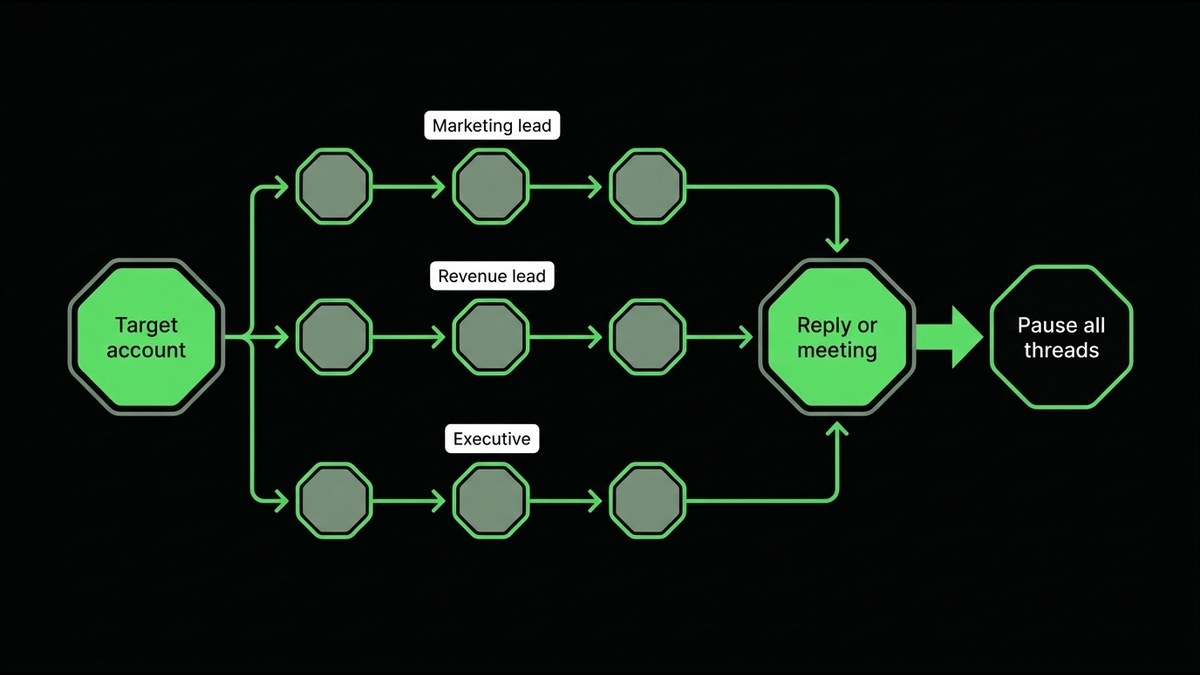
Multi-threading means reaching several people at one account, each with a message that fits their role. It is where outbound email sequences B2B teams run most often break. In a typical buying group, the marketing leader, the revenue leader and an executive all weigh in. A single generic email addressed to all three fits none of them.
Build separate sequences for each role at the same account. Each uses that role's pain and language. Marketing leadership cares about conversion drag and attribution. Revenue leadership cares about pipeline volatility and handoff. Executives care about predictability and ownership.
Then coordinate the threads. No account should receive conflicting pitches. One rule set should govern who is contacted, in which order, and what happens when any one person replies. Your email sequence software needs account-level suppression for this to work.
Keep the stack simple. Email is the main volume driver in our outbound channel mix. Persona- and industry-specific sequences matter more than the count of sends. Enrichment helps you personalize at scale, but only after the ICP filter has already done its job.
Three habits keep multi-threading clean:
- Start with the role most likely to own the pain, then add others.
- Reference the same underlying problem in each thread, in different words.
- Pause all threads the moment one person books a meeting.
How do you know a sequence is working?
Judge outbound email sequences B2B teams ship by replies, meetings and qualified pipeline. Open rate is a noisy, lagging signal. Privacy features in mail clients distort it, and a high open rate tells you nothing about buyer intent.
Track these in order:
Count only meetings with ICP-fit buyers toward results. Review sequences on a weekly rhythm, and let that review govern channel and offer decisions. If a step underperforms, change the message or the offer. If the whole sequence underperforms, look at the list.
Benchmark against your own baseline first. Industry figures vary by list, offer and sender health, so treat them as a rough reference, not a target. Track LinkedIn's contribution to booked meetings too, so the channel mix is judged on outcomes.
Attribution needs plumbing. Every reply and meeting should write back to the CRM with the sequence, step and persona attached. Without that, you cannot say which message drove pipeline. CRM workflow automation can handle that logging and the suppression rules that stop sequences when a deal moves.
- Reply rate by step.. It shows where the message stops earning attention.
- Positive reply rate.. Classify replies as interested, not now, wrong person or opt-out.
- Meeting-booked rate.. This is the first real conversion.
- SQL rate and time to SQL.. This is where ICP fit shows up.
Is done-for-you cold email worth it?
It is worth it only when the ICP and offer are already clear. An agency cannot fix an undefined ICP. It can only send to a bad list faster. Founders who still run outbound themselves often hope outsourcing will solve the pipeline problem. Usually the problem is upstream, in go-to-market architecture.
Before you hire anyone, check four things:
If those answers are clear, a partner can add real speed. A B2B marketing automation agency can build the sequencing, suppression and reporting layer so your team focuses on conversations. If the answers are unclear, fix the diagnosis first. Doing the wrong sequence fast is the most expensive mistake in outbound.
- ICP discipline.. Does the provider enforce your ICP aggressively, or will it count any booked meeting as a win?
- Handoff.. A clean CRM handoff matters as much as the send. A meeting without notes and next steps is a lost meeting.
- Measurement.. Do you get step-level reply data and meeting outcomes, or just a send count?
- Ownership.. Who owns the system after the first quarter: you, or the vendor?
Your next step
Sequence conversion is a systems problem, not a copywriting problem. Outbound email sequences B2B buyers respond to are built from the list up, not written from a template.
Audit your current sequence against the three layers: list fit, message and offer, handoff. Fix the earliest failing layer before you touch the rest.
- ✓ Audit list fit, then message, then handoff, before touching copy.
- ✓ Length matters less than whether each touch adds new information and the sequence has a defined exit.
- ✓ A strong template names a problem, ties it to an outcome, offers one proof point and asks for one small thing.
- ✓ Run role-specific sequences per account, and coordinate them so the buyer hears one consistent story.
- ✓ Judge sequences by ICP-fit meetings and pipeline, reviewed weekly, with every step tied back to the CRM.
FAQ
What are outbound email sequences in B2B?+
Outbound email sequences in B2B are planned series of messages sent to accounts that have not asked to hear from you. They work best when treated as infrastructure rather than one-off campaigns, with a clear ICP, a defined message and a clean handoff to sales.
How long should a B2B outbound cadence be?+
A B2B outbound cadence should be long enough to earn a conversation and short enough to stay respectful. A workable design uses about five touches: the problem, a proof point, a different angle, a useful asset, and a close-out. Every touch should add something new, and the sequence should stop on a reply, booked meeting, opt-out or closed-won status.
What goes into a good B2B cold email template?+
A good B2B cold email template has four parts: a problem named without being asserted, an outcome the buyer cares about such as pipeline or predictability, one proof point, and a single easy ask. Personalization should reference the buyer's motion, stage or role, not just a merged first name.
How do you multi-thread an outbound email sequence?+
Multi-threading means running separate, role-specific sequences to several people at the same account, such as the marketing leader, revenue leader and an executive. Coordinate the threads with account-level suppression so no account gets conflicting pitches, and pause all threads when one person books a meeting.
How do you know if an outbound email sequence is working?+
Judge a sequence by replies, meetings and qualified pipeline, not open rate. Track reply rate by step, positive reply rate, meeting-booked rate, and SQL rate with time to SQL. Count only meetings with ICP-fit buyers, and write every reply and meeting back to the CRM with sequence, step and persona attached.
Is done-for-you cold email worth it?+
Done-for-you cold email is worth it only when your ICP and offer are already clear. An agency cannot fix an undefined ICP and will only send to a bad list faster. Before hiring, check ICP discipline, handoff quality, step-level measurement, and who owns the system after the first quarter.