
CRM data quality governance is the set of rules, owners, and checks that keep CRM records accurate, complete, and consistent so forecasts hold up. It assigns each field an owner, defines each deal stage with entry and exit criteria, blocks bad data at entry, and reviews health on a fixed cadence.
Your pipeline review should not be a reconciliation exercise. In many Sales Ops teams, every weekly call starts the same way. Someone checks which fields are empty, which stages are wrong and which deals are real.
The CRO stops trusting the forecast. RevOps spends its hours cleaning instead of improving the system.
Tool sprawl makes this worse, and it is really an ownership problem. Here we lay out the CRM data quality governance process we use to fix the root cause. This data governance process has four controls: owners, stage rules, entry checks and a health scorecard.
What is CRM data quality governance?
It is the operating model that keeps CRM data trustworthy: named owners, agreed definitions, entry controls and a review cadence. It is different from a one-time cleanup. Cleanup fixes today's records. Governance stops tomorrow's bad records from getting in.
In our work with RevOps teams, the pattern repeats. A cleanup project finishes. The records look good for a quarter. Then decay returns. The cause is rarely a missing tool. No one owns the field definitions, and no one owns the entry rules that keep new records accurate. Governance is an operating model, not a cleanup project.
We treat CRM optimization, data integrity and tech stack governance as one revenue-systems discipline. It is not an IT chore. The same logic runs through a step-by-step RevOps system framework, where data rules come before reporting and automation.
A plain-English split helps here. Data quality asks whether a single record is right. Data integrity asks whether the whole set holds together across stages, owners and systems. You need both. A perfectly typed record in the wrong stage still breaks the forecast.
A CRM nobody trusts is a liability. Trust comes from structure, not from another round of cleanup.
Who should own CRM data quality?
Sales Ops owns the data governance process: the rules, the checks and the escalation. Reps own the accuracy of their own records. Leadership owns the final say on definitions. Sales Ops owns process integrity, not the revenue number.
That split removes a common accountability trap. If Sales Ops is blamed for every missed forecast, it will try to police behavior by hand. That does not scale. It also answers the objection we hear most: "I can't force reps to fill in fields." You don't force them. Effective CRM data quality governance moves enforcement into rules, required fields and a fixed review rhythm.
A simple ownership model has three roles:
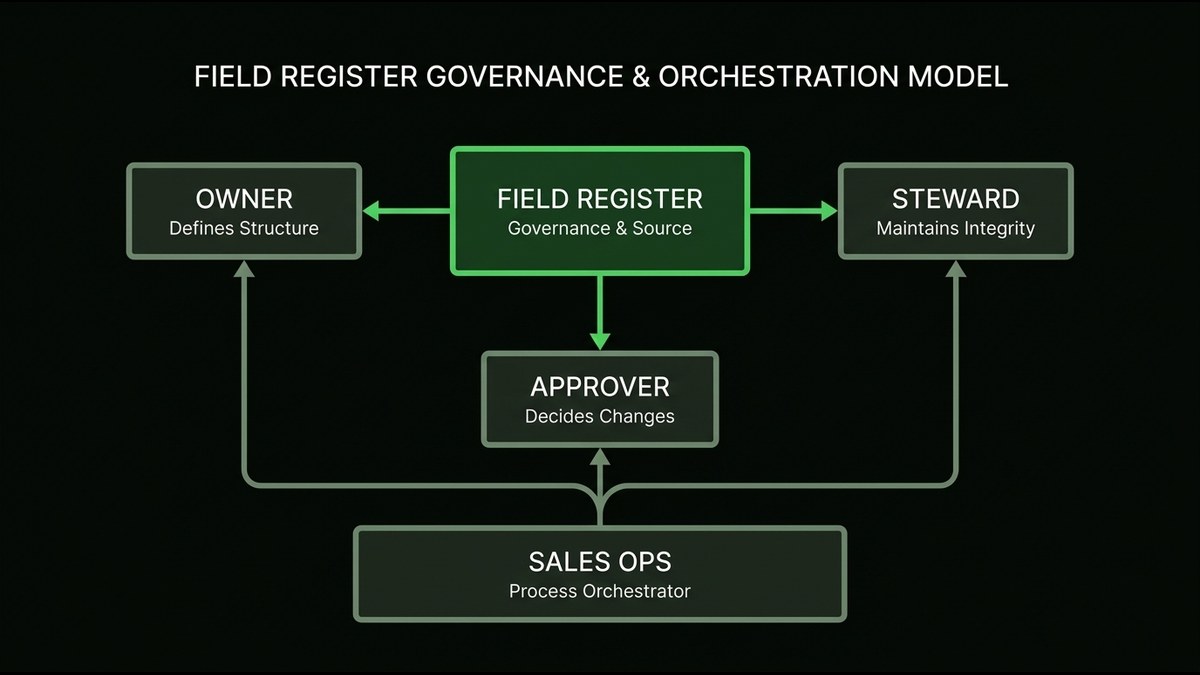
- Owner. Decides what a field or metric means and who may change it.
- Steward. Maintains the field day to day, fixes exceptions and flags drift.
- Approver. Leadership, with the final decision on definition changes.
Keep a field-level register
Every important field gets a named owner, a steward and a plain definition. This is where Marketing and Sales definitions collide, for example on what counts as a qualified lead. Set a time-bound escalation path so a dispute reaches a decision instead of stalling reports.
Sales Ops is the neutral orchestrator of the system, not the owner of all data.
How do deal stage rules protect pipeline integrity?
Each stage needs entry criteria, exit criteria and a maximum time in stage. A deal that breaks those limits gets requalified, repositioned or closed-lost. Without these rules, stages become opinions, and pipeline integrity erodes quietly.
Think about what happens without limits. One rep moves a deal to "proposal" after a good call. Another waits until the contract is drafted. Both are reasonable. Together they make the stage meaningless, and every report built on it becomes arguable.
Good stage rules fix this in three moves:
- Entry criteria. What must be true before a deal can enter the stage.
- Exit criteria. What must be true before it can leave.
- Time-in-stage limit. How long a deal may sit before someone reviews it.
What happens to deals that run past the limit?
Deals that run past the limit do not get left to drift. They are checked again against the entry criteria, given a new next step, or closed-lost on purpose. Closing a dead deal is a healthy act. It keeps the pipeline honest.
Treat an inflated pipeline as a warning sign, not a reporting quirk. When coverage looks high but stages are aging, the number is telling you something about the system. Pipeline coverage is not the same as pipeline health.
Stage rules turn a pipeline from a collection of opinions into a set of testable claims.
Stop bad CRM data at entry
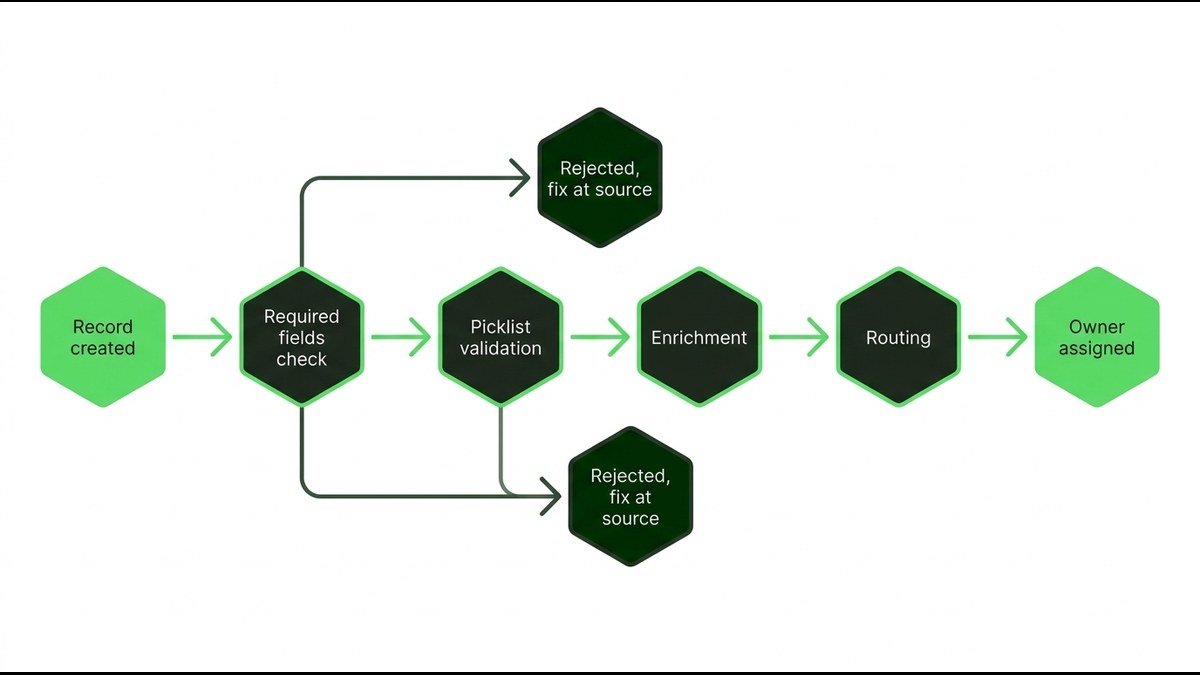
Prevent bad data at the point of creation. Use required fields, standardized picklists, automated enrichment and routing rules. Fixing records after the fact is the most expensive and least durable option.
Cleanup costs more than prevention because someone has to work out what the record should have said. By then the rep has forgotten the context. Entry controls capture it while it is fresh.
Attribution and ownership belong in the same category. Set them when a record is created, not later. Backdated attribution invites disputes, and split ownership leaves nobody accountable. Sales Ops should apply these rules without exceptions, because loose attribution quietly corrupts every report downstream.
Add a light daily habit on top of the automation. Each day, reps spend a few minutes keeping their own records current. It takes very little time. It also stops small gaps from piling up into a weekly reconciliation job.
Entry controls are the highest-leverage part of CRM data quality governance because they remove work instead of adding it.
How do you build forecast confidence?
Track a small set of health signals, each with an owner and a trend. If they hold over several quarters, forecast confidence follows. The signals are:
Each metric needs three things: a baseline, a target reviewed on a fixed cadence, and a named owner. Without a baseline you cannot tell whether things are improving. Without an owner, the number is nobody's job. We avoid generic targets here, because the right level depends on your sales cycle and your starting point. Set it from your own baseline, then review it on a schedule.
Add a few governance measures alongside the data ones. Examples include the exception backlog, how fast stewards resolve issues, and the share of key fields with a documented definition. These show whether the governance itself is working, not just the records.
The scorecard only helps if people see it. Put it in front of leadership on a regular rhythm, ideally in the same view as pipeline. Dashboards that unify marketing and pipeline data make that possible without a separate reporting project, and give RevOps teams one source of truth.
When the scorecard is stable, the forecast stops being an estimate defended in a meeting. It becomes the truth about the pipeline.
- Record completeness
- Forecast accuracy
- Rule compliance
- Stage aging
- Attribution accuracy
What should Sales Ops do next?
Start with four controls: named owners, deal stage rules, entry checks and a health scorecard. Missing any one of them lets decay back in. Owners without entry checks still collect bad records. Entry checks without stage rules still produce an inflated pipeline. That is why CRM data quality governance only works as a full system.
Then decide whether to build this in-house or with a partner. Building in-house works when you have the time and a neutral voice to settle definition disputes. A partner helps when the team is already stretched on weekly reconciliation. Either way, diagnose before you deliver. The most expensive mistake is building the wrong system quickly.
That is why our Fixed-Price Systems entry offer starts with diagnosis. If your forecast still depends on weekly reconciliation, a strategy call is where we find which of the four controls is missing.
- ✓ Governance is an operating model, not a cleanup project: cleanup fixes today's records, governance stops tomorrow's bad data.
- ✓ Sales Ops owns process integrity, reps own their own records, and leadership owns final definitions.
- ✓ Every deal stage needs entry criteria, exit criteria and a time-in-stage limit.
- ✓ Prevent bad data at entry with required fields, picklists, enrichment and routing rules.
- ✓ Owners, stage rules, entry checks and a health scorecard only work together as a full system.
FAQ
What is the difference between CRM data cleanup and CRM data governance?+
Cleanup fixes the records that are wrong today. Governance is the operating model of named owners, agreed definitions, entry controls and a review cadence that stops bad records from getting in. Without governance, decay usually returns within a quarter or so after a cleanup.
Who should own CRM data quality?+
Sales Ops owns the governance process: the rules, the checks and the escalation. Reps own the accuracy of their own records, and leadership has the final say on definitions. Sales Ops owns process integrity, not the revenue number.
How do you get reps to keep CRM data accurate if you can't force them?+
You move enforcement into the system instead of relying on persuasion. Required fields, standardized picklists, automated enrichment, routing rules and a fixed review rhythm make accurate entry the default. A short daily habit of updating their own records keeps small gaps from piling up.
What should deal stage rules include?+
Each deal stage needs entry criteria, exit criteria and a maximum time in stage. A deal that exceeds the limit is rechecked against the entry criteria, given a new next step, or closed-lost on purpose.
Which metrics belong on a CRM data health scorecard?+
Track record completeness, forecast accuracy, rule compliance, stage aging and attribution accuracy. Each needs a baseline, a target reviewed on a fixed cadence and a named owner. Governance measures such as exception backlog and steward resolution speed show whether the governance itself is working.
Should we build CRM governance in-house or with a partner?+
In-house works when you have the time and a neutral voice to settle definition disputes. A partner helps when the team is already stretched on weekly reconciliation. Either way, diagnose which controls are missing before building anything.