
CRM stage definitions align sales and marketing when every stage has written entry criteria, exit criteria, and a named owner, and both teams agree on them. Define lifecycle stages (marketing's handoff) separately from deal stages (sales' progression), tie each to observable buyer evidence, and enforce them with required CRM fields and time-in-stage limits.
Your teams don't disagree about leads. They disagree about what a stage means. Marketing doesn't have a lead generation problem. Most companies have an operations problem. You can see the symptoms in the CRM: duplicate contacts pile up, deal stages mean different things to different reps, and marketing and sales workflows don't connect. Then leadership asks for a pipeline report and nobody can defend it.
A CRM nobody trusts is worse than no CRM. With no CRM, nobody pretends the numbers are right. Fixing it often starts with CRM architecture configured to your funnel, but architecture only helps when the stages inside it mean something. Defining the stages is the part most rebuilds skip, which is why this work belongs in operations, not in a campaign brief.
The author's seat is B2B paid media, with four years across PPC, tracking and reporting insights, and the tracking foundations behind campaign execution. From that seat, one question matters more than any click-through rate: is a lead in the campaign report the same thing sales counts in the pipeline? When stage definitions are vague, it isn't. The campaign gets blamed, but the real culprit is a missing contract. This guide gives you the governance system to fix it: how to write stage definitions, separate lifecycle from deal stages, set entry and exit criteria, handle stalled deals, and make the CRM enforce all of it.
Why does misalignment start in stage definitions?
Ask marketing and sales to define a "qualified" lead and you will get two answers. Marketing says qualified means the contact fits the target profile and took a meaningful action. Sales says qualified means a buyer with budget who will take a call this week. Both teams are right by their own definition, and neither definition is written where both can see it. So the argument looks like a people problem. It is a missing contract.
The cost is concrete:
- Marketing produces content and campaigns, then counts the leads it delivered.
- Sales dismisses those leads as unqualified.
- Budget goes to volume nobody wants.
- Pipeline contribution gets disputed in every leadership meeting.
How do stage definitions align sales and marketing?
CRM stage definitions are written rules for when a contact or deal enters and leaves each stage. They align sales and marketing by replacing opinion ("that lead is junk") with shared, checkable criteria, so both teams measure the same handoff and the same pipeline.
Think of a stage definition as a contract between two teams. Most CRMs only hold a label: "MQL," "Discovery," "Proposal." A label tells you where a record sits. A contract tells you why it is there, who put it there, what must happen next and how long it may stay. Most guides treat stages as a taxonomy. A taxonomy describes, while a contract binds.
Good stage definitions rest on three parts for every stage:
- An entrance rule. What must be true to get in.
- An exit rule. What must be true to leave.
- A clock. How long a record may stay before someone has to make a decision.
Funnel, pipeline and adoption
Add a named owner and you have a stage nobody can quietly reinterpret.
One distinction first, since many guides lead with it. A funnel is buyer-centric: it tracks how a person moves from first awareness to purchase. A pipeline is seller-centric: it tracks deals, values and rep activity. Your CRM needs both views, and the definitions must connect them. Shared definitions, a clean handoff and a single pipeline view are what tie the two together.
Good definitions also fix adoption. CRM adoption failure is rarely laziness. Reps skip updates when a stage is vague, because they cannot tell what "done" means. They also skip them when the update feels like admin nobody reads. Clear criteria turn the update into a quick fact check instead of a judgment call, and workflows can then handle the rest.
Every definition also needs a guardian. Whoever runs sales operations guards the deal process, Marketing Ops guards the lead side, and RevOps guards the architecture. Ownership is covered in the enforcement section below.
What separates lifecycle stages from deal stages?
Lifecycle stages describe a person or account's relationship with you, from subscriber to customer. Deal stages describe a specific sales opportunity's progress. Marketing mostly owns the first set and sales owns the second. The handoff between them is where misalignment lives.
The two sets are easy to blur because they sound alike. A contact can be a "customer" in one property while an open deal sits at "Discovery" on another record. In a platform like HubSpot, for example, lifecycle stage is a contact property and deal stage lives on the deal. Other CRMs split it differently, so check how your own is configured. Here is how the two differ:
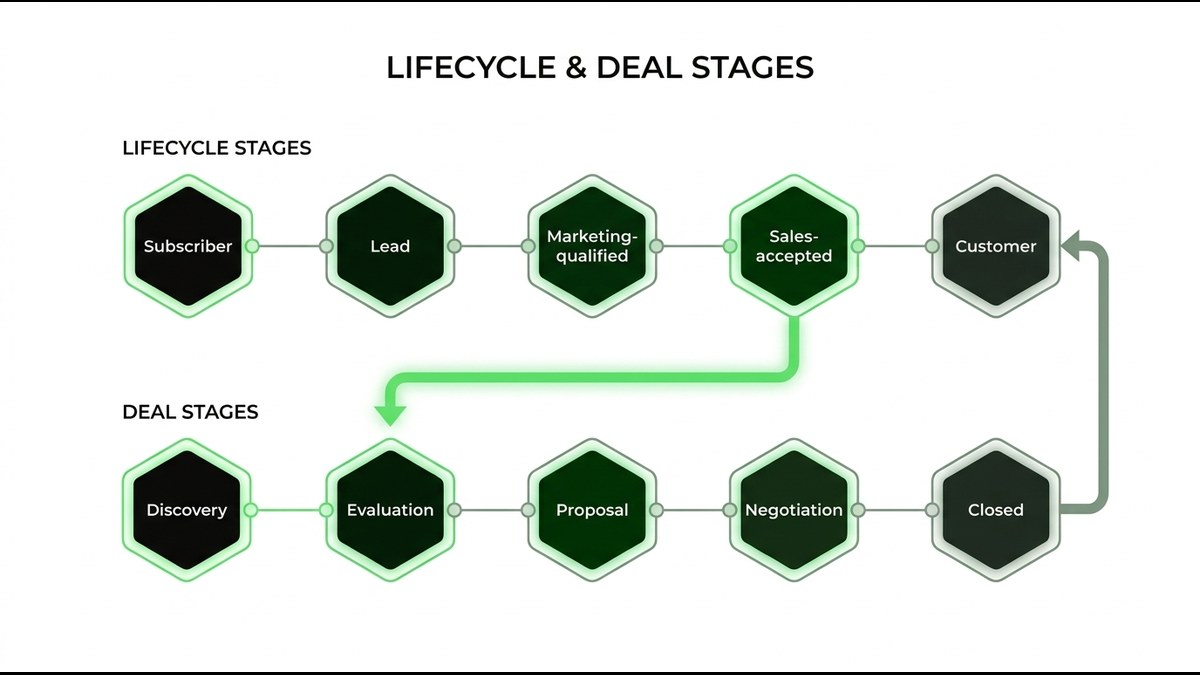
- Owner. Lifecycle stages belong to Marketing Ops, with sales agreeing to the handoff. Deal stages belong to sales, with sales operations guarding the rules.
- Object it applies to. Lifecycle stages sit on a contact or company record. Deal stages sit on one opportunity record, and an account can have several.
- What moves it. Lifecycle stages move on fit evidence and buyer behavior, often through automation. Deal stages move on confirmed buyer commitments from real conversations.
- Where the handoff happens. The last lifecycle stage before sales (sales-accepted) creates the first deal stage. That moment needs a named owner and a response clock.
- Typical failure. Lifecycle stages get set by form fills, so records jump ahead or stall. Deal stages get set by rep optimism, and nothing maps back to the lifecycle.
Wiring the handoff between the two sets
The usual symptoms of a broken split are unmapped deal stages and disconnected workflows. A closed-won deal should flip the lifecycle stage to customer. A lost deal should send the contact back to nurture. If neither happens, you have two disconnected systems. How RevOps and Marketing Ops split ownership matters here, because the handoff lives in the gap between the two roles.
This split is the heart of stage alignment, and it is a growth-system question, not a departmental one. SEO, PPC, RevOps, automation and CRO shouldn't run as separate departments. They are one growth system, and stages are its shared spine. Integrate RevOps in your CRM so you can see the full customer lifecycle from prospecting to post-sale. Every channel's contribution then traces to a deal.
The payoff is visible from the paid media side. Tracking can only report what the stages let it report. Clean handoff stages mean a LinkedIn or paid search lead can be followed to a closed deal, not just to a form fill.
What should entry and exit criteria look like?
Each stage needs entry criteria (what must be true to get in), exit criteria (what must be true to leave), and a maximum time-in-stage. Criteria must be observable buyer actions or confirmed facts, not rep opinion, so two people reading the same record reach the same conclusion.
Use one template for every set of pipeline stage criteria: entry, exit, maximum time-in-stage, owner. That is four fields. If you cannot fill all four, the stage is not defined yet.
This is where the "poster on the wall" problem starts. Agreement is free, and a workshop gets everyone nodding. The work is changing the definitions inside the CRM and enforcing them afterward.
Qualification frameworks give you raw material. BANT (budget, authority, need, timing) is a reliable starting point for most B2B deals. Complex enterprise sales often extend it with frameworks like MEDDIC. Treat them as input to your exit criteria, not a replacement for them.
Handoff stages: lead to marketing-qualified to sales-accepted
Marketing teams often measure activity instead of business outcomes, and criteria drift the same way. Criteria should be buyer evidence, not activity counts. Three email opens are not evidence. A buyer asking about implementation timing is.
It is the same rule applied to paid media: strategy must focus on tracking, reporting insights, and true buying intent rather than vanity metrics. Stage criteria are where that principle lives inside the CRM.
- Lead. Entry: a record with a valid contact and company, deduplicated. Exit: checked against the written ICP. Owner: Marketing Ops.
- Marketing-qualified. Entry: fits the ICP and showed intent through an observable action, such as a demo request, a revisit to pricing, or a reply to outreach. Exit: routed to a named rep with the behavior history attached. The clock is a response window agreed with sales.
- Sales-accepted. Entry: a rep reviews the record and either accepts it or rejects it with a reason from a picklist. Exit: a first conversation is held, and either a deal is created or the contact is recycled.
Deal stages: discovery through closed
Set every clock from your own history, not from a blog post. Use the typical time your won deals spend in each stage, plus a tolerance.
- Discovery. Entry: a held conversation with a sales-accepted contact. Exit: the buyer has confirmed the problem and its cost in their own words, and named who else decides.
- Evaluation. Entry: the decision group is identified. Exit: the buyer has shared success criteria and a budget range, and named the alternative, including doing nothing.
- Proposal. Entry: success criteria are agreed. Exit: the written proposal has been reviewed with the decision-maker present.
- Negotiation. Entry: the buyer has confirmed they intend to buy. Exit: the decision process, approvers and target date are documented.
- Closed. Won requires a signed order. Lost requires a reason from a controlled picklist.
Good versus bad criteria: a worked example
Take the Evaluation stage, and compare two ways to write its exit.
Run one test on every criterion: could someone open the record and verify the exit without asking the rep? If not, rewrite it.
- Bad. "Prospect seems interested and the champion likes us." That is opinion. Two people can read the record and disagree.
- Good. "Buyer shared written success criteria, named the budget holder, and booked a technical review." That is observable. Anyone can verify it.
How to align messaging when positioning is unclear?
Start from the stage definitions, not a messaging workshop. Define who qualifies as ICP and what a buyer must have said or done at each stage. Then audit which claims actually move deals forward. Messaging gaps show up as stalled stages and rejected leads, which tell you what positioning must fix.
Messaging fixes follow stage definitions, not the other way round. If your ICP is not written down, your stages cannot be. Every fit criterion in your pipeline should point back to one definition of who you sell to. Without it, marketing targets one buyer, sales chases another, and the positioning debate is really a customer debate. Settle the customer definition before you argue about the message.
Buyers also tend to research on their own before they speak to anyone, so your message gets judged before a rep is in the room. That makes your rejection and stall data the fastest honest feedback on positioning. Give every rejected lead and every stalled deal a reason, then group the reasons:
- Wrong fit. The lead sat outside the ICP. Fix targeting and the marketing-qualified criteria, not the copy.
- Right fit, wrong problem. The buyer did not recognize the problem you described. Fix the positioning.
- Right problem, no urgency. Your message names the pain but not the cost of waiting. Fix the offer and the proof.
- Stalls at evaluation. Buyers cannot justify choosing you. Fix comparisons, case material and sales enablement.
Deal progression: time-in-stage, regression, closed-lost rules
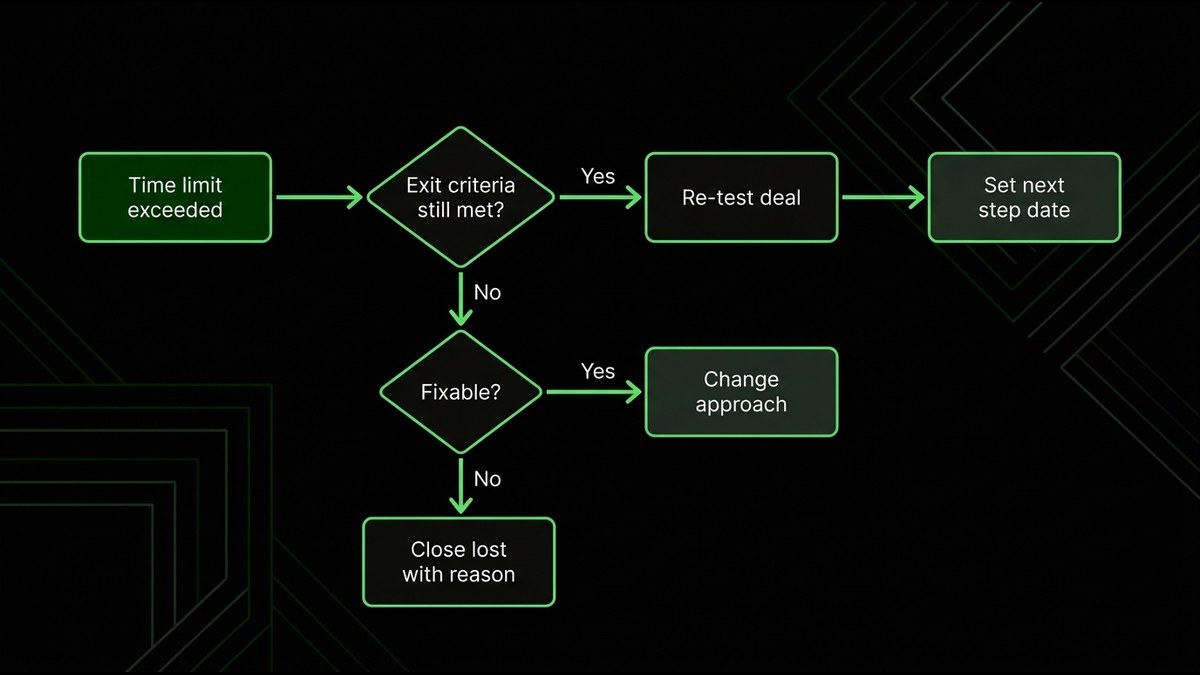
Definitions fail at the edges, so write the deal progression logic for them. A deal that outstays its stage limit gets a decision, not a shrug. There are three honest options: re-test whether the deal is still real, change the approach, or close it on purpose. Drifting is not an option.
Pipeline inflation is a risk signal, not a vanity number. A big pipeline full of aged deals tells you the forecast is soft. Treat the growth of aged deals as an alert, and the forecast gets honest faster. Build these edge rules into the CRM so they run without anyone policing them.
Regression needs rules too. Deals can move backward, but only with a reason. A backward move is information: maybe a new stakeholder appeared, or the buyer's priorities changed. Make the reason a required picklist field, log it, and review the patterns. Silent regression hides a broken stage definition.
Closed-lost reasons should be a controlled picklist, not free text. Free text gives you a hundred spellings of "price." A picklist gives you a pattern. That pattern feeds the messaging diagnostic described above and shows where the qualification rules let weak deals in.
Run pipeline reviews as decision meetings, not status updates. The agenda is short:
- Review open deals by stage.
- Check ICP fit and close probability.
- Name the stalled deals and the channel gaps.
- Leave with a decision on each flagged deal.
Why decision meetings matter
If nobody decides anything, you held a status meeting. The outcome you are buying is forecast accuracy, because a forecast built on enforced stages can be defended.
How do you make reps follow stage definitions?
Make the CRM do the enforcing: required fields on stage change, exit-criteria checklists, time-in-stage alerts, and pipeline reviews run as decision meetings. Assign sales operations ownership of process integrity. Reps follow definitions that reduce their admin load and that leadership actually uses.
Enforcement is where stage alignment survives or dies. You have heard the objection: "We already have stage definitions in a slide deck. Reps ignore them." A definition without enforcement is a poster. The second objection is "I can't force sales to change." You don't have to. You make the right behavior the easiest one, and you get a sponsor in the revenue leader's seat. Companies often buy software to solve problems that are actually operational, and a new CRM instance will not fix stages nobody agreed on.
Build enforcement into five mechanisms:
- Required fields. A stage change cannot save without the evidence its exit criteria demand.
- Exit checklists. The rep ticks verifiable items, which doubles as a deal summary for the next person.
- Time-in-stage alerts. The clock fires before the pipeline review, so the conversation is about decisions, not discovery.
- Workflow automation. Fill in what the system can know (source, dates, owner changes) so reps only enter what only they know. Every field you automate gives reps time back for selling.
- Decision-meeting reviews. Reps learn fast that the CRM matters when the leadership meeting runs from it.
Ownership and data decay
Ownership keeps it all alive. Sales operations owns process integrity, meaning the accuracy of the process, not the revenue outcome. Marketing Ops owns the lifecycle and lead side. RevOps owns the architecture and the shared view across both. When all three roles sit with one person or nobody, enforcement quietly decays. Build this as RevOps infrastructure your team owns, so the system outlasts any engagement.
Data decay is the other reason enforcement is continuous, not a one-off cleanup. CRM data goes stale on its own as contacts change jobs and records duplicate. Stage rules that run every day are the only defense.
How do you know the definitions work?
Look at four signals. Stage-to-stage conversion is stable and explainable. Few deals age past their stage limit. Forecast variance shrinks over time. Fewer disputes break out about lead quality. If reps still argue about what a stage means, the definition is not working.
Those signals map to operational metrics you can track:
- CRM completeness. The share of records carrying the fields your criteria require.
- Forecast accuracy. How close the forecast lands to the actual close.
- Stage aging. How many open deals sit past their stage limit.
- SLA compliance. How often the handoff response windows are met.
- Attribution accuracy. How reliably each deal traces to its source.
Baselines, visibility and attribution
Do not borrow thresholds from other companies. Pull your baseline for each metric first, then set targets from your own history and tighten them quarter by quarter. A target with no baseline is a guess with a number on it.
Then make it visible. Reporting insights should simplify complex data into practical, visual takeaways. Give each signal one chart, one owner and one question it answers. If a leader needs a walkthrough to read it, simplify it. Clean stages also make reporting trustworthy. When every stage means one thing, conversion rates compare across periods and teams. That is the foundation for dashboards leaders actually trust, and it is the difference between a report people read and a report people argue with.
It also makes attribution meaningful. Attribution is not about giving credit. It is about making better investment decisions. If stage data is dirty, no model can tell you which channel produces deals worth closing. With clean stages, multi-touch attribution models show which spend feeds real pipeline, not just lead counts.
What to do this week
Stage definitions come down to one idea: they are a contract, and contracts need ownership, criteria and enforcement. A new tool or a new campaign will not replace that. Diagnosis before delivery: find out which of your stages are labels and which are contracts before you build anything.
Start this week with this checklist:
- List every deal and lifecycle stage you have, and mark which ones lack written entry or exit criteria.
- Write all four template fields for the stage where the most disputes happen.
- Add a required rejection-reason picklist at the sales-accepted step.
- Pull a baseline for CRM completeness, stage aging and forecast variance.
- Name one guardian per stage group: sales operations, Marketing Ops and RevOps.
- ✓ The lead-quality fight is a definitions failure, so fix the definitions before you blame anyone.
- ✓ A stage is a contract with an entrance rule, an exit rule, a clock and an owner, not a label.
- ✓ Define lifecycle and deal stages separately, then wire the handoff between them so one story runs from first touch to renewal.
- ✓ Write every criterion as buyer evidence a stranger could verify from the record, and enforce it through the CRM and the review cadence.
- ✓ Judge your definitions by fewer disputes, tighter forecasts and less stage aging against your own baseline.
FAQ
What are CRM stage definitions?+
CRM stage definitions are written rules for when a contact or deal enters and leaves each stage. Each stage should have entry criteria, exit criteria, a maximum time-in-stage and a named owner, so sales and marketing measure the same handoff and the same pipeline.
What is the difference between lifecycle stages and deal stages?+
Lifecycle stages describe a person or account's relationship with your company, from subscriber to customer, and are mostly owned by marketing. Deal stages describe the progress of one specific sales opportunity and are owned by sales. The handoff between the two, usually the sales-accepted step, is where misalignment tends to happen.
What should entry and exit criteria include?+
Entry criteria state what must be true for a record to enter a stage, and exit criteria state what must be true to leave it. Both should be observable buyer actions or confirmed facts, such as shared written success criteria or a named budget holder, rather than rep opinion or activity counts like email opens.
How do you get sales reps to follow stage definitions?+
Make the CRM enforce them. Use required fields on stage change, exit-criteria checklists, time-in-stage alerts and workflow automation for data the system can know. Run pipeline reviews as decision meetings from the CRM, and assign sales operations ownership of process integrity.
How do you know if your stage definitions are working?+
Look for stable and explainable stage-to-stage conversion, few deals aging past their stage limit, shrinking forecast variance and fewer disputes about lead quality. Track CRM completeness, forecast accuracy, stage aging, SLA compliance and attribution accuracy against a baseline from your own history.
Sources
- [1]Complex enterprise sales often extend BANT with frameworks like MEDDIC. Forrester, Forrester B2B research, 2026.