
An ideal customer profile for outbound sales is a short, written list of observable account traits (industry, size, tech stack, buying trigger, and a confirmed pain) that predict a closed-won deal. Reps use it to decide which accounts to contact, which to tier lower, and which to decline before any outreach begins. A full pipeline that does not convert is a targeting problem, not a volume problem.
A full pipeline that does not convert is a targeting problem, not a volume problem, and the fix starts with a sharper ideal customer profile. Most teams already have an ICP document. The problem is that few reps can use it on a live account, and fewer managers can tell whether it still describes who they win.
If you own the revenue number, you feel the gap as a forecast that swings and a mid-funnel that stalls, long before anyone questions the profile. This guide treats ideal customer profile outbound sales work as a diagnostic. It runs a customer profile audit in five steps: spot drift, rebuild criteria from deal history, tier accounts, separate fit from qualification, and measure the result.
If you are repairing a scalable outbound engine, the ICP is the first part to get right. Every list, sequence and routing rule sits on top of it. Each section ends with a short "Check" list of yes/no questions. Hand it to your sales ops lead and compare answers.
What is an ideal customer profile for outbound sales?
An ICP for outbound is a documented set of account traits that predict a good fit: industry, size, tech stack, and triggers. It replaces gut-feel targeting, so outbound spend goes to accounts worth pursuing and away from those that will never convert.
Outbound is less forgiving than inbound. In inbound, the market picks you, and a vague profile gets corrected by who shows up. In outbound, you pick the account. Every bad choice costs a rep's time directly, and nothing in the system pushes back until the quarter's numbers do.
That is why the ICP is not a marketing artifact. It is an input to the whole revenue system. When the profile is vague, each channel guesses differently, and you pay for several sets of guesses. At Effiqs, we build ICP definition inside our Demand Gen work as the targeting foundation. The profile feeds B2B lead generation, sets the account criteria behind account-based marketing, and directs paid social audiences. It compounds through Growth Operations as closed-won data sharpens it, and a free audit is the usual place to start.
Here is my stance on how to judge it. Any ideal customer profile outbound sales program should be judged by tracking, reporting and true buying intent, not by vanity metrics. Contacts reached, emails opened and replies logged tell you that activity happened. They do not tell you the account was worth the activity. In paid media the same trap shows up as cheap clicks from an audience nobody should have targeted. An ICP earns its place only when you can see, in the CRM, whether the accounts it selected turned into pipeline.
Two distinctions keep the terms clean:
- ICP versus persona. Build the ICP first. Personas describe the people inside the companies the ICP defines, so they come second.
- ICP versus lead score. ICP fit is account-level and is judged before anyone has talked to you. Lead scoring is contact-level and reads behavior after contact.
- Check. Can a rep state your ICP in two sentences without opening a document?
- Check. Does it name industry, size, tech stack and a buying trigger?
- Check. Is it used to build outbound lists, not just to brief marketing?
- Check. Can you see ICP fit as a field on every account in the CRM?
How do you know your ICP has drifted?
Look for wide swings in deal size and sales cycle length, weak stage-to-stage conversion, friction between sales and marketing, and deals justified as "edge cases." If two or more show up, the profile no longer describes who you actually win.
Drift is quiet. An ICP built from customers you won three years ago describes a product and a market that have both moved since. Nobody decides to ignore it. Reps just keep finding deals that do not look like the document, and the document stays unchanged.
I have spent four years in digital marketing across PPC, tracking and reporting insights. The pattern I see most often is that drift shows up in the reporting long before anyone names it. The numbers get harder to read, and the explanations get longer.
Here are the five symptoms, each with what you would see in the CRM:
- Wide swings in deal size. Closed-won amounts scatter with no pattern by segment. Forecasts rely on averages that no single deal resembles.
- Wide swings in cycle length. Similar-looking accounts take very different times to close. Reps cannot say why.
- Weak conversion between stages. Accounts enter the funnel in volume and stall at the same step. This suggests the entry criteria admit accounts that were never going to pass.
- Sales-marketing friction. Marketing says the leads match the profile. Sales says they do not. Both are right, because each describes the ideal customer differently.
- "Edge case" deals. Wins and pursuits are routinely justified as exceptions. When exceptions outnumber the rule, the rule is wrong.
What does drift mean for forecasts and alignment?
For a VP Sales, the first two symptoms are the forecast problem and the third is the mid-funnel problem. All three trace back to one document that no longer matches reality.
The fourth symptom deserves its own attention. When two teams hold two versions of the ideal customer, every campaign is misaligned from the start. Fixing that is less about a better document than about shared definitions and one owner. That work sits under sales and marketing alignment.
Drift is also one finding in a wider health review of your revenue system. If these symptoms show up alongside forecast gaps or messy attribution, run a wider RevOps review before changing the ICP alone.
- Check. Do deal size and cycle length vary widely within the same segment?
- Check. Does one funnel stage lose most of the accounts that enter it?
- Check. Do sales and marketing describe the ideal customer in different words?
- Check. Did reps close or pursue deals last quarter and call them "edge cases"?
Which ICP definition criteria come from deal history?
Start from closed-won and closed-lost deals, CRM firmographics, and sales interviews. Keep only the traits that separate wins from losses and that a rep can verify quickly. Drop anything that is only easy to filter on.
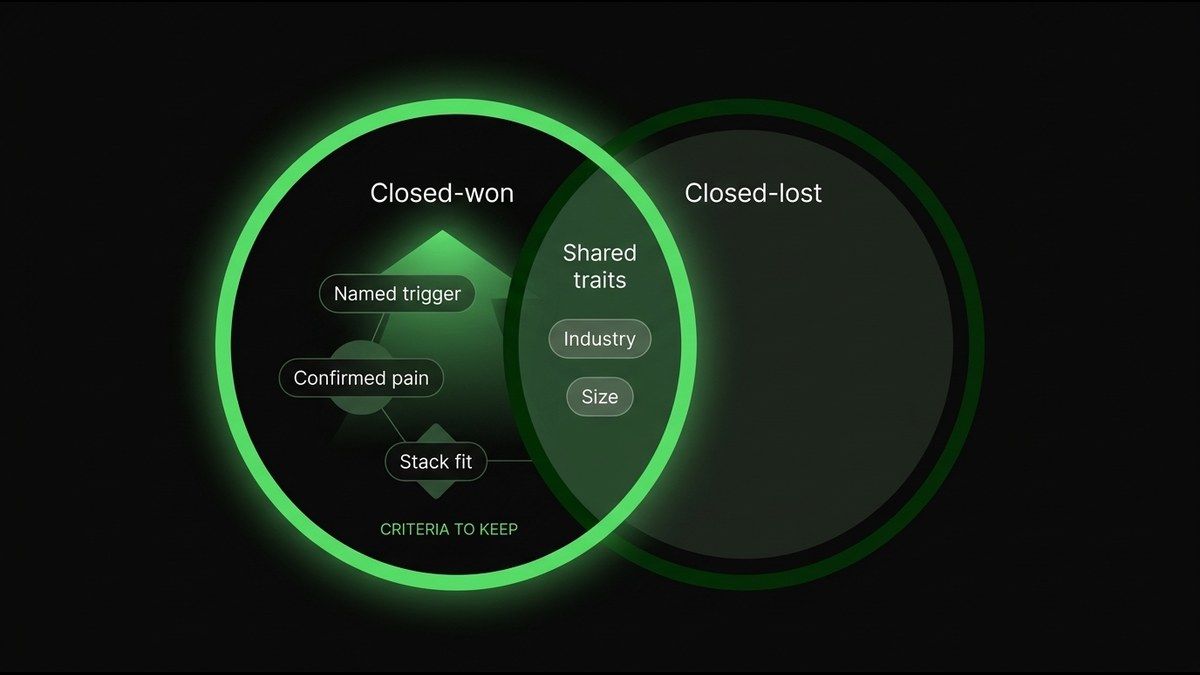
In our ICP work, we build the profile from closed-won and closed-lost history, CRM firmographics, and sales interviews. We use both sides of the ledger on purpose. A trait that appears in every win is not a predictor if it also appears in every loss. The useful ICP definition criteria are the ones that differ between the two groups.
Layer the evidence in four passes:
- Firmographics. Industry, company size and region from the CRM. These are the easiest fields to pull and the weakest predictors on their own.
- Tech stack. The tools in place that make your product easier to adopt or harder to displace. Record only what you can confirm.
- Pain. The specific problem the buyer named, in their words, in the deals you won.
- Trigger. The event that made the problem urgent: a new leader, a funding round, a failed rollout, a missed forecast.
How do you separate predictors from traits that describe everyone?
Picture two overlapping circles, one for closed-won deals and one for closed-lost deals. The overlap is the warning. Industry and size often sit there. They describe nearly everyone you talked to, so they filter lists but do not predict wins. Criteria that live only in the won circle are the ones worth keeping.
CRM fields will not hold everything. Interview the reps and ask what they notice in a winnable account that the data never captures. Typical answers are who sponsored the deal, how the buyer described the problem, and which accounts "felt wrong" early. Those notes become criteria once you turn them into something checkable. Do not set a minimum number of deals before you start. Work with the history you have and say plainly where it is thin.
Segment only on what would change the message. If two groups would hear the same pitch, they are one segment. That keeps the ICP small enough to run.
Finally, remember that accounts have more than one buyer. Once the account fit is settled, mapping the buyer journey and buying committee tells you who inside the account to approach and in what order.
- Check. Did you build the profile from lost deals as well as won ones?
- Check. Does each criterion appear more often in wins than in losses?
- Check. Has anyone interviewed reps for traits the CRM does not store?
- Check. Is any criterion on the list only because it is easy to filter?
How do you tier accounts for outbound?
Map each tier to two or three checkable attributes so any two reps place the same account in the same tier. Feed the tiers into routing and account planning, and decline the bottom tier outright instead of letting it linger.
This is the point where most ICPs fail. The document says "mid-market software company with a growth pain," and two reps read that sentence in two ways. A tier only works if it passes one test: two people looking at the same account reach the same tier. The same test applies to the whole profile.
Keep the criteria few and observable. For ideal customer profile outbound sales programs, two or three conditions that a rep can verify in a minute beat a fifteen-point scorecard that nobody completes. A common pattern is a point model with weighted categories and score bands. It looks rigorous, but it asks reps to fill in fields they do not have, so they guess, and the score stops meaning anything.
Here is an illustrative tier set, with each tier tied to attributes anyone can check. Treat it as a pattern, not a template. Your own deal history sets the attributes.
- Tier 1: pursue now. Industry on the list, tech stack confirmed, and a named trigger in the last few months. Gets senior rep time and tailored outreach.
- Tier 2: work steadily. Industry and stack match, but no trigger found yet. Gets lighter outreach and a periodic trigger check.
- Tier 3: decline. Fails the industry or stack condition. Does not enter a sequence.
How do triggers, routing and declining make tiers real?
The trigger condition does the timing work. The ICP says who is worth contacting. A trigger says when. Keeping the two apart stops a good account from being buried because it was quiet last month.
Then wire the tiers into the system. Routing sends Tier 1 accounts to the reps who can work them, and account planning gives them depth. In the CRM, scoring and routing configuration can carry the tier so the rules run without a spreadsheet.
The bottom tier is where the discipline lives. Decline it. Accounts that should be declined linger in pipeline as false hope, and they hide how thin the real pipeline is. If you never say no, the tiers are decoration.
- Check. Does each tier rest on two or three attributes a rep can verify in a minute?
- Check. Would two reps place the same account in the same tier?
- Check. Do the tiers drive routing and account planning?
- Check. Is the bottom tier actually declined, with no sequence?
What should qualification decide that the ICP cannot?
The ICP judges the account before contact. Qualification judges the opportunity after contact: is there a real growth pain, a budget owner, and a timeline? Accounts that fit but show no pain get declined early.
A fit-based profile cannot see inside a conversation. An account can match every criterion and still have no reason to act. Qualification is the gating step that closes that gap. It validates ICP fit, then checks for a material growth pain, a person who owns the budget, and a decision timeline that makes the deal worth working.
The pain gate is the one that saves the most time. A material pain is a real problem the buyer can describe and attach a cost to. Typical examples are a pipeline that swings unpredictably, attribution nobody trusts, outbound that underperforms, or tooling sprawl that fragments the data. A lead without an explicit pain is disqualified early. The account may be perfect on paper, but nothing in it forces a decision.
That is why qualification is best framed as the discipline of declining. Fit gets an account into the conversation. Pain, budget ownership and timing decide whether the conversation turns into a deal. Without that split, teams keep opportunities alive because the account "looked right."
Write the gates down and enforce them in the CRM. When a stage requires a field, such as the named pain or the budget owner, definition disputes end because the record answers them. Holding that line without losing good deals is part of a sound lead generation strategy. If marketing and sales argue over what counts as a qualified lead, five written gates for an SQL definition give both teams one standard to point to.
Decide who owns the call to decline. If every rep can quietly keep an account alive, the gates are suggestions. Name one role that confirms a decline or an exception, and have them record the reason. Over time, those reasons show you where the ICP is still wrong.
- Check. Is a named growth pain required before an opportunity advances?
- Check. Is the budget owner identified in the CRM record?
- Check. Are the gates written down and enforced by stage?
- Check. Does one person own the decision to decline?
How do you measure outbound targeting results?
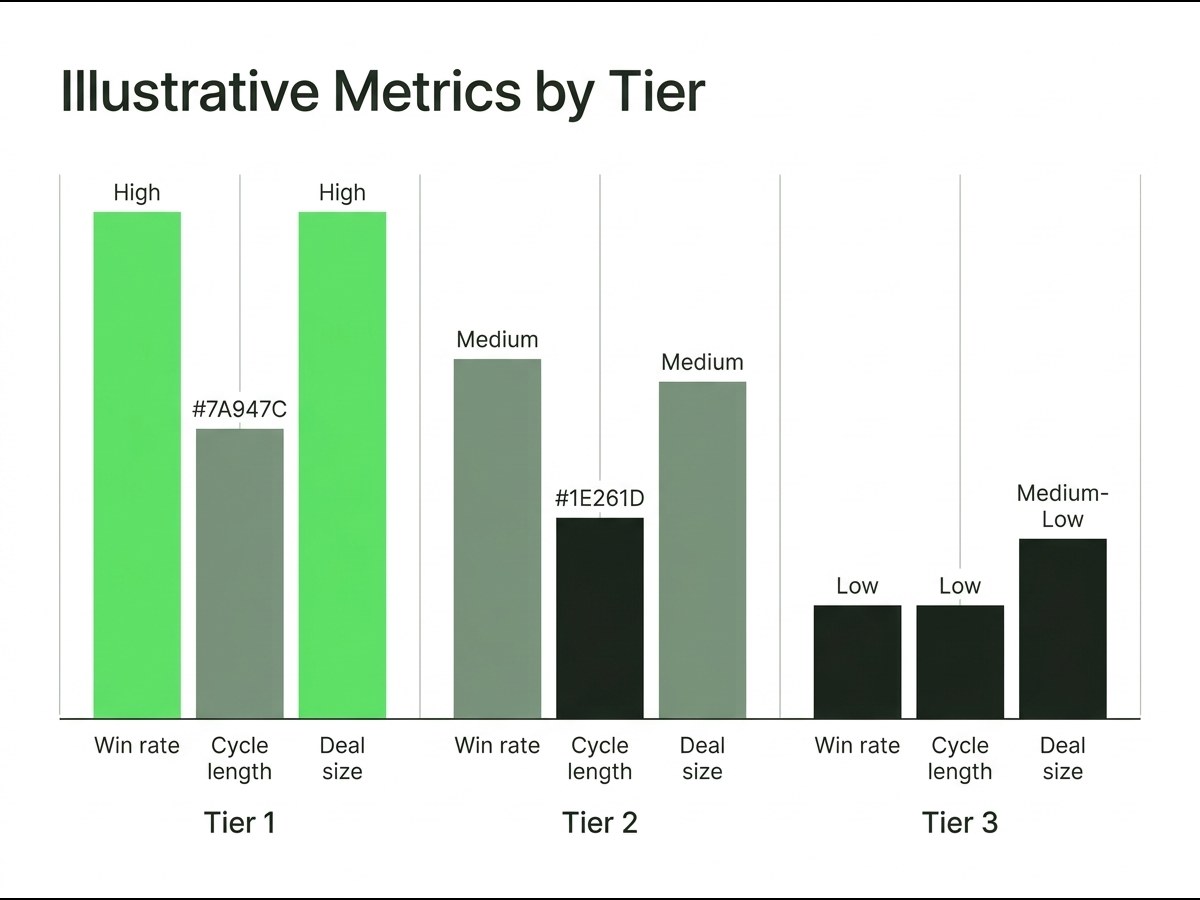
Tag every account with its tier in the CRM, then report win rate, cycle length and deal size by tier. If your top tier does not outperform the next one, recalibrate the criteria, not the rep.
This is where my view is firmest. Outbound targeting should be judged on buying intent and pipeline outcome, not activity volume. Contacts reached, emails sent and replies logged are easy to count, which is why they get reported. They say little about whether the accounts were right. Tracking foundations come before spend: if the tier is not on the account record, you cannot tell which part of the profile is working.
The setup is plain:
- Tag the tier on every account. Put it in a CRM field at the moment the account is assigned, not reconstructed later.
- Report outcomes by tier. Win rate, cycle length and deal size, side by side.
- Read intent, not activity. Count positive responses that name a pain or a timeline, and treat bare opens and clicks as noise.
- Compare tiers. The top tier should do better than the one below it on every outcome you track.
What do you do when the top tier does not win more?
A good report turns complex analytics into practical takeaways. One chart does more than a dashboard of tiles. Put tiers on the horizontal axis and show win rate, cycle length and deal size side by side, so anyone sees at a glance whether the tiers earn their ranking.
If the top tier does not beat the next one, the problem is the criteria. Look at which attributes define the tiers and ask which of them the won deals do not actually share. Replacing the rep fixes nothing if the list they work from is wrong.
Then set a cadence. Revisit the ICP at a regular interval agreed with sales and marketing, and do it as closed-won data accumulates. Each new set of wins and losses sharpens the profile, which is how an ICP compounds instead of ageing. The test of any ideal customer profile outbound sales effort is whether that feedback loop actually runs.
- Check. Is the tier tagged on every account record?
- Check. Can you see outcomes split by tier, not only in total?
- Check. Does the top tier beat the next tier on win rate?
- Check. Is there a fixed review date for the ICP?
How to read your customer profile audit
Fix the problems in the order the system depends on them: definition first, then tiering, then qualification, then measurement. Fixing a later step on top of a broken earlier one just moves the confusion downstream.
Count your "no" answers across the checks above, and place them in this order:
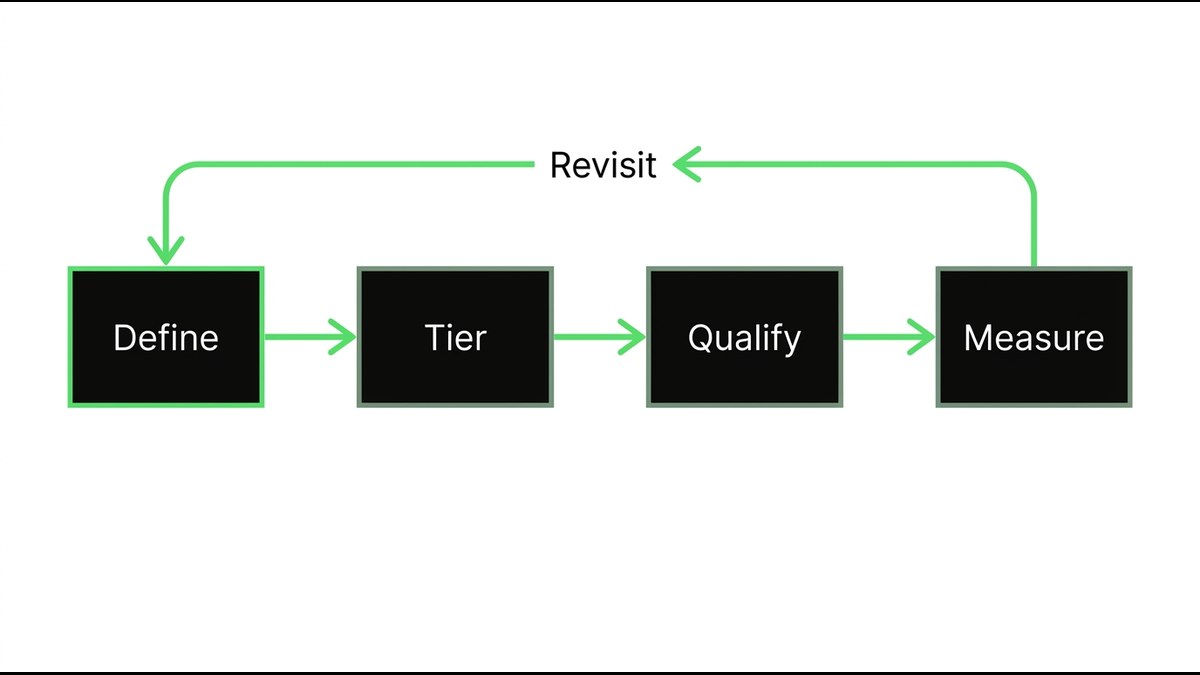
- Definition. If the profile is vague, built only from wins, or full of traits that merely describe everyone, rebuild it from deal history. Nothing else is stable until this is.
- Tiering. If two reps place the same account in different tiers, cut the criteria down to two or three observable attributes and start declining the bottom tier.
- Qualification. If fit-matched accounts stall because nobody confirmed a pain or a budget owner, write the gates and enforce them by stage.
- Measurement. If you cannot report outcomes by tier, add the tier field and the by-tier report before you change anything else.
Why is the audit a loop, not a one-time project?
Measurement feeds the definition, so the sequence is a loop. Drift is also expected, not a failure. Markets and products change, and the profile has to change with them.
One pattern to watch is several "no" answers in the first two steps. That usually means the issue sits in the profile itself, not in rep behavior or list quality. Settle the definition before you coach anyone.
What is the one test to keep?
Run one test on everything above: do two reps looking at the same account reach the same tier? If they do, your profile is observable, your criteria are few enough to use, and your team is aligned on who is worth contacting. If they do not, no scorecard will fix it.
An ideal customer profile outbound sales program is only real if you can track it. Tier tags in the CRM, reporting by tier, and a clear read on buying intent turn a document into a working system. Everything else, including list size, open rates and reply counts, is volume without proof of fit.
If the checklist exposed gaps you would rather work through with someone who does this daily, a conversation is the sensible next step.
- ✓ An outbound ICP is a working filter on accounts, and it only counts if you can track what it filters.
- ✓ If the profile cannot explain who you won last quarter, it has drifted, and the CRM already shows it.
- ✓ Keep the traits that separate wins from losses, and drop the ones that merely describe everybody.
- ✓ A tier is real only when two people reach the same one and the bottom one gets a no.
- ✓ Fix the earliest broken step first (definition, tiering, qualification, measurement), because every later step inherits its errors.
FAQ
What is an ideal customer profile for outbound sales?+
It is a short, written list of observable account traits (industry, size, tech stack, buying trigger, and a confirmed pain) that predict a closed-won deal. Reps use it to decide which accounts to contact, which to tier lower, and which to decline before any outreach begins.
How do I know if my ICP has drifted?+
Look for wide swings in deal size and sales cycle length, weak conversion between funnel stages, friction between sales and marketing over lead quality, and deals routinely justified as edge cases. If two or more of these show up, the profile no longer describes who you actually win.
What is the difference between an ICP and a lead score?+
ICP fit is account-level and is judged before anyone has talked to you. Lead scoring is contact-level and reads behavior after contact. Build the ICP first, then personas for the people inside the companies it defines.
How should I tier accounts for outbound?+
Tie each tier to two or three attributes a rep can verify in a minute, such as industry, confirmed tech stack, and a recent trigger, so two reps place the same account in the same tier. Feed the tiers into routing and account planning, and decline the bottom tier instead of letting it linger in pipeline.
What should qualification decide that the ICP cannot?+
The ICP judges the account before contact, while qualification judges the opportunity after contact. It checks for a real growth pain, a budget owner, and a decision timeline. An account that fits the profile but shows no pain should be declined early.
How do I measure whether my ICP is working?+
Tag every account with its tier in the CRM, then report win rate, cycle length and deal size by tier. The top tier should outperform the next one on every outcome. If it does not, recalibrate the criteria instead of blaming the rep.