
Structure account-based marketing B2B at mid-market as one system of five steps: select and tier a short list of accounts, map the buying group in each, run tiered plays, agree who owns what between sales and marketing, and measure at the account level. Judge results by pipeline and win rate, not lead counts.
Most mid-market teams hear "ABM" and picture an enterprise program: a platform contract, a research team and a custom campaign for every logo. That picture is why so many pilots stall. Account-based marketing B2B works at mid-market when you shrink it into a system a lean team can actually run. Our B2B ABM agency work starts from that premise: we diagnose the system first, then run the plays.
This guide is a mid-market ABM playbook built on the same premise. It covers how to pick accounts, map the buying group, run plays with a small team, assign ownership and measure results. The worked examples near the end are illustrative scenarios, not client case results.
What is account-based marketing B2B at mid-market?
Account-based marketing B2B flips the usual order. Lead generation starts with individuals who raise a hand, then works out which companies they belong to. ABM starts with the companies you have chosen, then works out how to reach the people inside them.
Most teams' reporting habits come from the first model. Lead generation touches nearly every organization at some level, so lead counts, form fills and cost per lead become the default language. They fit an ABM program badly, because ABM is built to produce fewer, better opportunities.
Mid-market changes the shape of the work in three ways.
ABM also does not suit every mid-market company. In our experience it pays off once the basics are in place: a defined sales motion, a marketing function (internal or fractional), a clearly owned revenue target and a real reason to tighten how growth is measured. Without those, fix the foundations first.
Many founders at this stage are the highest-paid SDR in their company. They open doors by hand because nothing else does it. Account-based marketing B2B is one way to move that job out of a person and into a system. If you want to know how success gets scored before you build anything, read why lead metrics break on account-based programs.
- The list is shorter.. You cannot run one-to-one programs for hundreds of logos, and you should not try.
- The team is smaller.. One marketer, a fractional lead or a small group often owns the whole motion, so every play has to be reusable.
- The sales motion is real but lean.. Deals are sales-led or hybrid, and a handful of people on each side decide who gets attention.
Which account-based marketing framework fits mid-market?
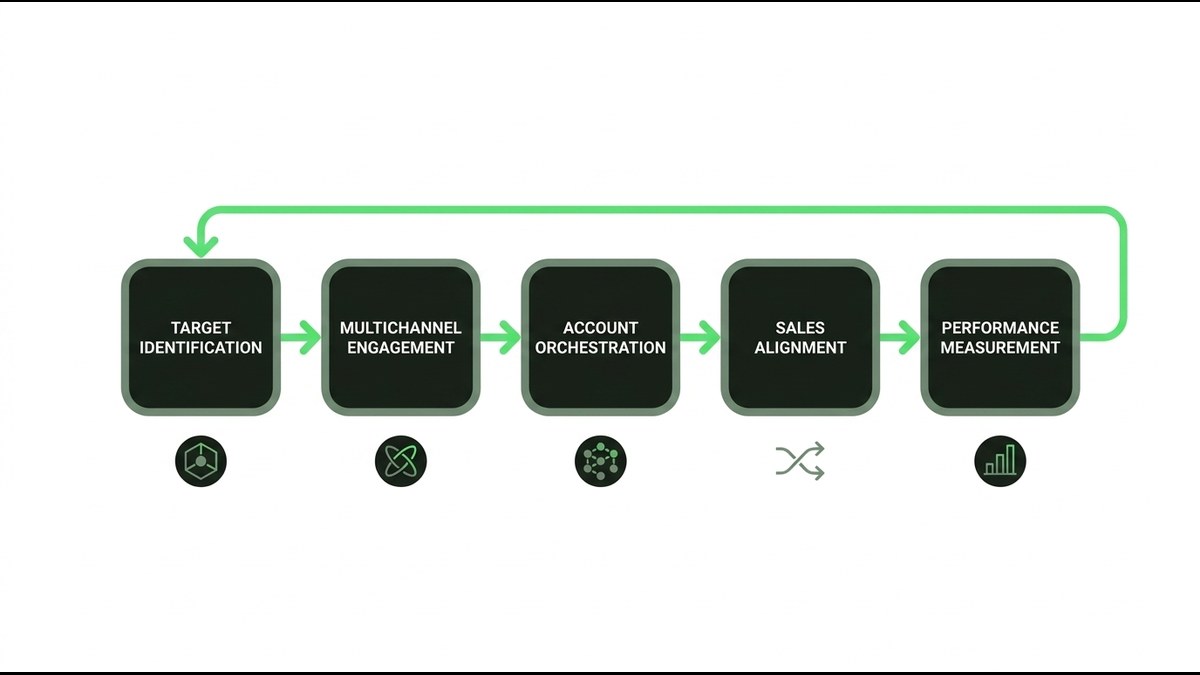
The account-based marketing framework that works for lean teams has five steps, in a fixed order: select and tier accounts, map the buying group in each account, run plays matched to each tier, align sales and marketing ownership, and measure at the account level.
The order matters because each step depends on the one before it. You cannot tier accounts you have not selected. You cannot map a buying group until you know which accounts deserve the effort. Ownership has to be settled before plays launch, or the plays run on a list nobody approved. Measurement comes last in the sequence but should be designed first, because it decides which data you capture along the way.
Treat this as one system, not five projects. The common failure is a team that buys a platform, launches ads to a list and measures clicks. That is activity with no architecture underneath it. When pipeline stalls, the cause is rarely the campaign. It is usually the GTM architecture: ICP, CRM fields, funnel stages and handoffs that were never built to support account-level work. We see this pattern again and again with mid-market B2B teams, which is why we diagnose before we build.
An ABM strategy SaaS teams can staff has to respect this sequence. A software company with a small marketing team cannot afford to rebuild its foundations mid-campaign. Decide the five steps on paper first.
Segmentation is the first foundation. Accounts belong in the same group only if the same message works for them. Industry, size and tech stack matter when they change what you say, and they do not when they merely change a label. Segmenting on what changes the message is the test to apply before you build tiers.
Entry points differ by role, and that shapes who sponsors the work. Marketing leaders with underperforming channels often sponsor ABM first. Revenue leaders care about pipeline quality and attribution. Founders want growth accountability and a final say on scope. Name the sponsor early. A program with no sponsor loses its budget the first time a quarter looks soft.
How do you tier target accounts for ABM?
Tiering decides how much effort each account earns. Without it, every account gets the same treatment, which means either too little for the best accounts or too much for the rest. Tiering by effort and fit works better than tiering by company size alone.
Start with fit. Build the ideal account profile from firmographics you can verify: industry, size band, the technology the account runs, and the sales motion it would need. Then add signals, the things that suggest timing, such as a funding event, a leadership change, a hiring push or visits to your pricing page. Fit tells you who could buy. Signals tell you who might buy now.
Effort should follow account value. The deepest custom work goes to the top tier, and programmatic coverage handles the bottom.
Review the tiers on a fixed rhythm. Move accounts up when signals appear and down when they go cold. Tiers are working assumptions, not a permanent ranking.
Content is where tiering gets expensive if you let it. Tier 1 gets custom pieces, Tier 2 gets adapted ones, and Tier 3 gets what already exists. Done well, ABM content marketing for B2B SaaS means personalization that pays for itself, because effort is matched to account value.

- Tier 1: your best-fit accounts with live signals. These are the accounts where a win would matter most and the timing looks right. Plan them one-to-one. Each gets a named owner on the sales side, a tailored message and a custom asset or two. Keep this list short. The most common mistake is the "everyone is tier 1" list, which has no focus and burns the budget in a quarter. A list your team can name from memory is about the right size.
- Tier 2: good-fit accounts without a clear signal yet. These accounts match your profile but show no urgency. Treat them as one-to-few. Group them by shared problem or vertical and run a common program, such as a themed content series, a webinar invitation or a sequence of shared ads. Promote an account to Tier 1 when a signal appears.
- Tier 3: coverage without custom work. These accounts are known and worth reaching, but they do not earn bespoke effort. Reach them with standard demand programs and review them on a schedule. Let them earn their way up through behavior.
How do you map the buying group?
Mid-market deals are rarely decided by one person. Several people decide, influence or block, so an account plan has to map people, not just company names. A list of logos tells sales where to look but not who to talk to. Account planning for B2B SaaS means mapping the people, not the logo.
For each Tier 1 account, capture six roles. Smaller accounts may combine them in one person.
Then record what each person cares about and what they have seen from you. A plan with six names and no next steps is a spreadsheet, not a plan. Each person needs a message, an owner on your side and a next touch.
This is where the size of the list pays off. A team tracking a few dozen Tier 1 accounts can keep this map fresh. A team tracking hundreds cannot. The mapping effort is the reason to keep Tier 1 short.
- Economic sponsor. The person who owns the growth target and gives final commercial sign-off. In smaller companies this is often the founder or CEO.
- Demand owner. The person accountable for demand performance, usually a marketing leader.
- Revenue owner. The person who owns pipeline quality and conversion, and who cares about attribution and operations.
- Practitioner. The person who will use the product or the output every day.
- Validator. Security, finance or compliance, who can slow a deal without being its champion.
- Blocker or skeptic. Anyone whose role or past experience makes them likely to resist.
Can a small team run ABM plays?
Yes, if each play is reusable and each tier has a different cost. A small team cannot build a custom program for every account, but it can build a few plays and adapt them. For broader ideas on scaling, see these enterprise SaaS marketing key strategies for growth.
Start with the trigger, not the channel. Each play answers a reason the buyer would act now: a new leader joins, a funding round closes, a channel underperforms, a reporting gap appears. Match the offer to what the persona feels at that moment. A marketing leader whose paid channels are flat needs a different first conversation than a revenue leader who cannot trust the attribution in the CRM. Aligning the first offer to the trigger shortens the sales conversation.
Build a short list of plays, one per trigger, and assign each to a tier.
Automation can handle the repetitive parts, such as list updates, alerts, sequence steps and reporting pulls. People should own the Tier 1 work, because that is where judgment decides the outcome.
Content is the other place to save effort. Write one strong narrative per vertical and adapt it by account. Diagnostic-first content works well for this audience: show the problem, show how you would assess it, then show what you would change.
Keep the scope honest. A lean motion has only so many moving parts: outbound, paid where it applies, the ABM plays themselves and the funnel work behind them. If you cannot staff all of them, cut one rather than run all badly. Any ABM strategy SaaS companies run on a small team should start with one channel and one play per tier, then add only when the first is working.
- Tier 1 plays. A tailored diagnostic offer, a custom point of view on the account's market, and coordinated outreach from sales and a senior sponsor on your side.
- Tier 2 plays. A themed content series by vertical, a small-group working session, and ads aimed at the account group rather than the account.
- Tier 3 plays. The standard demand program, with an alert if an account's behavior crosses a threshold.
Who should own ABM, sales or marketing?
Neither owns it alone. ABM fails most often in the gap between the two. Marketing runs ads to a list sales never approved, sales ignores the leads, and marketing gets blamed. The fix is a clear division of decisions.
Before any campaign launches, agree on three things. One account list. One set of definitions for terms such as "engaged," "qualified" and "opportunity." And one pipeline view that both sides read. Then review progress every month against revenue KPIs, not activity counts. We run account-based marketing B2B work this way: the plan stays open to adjustment while the data moves, and the conversation stays on pipeline instead of attribution disputes.
Position matters here. The program needs a senior owner who can settle disputes. In a mid-market company, that is often the CMO or the head of revenue, with the founder as final sign-off on scope. A junior coordinator can run the calendar but cannot arbitrate between a sales team and a marketing team. For a deeper view, see sales and marketing alignment for B2B SaaS. Automation changes who does the work, not who is accountable: a named person still owns the outcome for each account.
- Account selection. Joint. Marketing proposes accounts from the ideal profile and signals. Sales approves based on relationships and strategic fit.
- Messaging and content. Marketing writes. Sales tests the message against real conversations and says when buyers do not talk that way.
- Campaign delivery. Marketing runs ads, email and events. Sales runs outreach and follow-up.
- Data and reporting. RevOps or marketing operations owns the account list in the CRM, the definitions and the dashboard. Sales and marketing review the numbers together.
How do you measure ABM beyond leads?
Lead metrics break on ABM because the goal is different. Cost per lead and MQL counts understate ABM results, since ABM aims at fewer, better opportunities. A program that wins a handful of the right accounts can look weak on a lead report and strong on a revenue report. Measure at the account level instead. The full argument is in our piece on ABM measurement and why lead metrics break on account-based programs.
Here is the swap.
Think of the measures as a ladder. Engagement is the wide floor. It shows who is paying attention, but it is not proof. Coverage and pipeline are the narrower rungs, and revenue and win rate sit at the top. Report from the top down, so leadership sees proof first and activity second.
The data design has to come before the campaigns. You need account-level fields in the CRM, a clean link between contacts and accounts, campaign source on every touch, and sales activity timestamps. Without those, you will have engagement stats and no way to connect them to revenue. This is the work of RevOps and attribution, and it is the step most pilots skip.
Set review cadences by tier. Review Tier 1 accounts weekly in a pipeline meeting, spend against pipeline monthly, and account health and expansion each quarter.
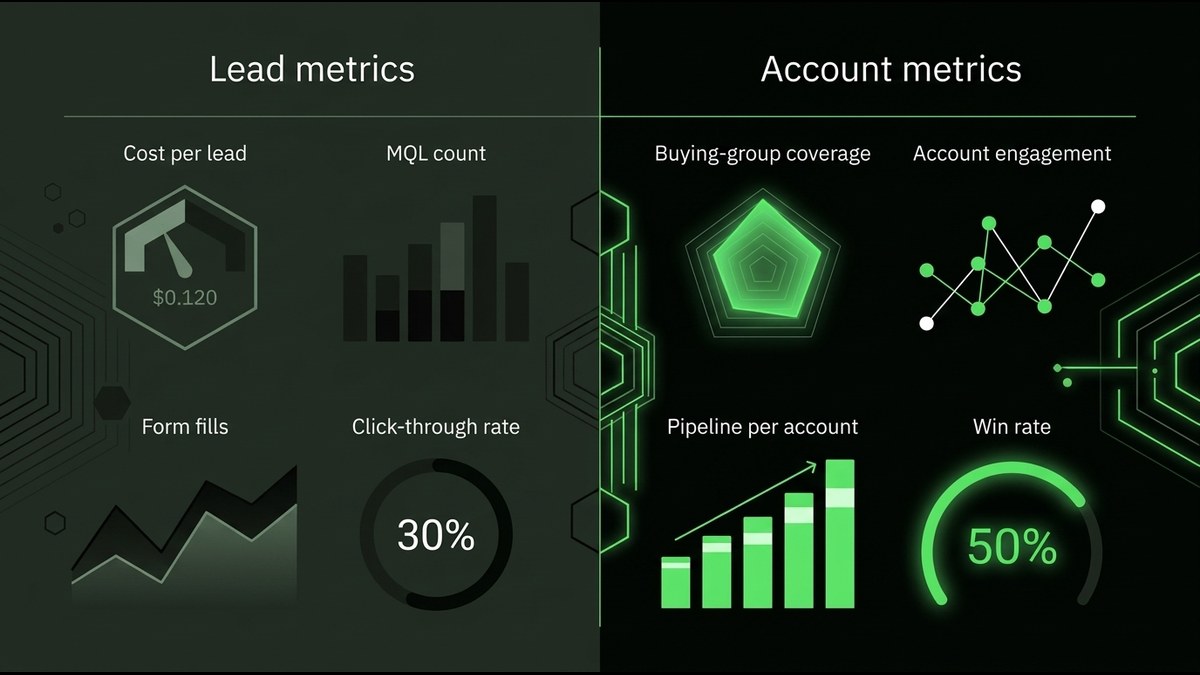
- Reach. Replace "leads captured" with buying-group coverage, meaning how many of the mapped roles in each Tier 1 account you have actually engaged.
- Engagement. Replace "clicks and downloads" with account engagement, meaning the combined activity of all contacts at one account over time.
- Output. Replace "MQLs" with pipeline created per target account, tied to the tier and play that produced it.
- Efficiency. Replace "cost per lead" with cost per opportunity and win rate for target accounts compared with non-target accounts.
- Speed. Add sales velocity on target accounts, so you can see whether the program shortens the cycle.
- Growth. Add expansion in won accounts, because ABM often pays back after the first deal.
Where does ABM fit in fintech GTM?
Fintech GTM strategy for mid-market companies with long sales cycles is where account-based marketing B2B earns its keep. Cycles are long, and many reviewers touch each deal, including security, finance, risk and compliance. A lead-based program cannot hold that many conversations together. An account plan can.
ABM fits as the connective tissue between marketing and sales over a long cycle. The plan keeps a record of who has been engaged, what they were told and what is still unanswered. When a validator joins late, the team already knows what they need to see.
Our view is that unclear GTM ownership, not compliance complexity, is what stalls the deal motion in fintech. Compliance reviews are slow but predictable. A deal where nobody owns the account, the message or the follow-up is the one that drifts. Settle ownership first, and the compliance steps become scheduled work.
That is a B2B GTM strategy question before it is a campaign question. Define the ideal account, the sales motion and the handoffs, and ABM then has something to attach to. A fintech team that skips this step usually ends up with a good list and no process. Then fix the working relationship between functions. Joint account selection, shared definitions and a regular pipeline review are the minimum. The sales marketing alignment work behind an ABM program is what keeps a long cycle from becoming a long silence.
Use readiness as a filter. If the sales motion, the marketing function and the revenue owner are not yet in place, start with the foundations and bring ABM in after.
What does mid-market ABM look like in practice?
These three scenarios are illustrative. They show how the five steps play out in different conditions, and they are not reports of client results. The first two show planning choices. The third shows a measurement problem that is easy to miss.
Scenario 1: A software team re-points its account list.
A B2B software company reviews its market intelligence and finds that its strongest fit is not where it has been selling. Its best opportunity is helping companies from one region enter another, such as Latin American companies entering the US market. The old account list described a different buyer.
The response starts at step one. Rebuild the ideal account profile around the new segment. Re-tier the accounts using the new signals, such as expansion announcements and US hiring. Re-map the buying group, because the people who decide on market entry are not the same as the people who bought growth operations. Then rewrite the plays around the new trigger.
The lesson is that positioning and account selection are one decision. When one changes, the other has to change with it, or the program keeps working a list that no longer matches the offer.
Scenario 2: A fintech team ends the "who approved this list" argument.
A mid-market fintech marketing lead proposes a Tier 1 list from the ideal profile and recent signals. Sales reviews it account by account, removes a few where a relationship already exists, and adds a few the marketing data missed. Both sides sign off on one list and one definition of "engaged."
From then on, marketing runs the shared plays and sales owns outreach. A single pipeline view, reviewed monthly, shows which accounts moved and which stalled. The complaints about wasted marketing effort lose their basis, because the sales team chose the accounts. The change is not in the tactics. It is in who decides.
Scenario 3: A site setup quietly splits the signal.
A mid-market team builds account-specific landing pages for Tier 1 accounts and ties reporting to them. Weeks later, the numbers look thin. The cause is not the campaign. It is a technical setup: canonical tags declare one version of the domain (without "www"), while the robots file and the search console property use the other.
We have seen this kind of mismatch on Webflow builds, including our own. It splits search signals across two versions of the same page and muddies the traffic data that feeds account engagement. For a program that depends on account-level reporting, that is a measurement defect, not a cosmetic one.
The fix is a short audit before launch. Check that canonical tags, redirects, analytics properties and CRM source fields all agree on one version. Then build the dashboard. Good B2B marketing reporting starts with clean inputs, and account-level views are less forgiving of dirty ones than lead reports are.
What should you do next?
Account-based marketing B2B is feasible at mid-market when you build the system before you scale the campaigns. Select and tier a short list. Map the people in each account. Run a few plays matched to triggers. Settle ownership between sales, marketing and RevOps. Measure pipeline and win rate by account.
Do not start with a tool or a campaign. Start with the diagnosis: which of these five steps is missing or broken in your business today? That is the step to fix first. We are diagnostic-first for that reason, because the most expensive mistake is executing fast on the wrong system.
If you want a second view on where your ABM motion stands, talk to us.
- ✓ Account-based marketing B2B at mid-market is a small, owned, measurable system, not a scaled-down enterprise program.
- ✓ Build the five steps in order, as one system, and name a sponsor before the first campaign runs.
- ✓ Tier by fit and timing, keep Tier 1 small enough to name from memory, and map six buying-group roles in each Tier 1 account.
- ✓ Share decisions between sales and marketing, name one senior owner, and agree on one list, one set of definitions and one pipeline view before launch.
- ✓ Retire lead metrics for ABM: report buying-group coverage, pipeline and win rate by account, and build the data model before the first campaign.
FAQ
What is account-based marketing B2B?+
Account-based marketing B2B starts with a chosen list of target companies and works out how to reach the people inside them. Lead generation does the reverse, starting with individuals who raise a hand and then identifying their companies. ABM is built to produce fewer, better opportunities.
How do you tier target accounts for ABM?+
Tier accounts by fit and timing. Build an ideal account profile from verifiable firmographics, then add signals such as funding events, leadership changes or hiring pushes. Tier 1 gets one-to-one work, Tier 2 gets one-to-few programs grouped by problem or vertical, and Tier 3 gets standard demand programs with scheduled reviews.
Can a small team run account-based marketing?+
Yes, if each play is reusable and effort differs by tier. Match each play to a buyer trigger, automate repetitive work such as list updates and alerts, and keep people on the Tier 1 accounts. Start with one channel and one play per tier, and add more only when the first is working.
Who should own ABM, sales or marketing?+
Neither owns it alone. Account selection is joint, marketing writes messaging and runs campaign delivery, sales runs outreach and follow-up, and RevOps or marketing operations owns the account list, definitions and dashboard. A senior owner such as the CMO or head of revenue should settle disputes.
How do you measure ABM beyond lead counts?+
Measure at the account level. Track buying-group coverage, account engagement, pipeline created per target account, cost per opportunity, win rate against non-target accounts, sales velocity and expansion in won accounts. Report from the top down, with revenue and win rate first and engagement last.
Sources
- [1]Lead generation touches nearly every organization at some level. Dummies, Lead generation: establish goals after defining your key metrics.