
Demand generation for B2B SaaS is a revenue system that identifies, engages, and converts high-intent buyers into qualified pipeline. It is measured by pipeline velocity, not lead volume. The right channel mix depends on ICP density, sales cycle length, and whether you sell sales-led or product-led.
Most demand generation programs at the $3-20M ARR stage do not fail for lack of effort. They fail because the system behind them is loose. Budget sits in the channels that are easiest to attribute. Sales says lead quality is poor. The board wants predictable pipeline coverage and gets spikes.
I built Effiqs around Strategic Growth Operations and Revenue Systems rather than traditional digital marketing services, and this playbook reflects that view of how demand should be run.
Why Is Your Pipeline Still Volatile?
Our view is direct. Marketing rarely has a lead generation problem. It has an operations problem. When pipeline stalls, the cause is almost never a missing channel. It is unclear channel ownership, a loose ICP definition, and reporting that tracks activity instead of outcomes. That is why we build one connected system instead of a pile of separate channel projects. SEO, paid media, CRM, analytics, and automation run as one operating model, not as five departments with five scoreboards.
This guide treats demand generation as a diagnostic discipline, not a default playbook. You will get a way to match channels to your motion, a budget model tied to revenue outcomes, metrics that hold up in a board meeting, and a 90-day plan. If you want a demand gen strategy growth-stage teams can run without guessing, diagnose first and spend second.
What Demand Generation Actually Means at $3-20M ARR
Demand generation is a revenue system. Its job is to create qualified pipeline, not to fill the CRM. A lead is a contact. A qualified opportunity is a buyer with a problem, a budget, and a reason to act now. Confusing the two is how teams end up with a full database and an empty forecast. Strong programs are judged by the second number, not the first.
At Effiqs, we separate three motions that practitioners often blend together. Brand is getting known. Demand is getting chosen. Expand is becoming profitable by growing the customers you already won. Each motion needs an owner, a budget, and a metric tied to revenue.
These motions depend on each other. Most B2B buyers do a lot of research before they ever talk to sales. If your brand is not in that early conversation, demand has to work harder for every deal. If expansion is ignored, you pay full acquisition cost to replace revenue you could have kept.
The measurement implication matters most. Forrester's B2B research points to pipeline velocity, not campaign volume, as the real indicator of demand effectiveness. A campaign that produces many leads and slow, thin pipeline is not working, however good its dashboard looks.
Demand vs. Brand vs. Expand: Which Gets Funded?
Most growth-stage teams over-rotate on demand. The reason is not strategy. It is visibility. Demand shows up cleanly in attribution software, so it looks like the one motion that works. Brand and expand are harder to see, so they get cut first.
The result is predictable: bloated pipeline, rising CAC, and longer sales cycles. Revenue leaders also tend to find that the sources producing most of their revenue do not match where the budget sits. Referrals, word of mouth, and founder-led conversations rarely show up in a last-touch report.
This is where the metrics question starts. Gartner's marketing research argues that performance metrics should reflect revenue outcomes such as pipeline and velocity, not vanity counts such as leads and MQLs. We agree, and we go one step further. Attribution is not about giving credit. It is about making better investment decisions. If a report cannot change where you put the next dollar, it is decoration.
Many teams also buy a tool to fix what is really an operational gap. A new platform cannot fix a vague definition of "high intent." Only a clear definition, agreed between marketing and sales, can.
What Changes at $3-20M ARR?
At this stage you are past founder-led outreach and single-channel reliance. You are not yet an enterprise with dedicated channel teams. That middle position creates two constraints. First, the demand engine has to be integrated, because fragmented vendor work leaks pipeline at every handoff. Second, it has to be efficient. CAC pressure is real, and the board is watching payback.
In our work with growth-stage clients, we see pipeline volatility most often caused by fragmented channel execution and weak ICP discipline, not insufficient spend. The companies that stabilize demand impose operational clarity on their channel strategy: one owner per channel, quarterly performance reviews, and ruthless pruning of underperforming tactics. After 15 years in B2B marketing and work with more than 250 companies, the pattern has held. Better systems usually beat more channels. The clearest wins I have seen came from helping SaaS companies reduce CAC while improving lead quality, and they came from better operational alignment between marketing and sales, not from a bigger media plan.
Salesforce describes modern demand generation as more than filling the funnel. It is about helping the right buyers take the next step on their terms. That framing fits this stage. You cannot afford to chase everyone. You need to find the buyers who are ready and remove friction for them.
ICP clarity is the precondition. If you cannot say which accounts convert, retain, and expand, no channel will fix that. It is often the right first step before you scale any channel.
Three Demand Failure Modes Teams Repeat
Three leaks show up again and again in B2B SaaS demand programs. Each is a conversion problem, not a traffic problem.
- Paid spend without a brand foundation. Teams push budget into paid because it is measurable. Then they ask paid to do the job of positioning. BCG's work on marketing effectiveness flags over-rotation on paid without a brand foundation as wasteful. Buyers who do not know you either do not click, or they click once and never return.
- A loose definition of "high intent". When every form fill counts, MQLs bloat and sales stops trusting marketing's lists. Define high intent by behavior instead: demo requests, pricing page visits from target accounts, repeat visits from several people at one company, and replies to outbound. Keep content downloads in a separate, lower-priority bucket.
- Slow speed-to-lead on demo requests. A high-intent buyer who waits hours for a reply starts talking to someone else. Track the time from request to first human response, and the share of demo requests that become qualified opportunities. Industry benchmarks are a rough guide at best, so set your own baseline first. A healthy rate is one that holds steady as volume grows.
A Marketing Channel Strategy SaaS Teams Can Defend
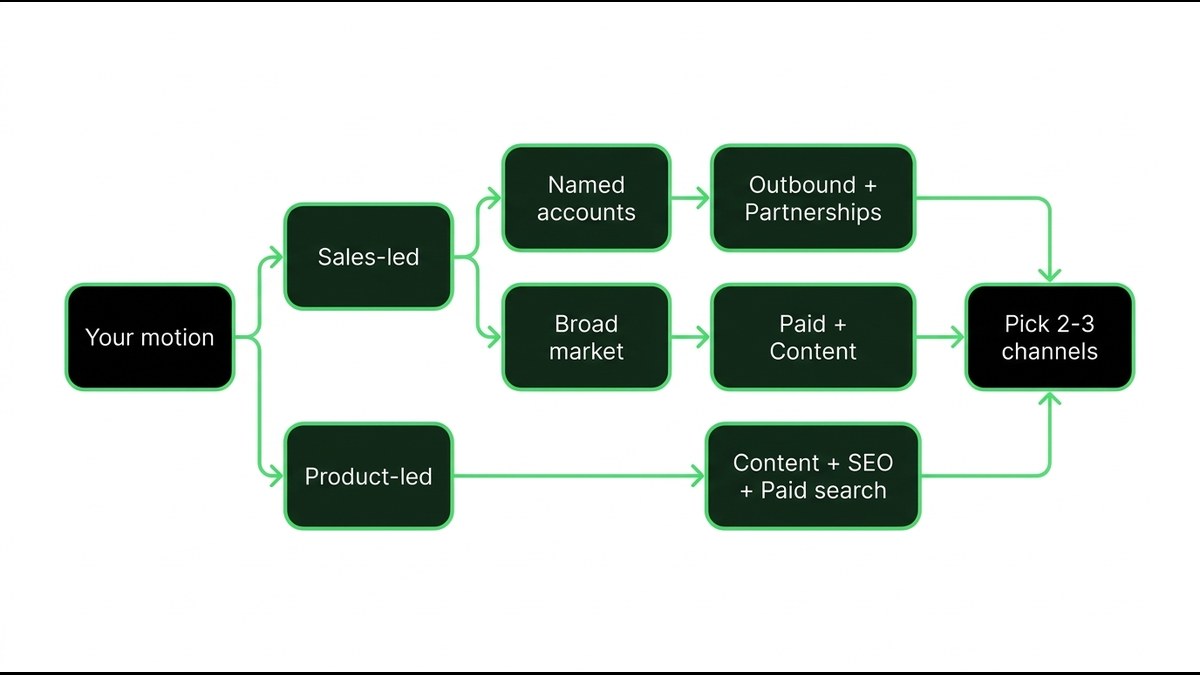
Channel selection is the diagnostic core of any demand generation playbook. A defensible channel strategy starts with four variables, not with the channel your team knows best.
Each variable changes the priority order. Pick two or three channels from the decision matrix below. Not six. If you cannot answer the ICP question yet, stop and answer it first.
- Variable: Motion. Sales-led or product-led.
- Variable: ICP density. Named accounts or broad total addressable market.
- Variable: Deal size. How much revenue justifies a human touch.
- Variable: Cycle length. How many people must agree before a deal closes.
- Sales-led, named-account ICP, higher ACV. Outbound first. Paid retargeting and partnerships second. Events for late-stage acceleration.
- Sales-led, broad market, mid ACV. Paid search and content with SEO first. Outbound second.
- Product-led, lower ACV. Content with SEO and product-led loops first. Paid search second. Outbound last.
- Long cycle, fragmented buying committee. Content, events, and account-based programs first, because several people need education.
- Short cycle, single buyer. Paid search and outbound first, because speed matters more than depth.
Outbound (Email + LinkedIn): When It Works, When It Doesn't
Outbound works best for sales-led companies with a higher ACV and a named-account ICP. It needs a senior SDR or BDR, an enrichment and sequencing stack (tools like Clay, Apollo, and Instantly are common), and strict list hygiene.
It fails when the ICP is loose or the message is generic. Sending more volume to the wrong list only trains your domain to land in spam. If reply-to-meeting or meeting-to-opportunity rates are weak, fix the leak before adding volume.
Paid (LinkedIn Ads, Google Search, Retargeting): The High-Intent Amplifier
Paid works when the brand foundation and website conversion paths are already solid. Think of it as an amplifier. It makes a clear message louder. It also makes a confused message more expensive.
Paid fails when it is used as top-of-funnel lead generation with no nurture behind it. Keep it a minority share of total marketing spend until the baseline holds. Use Google Search to capture existing demand, LinkedIn to reach named accounts, and retargeting to bring back visitors who showed real intent.
After managing advertising spend across many B2B clients, I will say this plainly: the biggest paid wins rarely came from a new audience or a clever creative test. They came from fixing what happened after the click, in the CRM, in routing, and in follow-up speed.
Content + SEO: The Compound Channel
Content with SEO is the slowest channel to ramp and often the highest in long-term return. Plan for at least two quarters of consistent publishing before you expect material pipeline impact. It fits best when you must educate a fragmented buying committee or explain a complex sale.
Build pillar content hubs with a clear internal linking structure. Use paid search data to learn which queries convert, then write for those first. SEO and PPC are not separate departments. They are two views of the same demand, and we run them with CRM and analytics data in the same room so each informs the other.
Partnerships + Co-Marketing: The High-Trust Play
Introductions from investors, fractional executives, and complementary SaaS vendors carry trust that no ad can buy. Volume is low. Conversion is high.
You need a defined partner playbook and a regular pipeline review. The main failure mode is dependence on one or two partners. That creates a single point of failure. If one relationship cools, your pipeline drops with it.
Events + Webinars: The Relationship Accelerator
Events and webinars suit late-stage pipeline, not top-of-funnel awareness. They cost a lot of founder and executive time. That cost is only justified when each event ties to a defined next step, such as an entry offer or a scoped engagement. Authority channels without a conversion path become founder time sinks.
Budget Allocation Model: Where to Invest First
Budget should start with the brand, demand, and expand frame. As a starting hypothesis, give demand the largest share, brand a substantial minority, and expand a smaller but real slice. Then adjust for stage and motion. A sales-led company selling to named accounts may weight brand and account-based outreach more heavily. A product-led company may put more into capturing existing search demand. Treat that split as a hypothesis, not a benchmark. Your own revenue data should overrule it.
Budget tells the truth about strategic priorities. Write down your top three stated priorities, then list where the money actually goes. If your deck says account-based outreach is the priority and most of your spend sits in paid search, you are telling yourself a story.
Budget should follow the business problem, not channel familiarity. Judge every line with the same test: does it speed up qualified pipeline? That is the velocity-first standard behind Forrester's B2B research, and it is a useful filter when someone proposes a new line item.
Here is a practical reset sequence:
- Step 1. Pull closed-won revenue for the last two quarters and trace each deal to its true source, using sales notes and customer answers.
- Step 2. Map every marketing dollar to one of the three motions and to one owner.
- Step 3. Move money from the lines with the weakest pipeline contribution to the gap your audit exposed.
- Step 4. Review again next quarter. Do not reallocate on a single month of data.
Foundation First: Budgets Under $50K a Month
If your total marketing budget is under $50K a month, the priority is foundation, not scale. Most of the biggest growth opportunities at this size hide in process inefficiencies, not in media budgets. Work through four items in order.
- Website conversion paths. Make sure a high-intent visitor can find the offer and act on it in a few clicks.
- ICP and persona clarity. Write down which accounts you win, keep, and expand. Use that to cut your target list.
- Attribution plumbing. Capture the source on every opportunity, including a self-reported field. Make sure the CRM records it cleanly.
- One repeatable outbound motion. Pick one list, one message, and one owner. Run it until the numbers are stable.
Do Not Layer Spend on a Leaky Baseline
Do not layer on paid or events until this baseline holds. Adding spend on top of a leaky site just buys more leaks. A small budget with clean plumbing beats a large budget with murky data every time.
Clean plumbing also means clear consent on every form you add, and telling buyers how their data is used.
Which Demand Metrics Actually Matter?
Measuring demand performance starts with one change: stop making MQLs the headline number. Report four numbers instead: pipeline created, pipeline velocity, opportunity-to-close rate, and CAC payback period. We measure demand on qualified opportunity creation and pipeline velocity, because that is what the board cares about. This matches the direction of Gartner's guidance on revenue-tied measurement: metrics should reflect revenue outcomes, not activity counts.
Then give each channel the metric that fits its job. Most marketing teams measure activity instead of business outcomes. A weekly review built on these metrics changes that. It also gives sales and marketing one shared scoreboard, which removes much of the lead-quality argument.
- Pipeline created. Qualified opportunity value, by source.
- Pipeline velocity. How quickly opportunities move through stages.
- Opportunity-to-close rate. How many qualified opportunities become revenue.
- CAC payback period. How long it takes to recover acquisition cost.
- Outbound. Meetings booked that become qualified opportunities, not emails sent.
- Paid. Cost per qualified opportunity, not cost per lead.
- Content and SEO. Organic-sourced opportunities, branded search trend, and self-reported attribution.
- Partnerships. Partner-sourced pipeline and win rate.
- Events. Late-stage pipeline influenced and speed of deals after the event.
Why Attribution Software Lies, and the Fix
Attribution platforms have a structural bias. They over-credit the last visible touch. They under-report dark social, word of mouth, podcasts, and introductions that sales sourced. Paid gets the credit because it leaves a click trail.
That bias feeds the over-rotation problem. BCG's marketing effectiveness work flags paid spend without a brand foundation as wasteful, and last-touch reporting is how many teams talk themselves into it. The dashboard says paid is working. The revenue audit says otherwise.
The honest measurement stack has three layers:
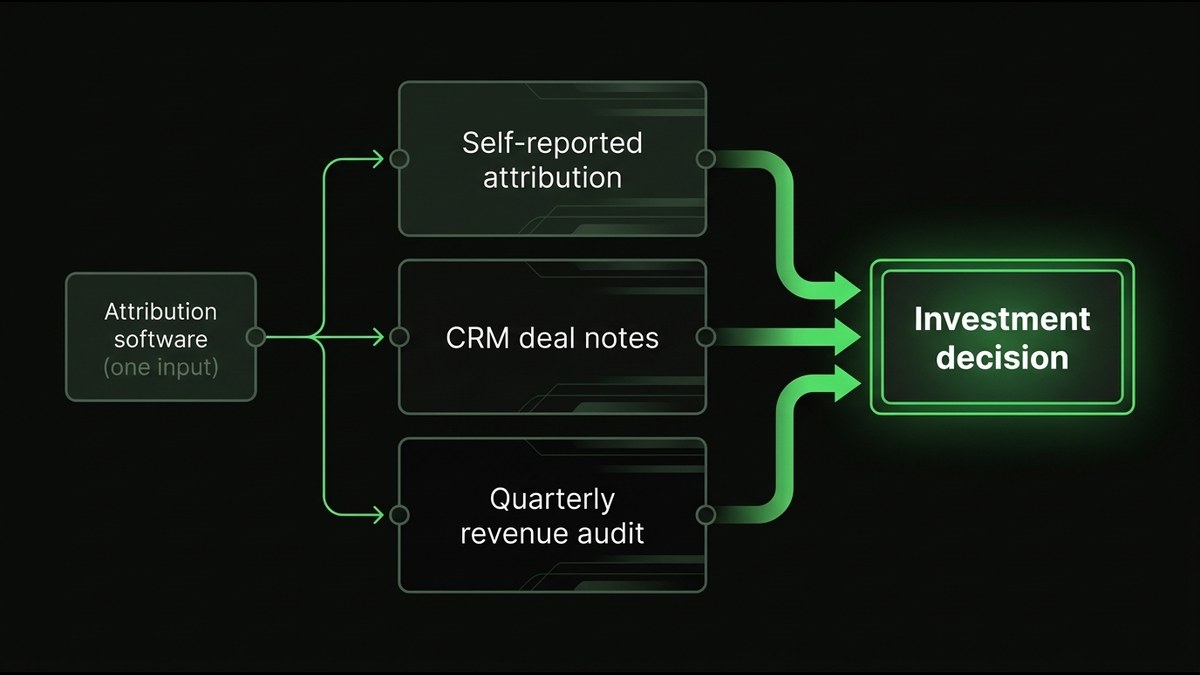
- Self-reported attribution. Add a required "How did you hear about us?" field on demo forms. Read the free-text answers.
- CRM deal notes. Have sales record how the buyer first heard of you and who introduced the deal.
- A quarterly revenue source audit. Compare closed-won sources against budget allocation and look for gaps.
Treat Attribution Software as One Input
Software can still help, as one input. It should not be the arbiter. Attribution is not about assigning credit. It is about deciding where the next dollar goes. Over the years I have built HubSpot, attribution, and automation systems that replaced manual marketing workflows. The best ones combined tool data with human answers, because neither is complete alone.
Whatever you capture, tell buyers how you use it.
Common Mistakes Growth-Stage Teams Make
Each of these mistakes has a diagnostic test and a fix. A related error runs through all four: buying software to fix an operational problem. Before you sign a new contract, ask whether the real gap is a process, a definition, or a handoff. Tools amplify a clear process. They do not create one.
- Running demand before fixing website clarity. Test: ask three people outside marketing to find your offer and say what you sell in one sentence. If they struggle, your site is a leak. Fix: repair the message and the conversion path first.
- Overfunding a single channel. Usually it is paid. Test: check what share of your pipeline comes from your largest channel, and whether you ever tested an alternative. Fix: cap the dominant channel and fund one structured test elsewhere.
- No clear owner for each channel. When everyone owns demand, nobody does. Test: name the person accountable for each channel's pipeline number. If you cannot, ownership is the gap. Fix: assign one owner per channel and review results quarterly.
- Treating demand as a campaign function. Campaigns spike and then stop. A system compounds. Test: ask what would keep producing pipeline next quarter if you launched nothing new. Fix: build repeatable motions with defined scope, owners, and metrics, and let campaigns plug into them.
Your 90-Day Demand Generation Playbook
A demand generation playbook is only useful if it is iterative. You refine it from data, not from instinct. Here is a three-month sequence.
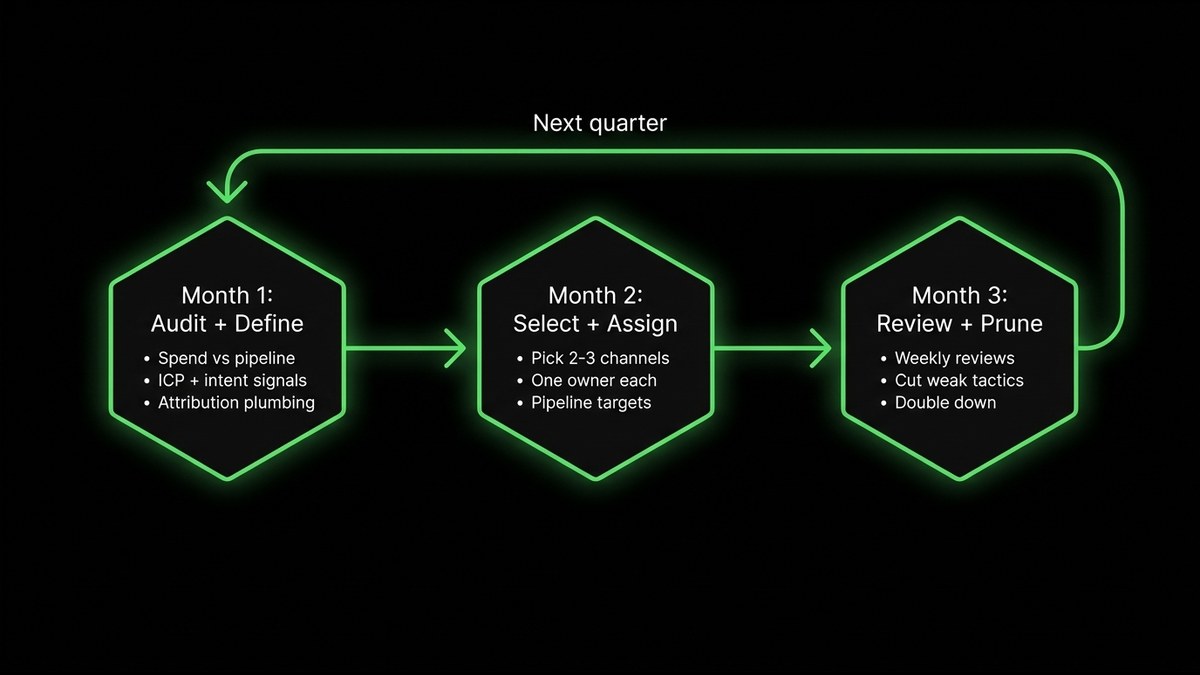
- Month 1: Audit and Define. Audit current spend against pipeline contribution. Trace closed-won deals to true sources. Define your ICP and the behaviors that signal high intent. Fix attribution plumbing: source fields, self-reported answers, and CRM notes. Do not launch anything new yet. The goal is an honest baseline.
- Month 2: Select and Assign. Use the channel selection matrix to pick two or three channels. Assign one owner to each. Set pipeline targets per channel in qualified opportunities, not leads. Agree on the speed-to-lead SLA for demo requests between marketing and sales. Launch the first versions of each motion.
- Month 3: Review and Prune. Hold a weekly performance review using the four core metrics. Cut tactics that are not creating qualified pipeline. Double down on the ones that are. Document what you learned, then set targets for the next quarter.
What the 90-Day Plan Leaves Out
Notice what is missing from this plan: a long list of new tools. The first 90 days are about clarity, ownership, and measurement. That is where most of the hidden efficiency sits.
The same logic applies to AI. It will not replace marketers. It will replace marketers who do not know how to build repeatable systems. Automate a process only after it is defined, owned, and measured, or you will simply produce the wrong output faster.
- ✓ Fix the system before you add another channel: ownership, ICP clarity, and outcome-based reporting come first.
- ✓ Define demand by the qualified pipeline it creates and how fast that pipeline moves, not by lead volume.
- ✓ Choose channels by motion, ICP density, deal size, and cycle length, then run two or three of them well.
- ✓ Treat attribution software as one input and let self-reported data and sales notes keep it honest.
- ✓ Use the first 90 days to build clarity and ownership, then let the data decide what to scale.
FAQ
How many demand channels should a $3-20M ARR SaaS company run?+
Two or three, chosen from a matrix of motion (sales-led or product-led), ICP density, deal size, and cycle length. Running six channels at once spreads ownership and budget too thin to learn which one works.
Which metrics should replace MQLs as the headline demand number?+
Report pipeline created, pipeline velocity, opportunity-to-close rate, and CAC payback period. Then give each channel a metric that fits its role, such as cost per qualified opportunity for paid or partner-sourced pipeline for partnerships.
What should a B2B SaaS team do first if its marketing budget is under $50K a month?+
Build the foundation before scaling spend: fix website conversion paths, clarify the ICP, set up clean attribution plumbing including a self-reported source field, and run one repeatable outbound motion with one list, one message, and one owner.
Why can attribution software mislead demand generation decisions?+
Attribution platforms over-credit the last visible touch and under-report dark social, word of mouth, podcasts, and sales-sourced introductions. Pairing software with a self-reported attribution field, CRM deal notes, and a quarterly revenue source audit gives a more honest picture.
When should a growth-stage SaaS company bring in an outside partner for demand generation?+
When pipeline is volatile quarter to quarter, attribution is untrusted, several channels have failed to scale predictably, and there is no senior marketing leader to own strategy. In that case an integrated team accountable for the whole system helps more than another point vendor.
Sources
- [1]Pipeline velocity, not campaign volume, is the real indicator of demand effectiveness. Forrester, Forrester's B2B research.
- [2]Performance metrics should reflect revenue outcomes such as pipeline and velocity, not vanity counts such as leads and MQLs. Gartner, Gartner's marketing research.
- [3]Over-rotation on paid without a brand foundation is wasteful. BCG, BCG's work on marketing effectiveness.
- [4]Modern demand generation is about helping the right buyers take the next step on their terms. Salesforce, Salesforce's description of modern demand generation.