
When evaluating a growth operations agency, ask who owns the outcome when conversion stalls, whether they diagnose before they prescribe, who owns the systems they build, how they report results, and whether you need a partner or an in-house hire. The right partner owns your whole revenue engine, not just your campaigns.
Most buyers at this stage have been burned before. An agency ran campaigns, sent reports, then went quiet when the funnel stalled. You do not need another vendor to execute your current playbook faster. You need a partner who can tell you whether the playbook is right.
This guide works as a buyer-side framework for growth operations agency evaluation. It lists the questions to ask and what a good answer sounds like, so you can score any shortlist, including us. We are a growth consultancy for B2B SaaS companies, and we would rather you ask hard questions than sign on a pitch.
How do you evaluate a growth operations agency?
Start with the engagement itself, not the pitch deck. A real growth operations agency evaluation asks one thing first: what exactly are you buying?
Growth operations is not a bundle of hours. It is not a set of campaigns or a pile of deliverables. It is ongoing ownership of your growth engine, with continuous optimization across strategy, execution and systems. One accountable operator coordinates every growth lever.
When you are hiring growth agency support, test for that ownership. Ask the agency to describe its scope in terms of outcomes and systems. Then ask what happens when a lever underperforms. If the answer is "we raise it in the monthly report," you are buying execution. If the answer is "we change the plan and own the fix," you are buying operations.
Look for scope that covers strategy, demand, content, design and revenue systems as one integrated stack. A B2B RevOps agency built this way treats the CRM, attribution and funnel logic as part of the growth job, not as someone else's problem.
Score outcomes and systems higher than channels and deliverables. A long list of tactics tells you little. Clear ownership tells you a lot.
Who owns the outcome when conversion stalls?
This is the question that exposes the most agencies. Every funnel stalls at some point. What matters is who is on the hook when it does.
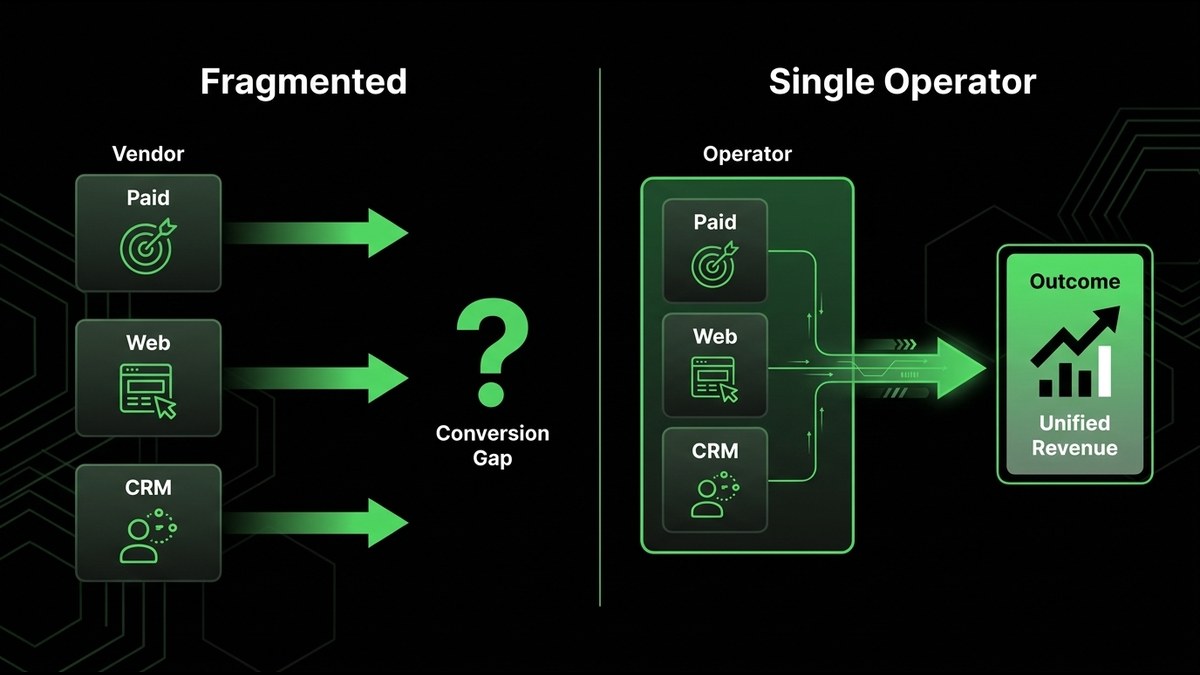
Fragmented setups fail here. One vendor runs paid media, another builds the site, a third manages the CRM. Each hits its own targets, and none owns the conversion problem. The gap between them is where pipeline disappears.
In our work with B2B clients, this pattern repeats. Strategy, demand and revenue operations sit with separate vendors. Handoffs blur, attribution breaks, and every review ends with each party pointing at someone else's piece.
Ask these questions on the first call:
- Who is accountable if the funnel does not convert?
- Will one named person coordinate strategy, demand and systems?
- What do you change first when results slip?
What does accountable ownership look like in practice?
A growth operations partner replaces fragmented execution with accountable ownership. The goal is predictable, compounding revenue, which is a different promise from "more leads."
If nobody can name the owner of a missed conversion target, nobody owns it.
Do they diagnose before they prescribe?
Our rule is diagnosis before delivery. The costliest mistake in growth is executing the wrong system quickly. A credible partner audits your funnel, attribution and CRM before proposing scope.
Watch the first meeting closely in any growth operations agency evaluation. A red flag is a proposal before the agency has asked a single question about your business. A green flag is a list of questions you cannot yet answer, such as:
- How do you define a qualified pipeline stage today?
- How long is your typical sales cycle, and where do deals stall?
- Which attribution model do you trust, and why?
How should diagnosis shape the order of work?
Agencies that defer to your existing attribution model without testing it are inheriting the flaw. Agencies that skip discovery are guessing.
Good diagnosis also sets the order of work. Many founders ask which to fix first: positioning, funnel, CRM or demand. A partner who has diagnosed properly can answer with reasons, not a menu. After diagnosis, the strategy layer should cover go-to-market refinement, channel prioritization, experiment design, roadmap ownership and regular performance reviews.
Also ask how the engagement starts. A short, fixed-price diagnostic that only proceeds when a real growth problem is on the table protects both sides. It keeps the work honest and the scope tight.
Who owns the systems they build?
Strategy is only useful if it runs on infrastructure you control. Ask where the work will live and who holds the keys afterward.
The right answer is client-owned infrastructure. Everything gets built inside your own CRM and tracking stack, and your team holds admin access when the engagement ends. If the agency keeps dashboards in its own tools or controls your accounts, you are renting your revenue system.
Founders often ask what has to exist before pipeline scales without them. Part of the answer is systems that work without the agency in the room. Probe the technical scope:
- CRM optimization and clean data structures
- Attribution and reporting you can audit
- Funnel diagnostics that show where deals leak
- Governance for the tech stack, so tools do not sprawl
- Data integrity and visibility across teams
What should a clean handover look like?
A HubSpot implementation agency that builds inside your portal should be able to show you documentation, naming conventions and permission settings. Ask to see them. Then ask what a clean exit looks like.
Fixed-price system builds suit this well. Broken or fragmented systems are a common reason buyers look for help, and a defined build with a defined handover removes the ambiguity.
How should a growth partner report results?
In a growth operations agency evaluation, reporting reveals mindset faster than any case study. Ask: "How will we know what's working?"
Reporting should tie spend to pipeline and revenue inside the CRM, using definitions agreed in advance. Impressions and engagement are not outcomes. Pipeline contribution, acquisition cost, sales cycle length and funnel efficiency are.
Marketing and revenue leaders feel this pain sharply. They are told campaigns are performing while the pipeline tells a different story. We call that the attribution black hole. It opens when nobody agreed upfront what counts as a qualified lead or a sourced deal.
Before you sign, ask for these:
- A written metric dictionary covering stages, sources and ownership
- Live access to dashboards, not a monthly PDF
- A reporting cadence that includes decisions, not just numbers
How do you handle claims about AI search visibility?
Be careful with newer claims too. If an agency promises visibility in AI-driven search, ask how it measures that and whether you can verify it. A claim without a measurement method is a slogan.
Strong reporting lives where the data lives. A HubSpot management agency that runs your reporting inside the CRM gives you numbers sales and marketing can both trust.
Should you hire in-house or bring in a partner?
Founders put it bluntly: how do I stop being the highest-paid SDR in my company? The real question is whether one hire can fix the problem, or whether you need a partner that builds and operates the system.
An in-house hire fits when one person can staff every layer. That is rare. A growth lead can own strategy, but they seldom also build the CRM architecture, run demand and manage attribution well.
A partner fits when strategy, systems and execution all need repair at once. This is the founder-led ceiling: growth depends on you because nothing around you runs without you. A partner can build the structure and operate it while your own team matures.
Apply the same discipline to growth consultant selection as you would to any senior hire. Ask for the named lead, how senior people stay involved, and what the first 90 days produce. Review the tactics a partner covers and check that none sit outside its accountability.
Plan the transition too. A good partner works toward your independence, with a handover path to an internal team when you are ready.
A scorecard for your growth operations agency evaluation
Turn the questions above into a scorecard. Rate each from one to five and weight outcomes and systems above channels.
- Ownership. One named operator is accountable for conversion, not a rotating "team."
- Diagnosis. Audit of funnel, attribution and CRM comes before any scope or price.
- System ownership. Everything is built in your stack, with admin access held by you.
- Reporting. Pipeline and revenue metrics, defined in advance, visible live in the CRM.
- Fit. The partner covers every layer that needs repair, or says plainly where it stops.
What a good answer sounds like
The right partner answers these questions with specifics, not deflection. They name owners, show how they diagnose, hand over the systems and report on revenue.
If you want to run this agency evaluation framework against us, we will answer every question above on a call.
- ✓ Judge a growth partner by what it owns, not by what it produces.
- ✓ If nobody can name the owner of a missed conversion target, nobody owns it.
- ✓ A partner who prescribes before diagnosing is selling a product, not solving your problem.
- ✓ Build in your stack, hand over the keys, and document everything.
- ✓ Insist on pipeline and revenue definitions agreed before work starts, and use a weighted scorecard to compare partners.
FAQ
How do you evaluate a growth operations agency?+
Start with what you are buying. Growth operations is ongoing ownership of your growth engine across strategy, execution and systems, not a bundle of hours or campaigns. Ask the agency to describe its scope in outcomes and systems, then ask what happens when a lever underperforms. An agency that changes the plan and owns the fix is operating. One that raises it in a monthly report is executing.
Who should own the outcome when conversion stalls?+
One named, accountable operator should coordinate strategy, demand and systems. When paid media, web and CRM sit with separate vendors, each hits its own targets and nobody owns the conversion problem, which is where pipeline disappears.
Why should an agency diagnose before proposing scope?+
The costliest mistake in growth is executing the wrong system quickly. A credible partner audits your funnel, attribution and CRM first, then recommends an order of work with reasons. A proposal made before any questions about your business is a red flag.
Who should own the CRM and systems an agency builds?+
You should. Everything should be built inside your own CRM and tracking stack, and your team should hold admin access when the engagement ends. If the agency keeps dashboards in its own tools or controls your accounts, you are renting your revenue system.
What should a growth agency report on?+
Reporting should tie spend to pipeline and revenue inside the CRM, using definitions agreed in advance. Focus on pipeline contribution, acquisition cost, sales cycle length and funnel efficiency rather than impressions or engagement. Ask for a written metric dictionary and live dashboard access.
Should I hire in-house or use a growth partner?+
Hire in-house when one person can cover every layer, including strategy, CRM architecture, demand and attribution, which is rare. Bring in a partner when strategy, systems and execution all need repair at once, and look for one that plans a handover to your internal team.