
A B2B website usually fails to convert because of one of five structural problems, not weak design: broken attribution, an unclear offer, a message that misses the market, a funnel that ignores the buying group, or UX that assumes one visit. Fix them in that order, starting with measurement, because every later fix depends on numbers you can trust.
Your pipeline exists. Your proof of it doesn't. That gap is where most conversion work goes wrong. Teams buy more traffic, test button colors or approve a redesign. Each move can fix the wrong layer, fast. That is the most expensive mistake in this work, because the real leak stays open. Diagnosis comes before delivery.
This guide gives you the five layers, the order to repair them in, and a short audit you can run yourself. It is written for marketing leaders who answer for demand without owning the whole funnel. The same logic holds for CRO for SaaS in general.
You will not find benchmark conversion rates here. Most website conversion optimization B2B advice opens with averages, and an average hides the one broken step. A number from another company says little about yours.
Can you trust your conversion numbers?
Often not. If form fills, demo requests and CRM stages are not tied to the same visitor, your conversion rate measures activity, not pipeline. Check that every conversion fires once, reaches the CRM and carries its source. Until it does, every other fix is a guess.
I manage B2B paid search and LinkedIn campaigns, and the tracking behind them. Four years across PPC, tracking and reporting have taught me one rule: a form fill is not evidence. A conversion that carries source, stage and pipeline outcome is. Paid media strategy must focus on tracking, reporting insights, and true buying intent rather than vanity metrics.
Numbers drift more easily than you would expect. On our own setup, we found several overlapping outbound-click conversion actions, including one for strategy-call booking. Overlapping actions can count the same click more than once and inflate reported conversions. Consolidating them came first, before any reporting could be trusted.
Speed data can mislead too. A site-speed score can drop because of the scripts that load tracking and CRM tools, not because of the page design. In that case the fix is server-side tagging, not a redesign. Slow mobile first-byte time is another trap. It can be a delivery issue on the CDN that no page-level edit repairs.
There is also a people problem. Marketing answers for demand. Revenue leadership answers for what that demand becomes. The two often read different numbers. Shared, CRM-connected measurement settles that argument with data.
Reporting insights should simplify complex data into practical, visual takeaways. If your dashboard cannot show where visitors drop out between first click and qualified opportunity, start here.
B2B landing page optimization: one offer per page
A page converts when a visitor can name the single next step and why it is worth taking. Does every page make one clear offer? Most do not. They ask for a demo, a download, a trial and a newsletter signup at once.
That is offer sprawl: one page, four jobs. The visitor has to decide what the page is for. Many leave instead.
Good B2B landing page optimization starts by assigning each page one job. Then it matches that job to how ready the visitor is:
Design earns its place by making the next step obvious. Looks come second. A beautiful page with four competing calls to action loses to a plain page with one.
The common objection is "we need more traffic." More traffic into a leaking page multiplies the leak. Conversion gains compound on traffic you already paid for.
One more detail sits under the offer: the page address itself. On our own site, we found pages declaring a non-www canonical while our robots file and Search Console property used the www version. That splits signals for what should be one page. One page should have one address, one job and one set of numbers.
- Cold visitor from a search ad. Needs a low-commitment next step.
- Returning visitor comparing vendors. Needs proof and a path to talk to someone.
- Visitor from a sales email. Needs the page to continue the email's promise.
Does your message match your market?
Message-market misalignment means the page describes your product in your words, not the buyer's problem in theirs. Visitors from a specific ICP should see their situation named in the headline. If the page could belong to any competitor, the message is the leak.
Here is a quick test. Read your headline aloud. Does it name a role, a situation and a problem? Or does it name a product category and a promise to "grow faster"?
Two growth pains show up again and again in B2B SaaS. A website or message that suppresses conversion is one. A gap between the brand story and what sales hears on calls is the other. When sales says leads are poor and marketing says they are fine, the message is often attracting the wrong people, or the right people for the wrong reason.
Different roles also arrive with different triggers. A CMO with a site that underperforms is looking for something other than what a revenue leader wants. The revenue leader wants clean attribution and pipeline quality. Your pages should speak to the trigger that brought each visitor, not to everyone at once.
A practical fix has three steps:
Landing pages built around your ICP's problem follow this pattern. The page earns the next click by showing that you understand the situation. Do this before you test headlines. A/B tests on a vague message only compare two vague messages.
- Step 1. Write down the buyer's problem in the buyer's own words.
- Step 2. Put that problem in the headline and the first line of proof.
- Step 3. Cut anything that describes the product without tying it to that problem.
Does your funnel serve a buying group?
B2B purchases involve several people across departments, each with different questions and proof needs. A funnel built for one visitor fails them. Give each role something to act on, and offer a path that does not force a sales call first.
Think of the roles as a group, not a lead:
Most sites serve the champion and nobody else. Then the deal stalls where the other roles hit a wall.
This is also where an average conversion rate misleads. It blends all roles into one number. The leak may sit at one role's step, such as a technical page that never answers the security question.
Good website conversion optimization B2B work needs a defined scope. Decide which step you are fixing, for which role, and with what proof. A project that tries to improve conversion everywhere improves it nowhere.
Bring revenue leadership in early. Website and messaging affect pipeline in ways only CRM data reveals. When both teams read the same funnel, the lead-quality argument ends.
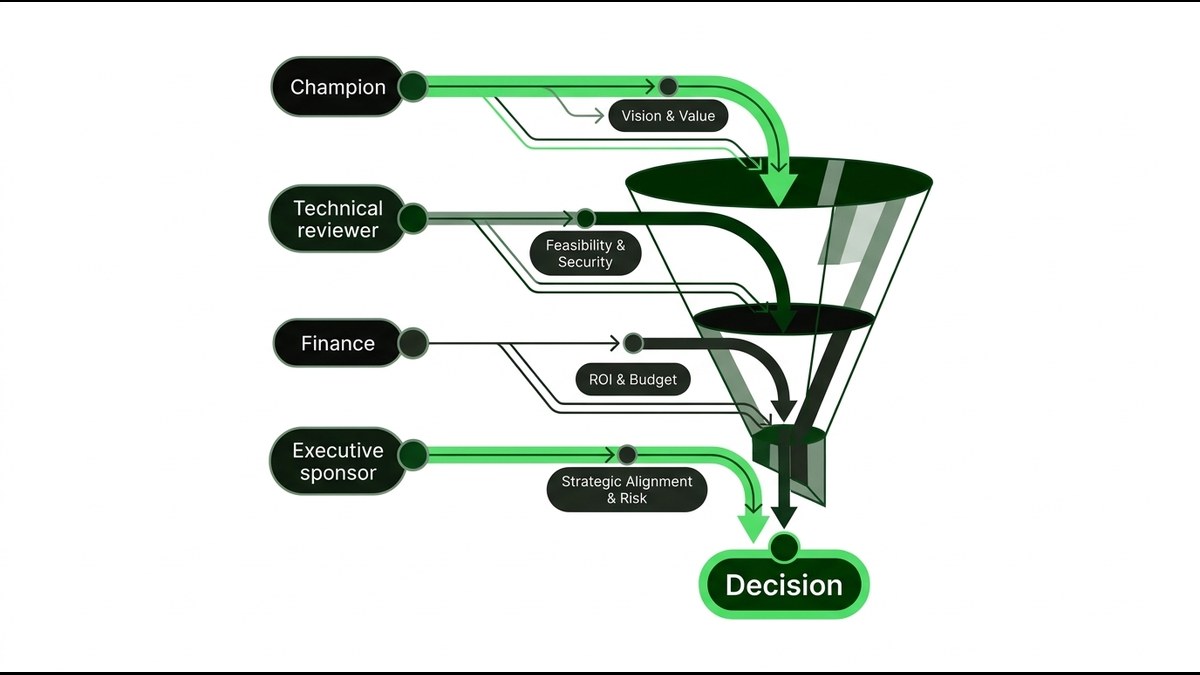
- The champion. Needs a shareable summary they can forward without rewriting it.
- The technical reviewer. Needs detail: integrations, security, how it works.
- Finance. Needs proof of value and clear commercial logic.
- The executive sponsor. Needs the business case in a few minutes.
Does your UX assume one session?
Most B2B buyers return several times before they act. UX built for a single visit hides pricing logic, buries proof and asks for full contact details too early. Design for the return visit: clear re-entry points, lighter first commitments and pages that pick up where the last visit ended.
This matters most in CRO for SaaS, where the cycle is long and the buying group changes over time. A visitor who leaves after the first session has not said no. They have said "not yet."
Four design moves help the return visit:
Measurement matters here as well. If your tracking treats each session as a new person, you will never see the journey. Another example from our own site: some redirect-destination pages declared a different canonical host than the one we track. When a visitor's return lands on a page with a different address, reporting can split one buyer's history in two. That makes the journey look shorter and the funnel look worse than it is.
The idea of redesigning the problem instead of the site applies here. Many "dated site" complaints are really complaints about friction. A fresh look will not remove a form that asks for too much too soon.
B2B SaaS buyers compare vendors across sessions, devices and colleagues. Your UX should assume that.
- Lighter first commitments. Offer a guide, a short demo or a sample before you ask for a phone number.
- Proof that survives a handoff. A colleague who never saw the first visit should grasp the value in a minute.
- Clear re-entry points. Make pricing logic, integrations and case proof one click from any page.
- Honest next steps. Say what happens after a form is submitted, and by when.
What should B2B website conversion optimization fix first?
For website conversion optimization B2B teams, fix measurement first, then the offer, then the message, then funnel logic, then UX. Each layer depends on the one before it. Testing a new headline on data you cannot trust wastes a quarter. A short website conversion audit shows which layer is failing now.
Use this matrix to match a symptom to a check and a fix:
- Measurement. Symptom: marketing and sales disagree on lead quality. Check: does each conversion fire once, reach the CRM and carry its source? Fix: consolidate overlapping conversion actions and connect tracking to CRM stages.
- Offer. Symptom: visitors read the page and do nothing. Check: can a visitor name the single next step? Fix: one offer per page, matched to visitor readiness.
- Message. Symptom: traffic is relevant but engagement is thin. Check: does the headline name the buyer's problem? Fix: rewrite around the ICP's situation, not your product.
- Funnel logic. Symptom: deals stall after a good first call. Check: does every role in the buying group have something to act on? Fix: add role-specific proof and a shareable summary.
- UX. Symptom: visitors return but never convert. Check: are pricing logic and proof easy to find on a second visit? Fix: lighter first commitments and clear re-entry points.
A five-point website conversion audit
You can run this without a vendor. Answer each question with evidence, not opinion.
If you answer "no" or "not sure" to the first two, stop there. Tests and redesigns built on untrusted data produce noise. Plenty of teams run A/B tests on exactly that foundation.
- Does every conversion fire once, with no overlapping actions?
- Do conversions reach the CRM and carry source and stage?
- Does each page have one offer?
- Does the headline name the ICP's problem?
- Can each buying-group role find proof within one or two clicks?
Why diagnosis comes before delivery
Fixing the wrong layer quickly is the most expensive mistake in conversion work. It feels productive, and it leaves the real leak in place. That is why finding the step that leaks beats chasing an average.
Order matters because the layers stack. A clear offer cannot rescue a broken tracking setup. A sharp message cannot rescue a page with four offers.
Where to start this week
Pick the first layer on the list where you answered "not sure." Get evidence for it before you approve a test, a campaign or a redesign. Then repair the next layer.
If you would like a second pair of eyes, book a strategy call with Effiqs and we can look at which of these five layers is failing on your site.
- ✓ Measure first, because every later fix depends on numbers you can trust.
- ✓ Give each page one offer, matched to how ready the visitor is.
- ✓ Name the buyer's problem in the headline, or the message is the leak.
- ✓ Build the funnel for a buying group, then measure each role's step, and design the UX for the return visit.
- ✓ Run the five-point audit top-down and fix the first layer that fails.
FAQ
Why do B2B websites fail to convert?+
Usually because of one of five structural problems rather than weak design: broken attribution, an unclear offer, a message that misses the market, a funnel that ignores the buying group, or UX built for a single visit.
What should I fix first when optimizing a B2B website for conversions?+
Fix measurement first, then the offer, then the message, then funnel logic, then UX. Each layer depends on the one before it, so testing a new headline on data you cannot trust wastes time.
How do I know if my conversion tracking can be trusted?+
Check that every conversion fires once, reaches the CRM and carries its source. Overlapping conversion actions can count the same click more than once and inflate reported conversions, and conversions not tied to the same visitor in the CRM measure activity, not pipeline.
Why is an average conversion rate misleading for B2B?+
An average blends every role and step into one number, which hides the single broken step. The leak may sit at one role's step, such as a technical page that never answers the security question.
What does one offer per page mean in B2B landing page optimization?+
Each page is assigned one job and one clear next step, matched to how ready the visitor is. A cold search visitor needs a low-commitment step, a returning vendor-comparer needs proof and a path to talk to someone, and a visitor from a sales email needs the page to continue the email's promise.
How should a B2B funnel serve a buying group?+
Give each role something to act on: a shareable summary for the champion, technical detail for the reviewer, proof of value for finance and a short business case for the executive sponsor. Offer a path that does not force a sales call first.