
For most B2B teams, a W-shaped multi-touch attribution model run at account level is the best starting point. It credits first touch, lead creation and opportunity creation, which matches long, multi-stakeholder buying cycles. No attribution model is correct, so compare it against a first-touch view and self-reported attribution before moving budget.
Most attribution projects fail before anyone picks a model, because every attribution model is wrong in a known way and the data underneath is usually worse. The model is rarely what's broken.
Here is the situation I see most often. Pipeline exists. Attribution doesn't. GA4 says one thing, HubSpot says another, and the CEO asks "which channel is working?" in the same breath as "why did pipeline dip?" Nobody has a defensible answer, so budget goes to whoever argues loudest.
That is the real cost. Attribution isn't about giving credit. It's about making better investment decisions. If a model doesn't change what you fund, cut or test, it's a reporting exercise. Companies also buy software to fix what is really an operational problem, and a smarter model on top of dirty data buys a more confident wrong answer. This guide covers what each model credits and hides, a four-filter method for attribution framework selection, the data you need first, and a way to validate before you move money.
What is a multi-touch attribution model in B2B?
A multi-touch attribution model splits credit for a deal across several buyer interactions instead of giving it all to one. Rule-based models use fixed weights. Data-driven models learn weights from converting and non-converting paths. It shows association between touches and pipeline, not proof of cause.
First-touch and last-touch models are the single-credit options. One interaction gets everything. They're easy to run and easy to misread, because a B2B deal rarely has one moment that matters. Multi-touch models spread credit across the path, which is closer to how a buying group actually decides.
Rule-based versus data-driven: rule-based models (linear, time decay, U-shaped, W-shaped, full-path) apply weights someone chose in advance. You can explain them to a CFO in one sentence. Data-driven models estimate weights from the paths of buyers who converted and buyers who didn't. They need volume, and they're harder to audit. Check your platform's documentation for its exact definitions and for which plan tier unlocks each model.
Where marketing mix modeling fits: it isn't a competitor to these models. Marketing mix modeling (MMM) is a separate method that works on aggregate spend and outcomes over time, with no individual journeys. Open-source examples include Meta's Robyn project. Use MMM for channel-level budget questions. Use multi-touch for path-level questions.
The real question is the decision the model will change. Fund webinars or cut them? Shift paid spend toward partner programs? Finance asks the same thing from another angle. A fractional or in-house CFO can't model CAC payback if nobody can say which spend produced which revenue. Board-ready unit economics require clean attribution, so fix the data before the next budget cycle.
I've managed over $35 million in advertising spend across B2B clients. In that work, attribution only earned its keep when it was tied to a decision about where the next dollar goes. Our approach starts from that decision, not from the tool.
There is a readiness caveat too. Attribution output is only as reliable as the CRM platform underneath it. A model can't repair a CRM that was set up loosely.
What causes attribution blind spots in multi-touch B2B sales cycles?
Blind spots come from untracked touches (peer networks, DMs, events, podcasts), last-touch bias toward branded search and direct visits, long cycles outlasting lookback windows, and CRM gaps such as missing buying-committee contacts or offline conversions. Most are data and process failures, not model failures.
A lookback window is the span of time a tool searches backward for touches. If your cycle runs longer, early touches simply vanish from the report. So look upstream of the model first. The result is an attribution mirage: the wrong cause gets the credit, so the wrong budget gets the money. It usually shows up as pipeline volatility, where one quarter looks strong, the next dips, and nobody can explain either.
Last touch lands on branded search and direct. Buyers who have already decided search your name or type your URL, and last-touch reporting hands that visit all the credit. In B2B SaaS it mostly harvests demand that was created somewhere else. Then the budget follows the report. Money moves toward whatever finished the job and away from whatever started it. Six months later, the demand dries up and the dashboard still looks fine.
Dark social and untracked peer influence are the next gap. Alexis Madrigal coined the term "dark social" in a 2012 article in The Atlantic. It describes sharing that happens in private channels with no referrer data. For B2B, think Slack communities, DMs, podcasts and events. Early influence is structural, not accidental. Most B2B buyers aren't in the market at any given moment, so impressions build long before anyone visits your site, and that early influence never shows up as a click.
CRM and process gaps matter just as much. Buying decisions are made by groups, not individuals. If your CRM holds one contact per opportunity, every touch from the other stakeholders disappears. Other gaps are quieter:
- Duplicate conversion events. When the same action fires under two or three names, counts inflate and reporting is quietly corrupted.
- Offline revenue that never returns. Calls, meetings and signed contracts stay in the CRM. Ad platforms never learn which clicks led to money.
- Loose stage definitions. When a qualified lead means anything, volume looks like progress. More leads don't equal more revenue. Better leads do, which is why strict stage definitions matter.
Which multi-touch attribution model is best for B2B?
There is no single best model. U-shaped suits lead-generation goals. W-shaped suits pipeline goals because it credits the opportunity-creating touch. Run either at account level and compare it against a first-touch view and self-reported attribution before changing budget.
Picking a multi-touch attribution model B2B teams can defend starts with knowing what each one credits and where it breaks. Exact weight splits differ by tool, so check your platform's documentation before copying any percentages.
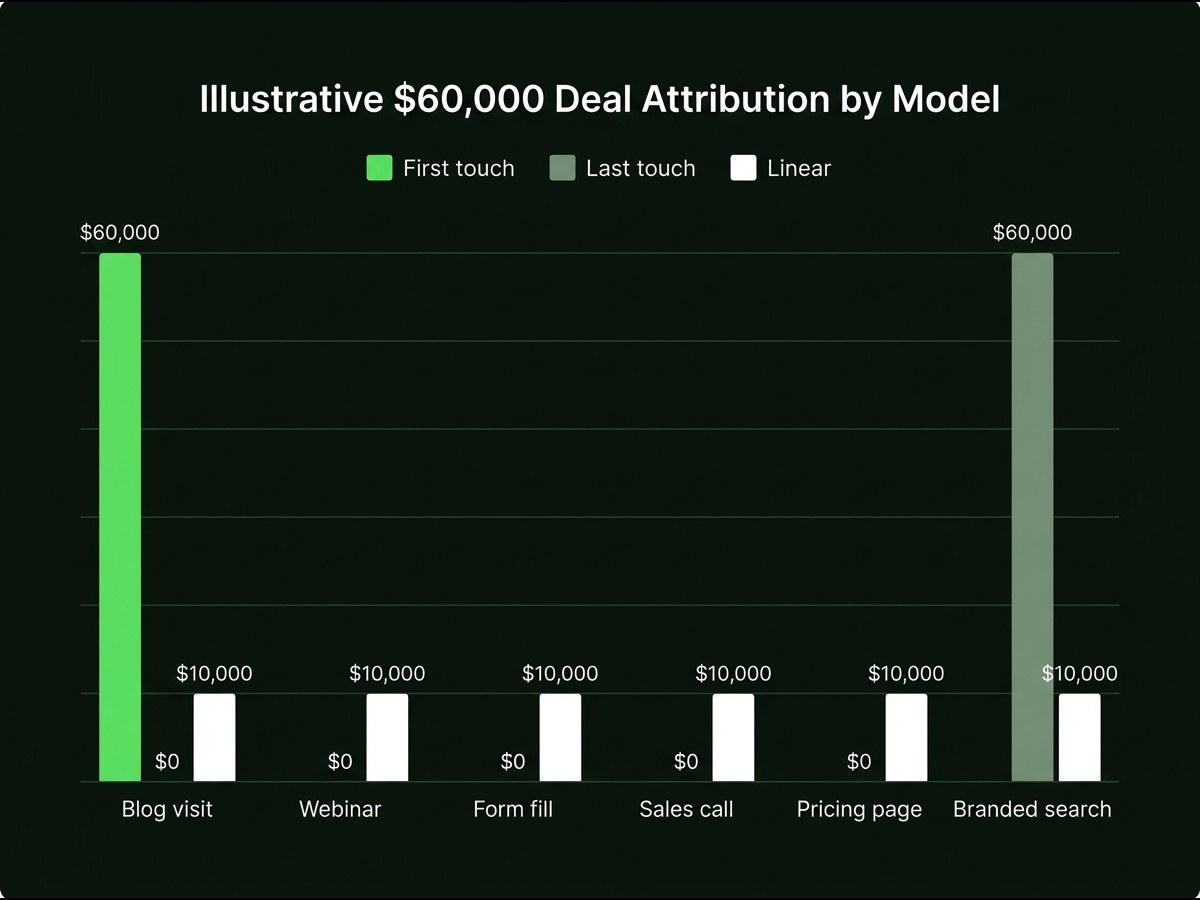
A worked example (illustrative): take a made-up $60,000 deal with six tracked touches: a blog visit, a webinar, a form fill that creates the lead, a sales call that creates the opportunity, a pricing-page visit, and a branded search click before signing. First touch gives the blog visit all $60,000. Last touch gives the branded search click all $60,000. Linear gives each touch $10,000. A W-shaped model gives the largest shares to the blog visit, the form fill and the sales call, and splits the remainder among the rest.
The budget decision changes with the model. Last touch says "double branded search, trim content." W-shaped says "protect the content that starts deals and the sales motion that converts them." Same deal, opposite moves.
Our recommendation is to start with a W-shaped or full-path model at account level. Account level matters because a deal belongs to a company, not to one contact. It's also how you measure ABM honestly. Then add two cross-checks: a first-touch view and self-reported attribution (the "how did you hear about us" answer). Where they disagree, you've found something worth investigating.
This fits our existing position that models are useful, never correct. I've built HubSpot, attribution and automation systems that replaced manual marketing workflows, and the W-shaped default holds because the lifecycle timestamps it needs are ones a well-built CRM can create.
Be careful with GA4. Its built-in attribution options are narrower than most teams assume, and Google has retired several rule-based models, so check what your property still offers. U-shaped or W-shaped reporting generally has to come from your CRM or a dedicated tool.
A word on data-driven models. They are machine learning applied to your paths, and they're only as good as the volume and cleanliness behind them. We treat AI as acceleration with human oversight, not a replacement for it. Someone still has to own the assumptions, and teams that skip the readiness check before any model tend to rediscover why CRM readiness comes first.
- First touch. All credit to the first interaction. Fits measuring demand creation. Fails by ignoring nurture and sales-assisted work.
- Last touch. All credit to the last interaction. Fits short, transactional cycles. In B2B SaaS it usually lands on branded search or direct, which harvests demand created elsewhere.
- Linear. Equal credit to every touch. A sane baseline. Fails by treating a webinar and a pricing-page visit as equals.
- Time decay. More credit nearer conversion. Fits shorter cycles. Fails by undercrediting early demand creation.
- U-shaped. Extra weight on first touch and lead creation. Default for lead-generation goals. Fails by ignoring the opportunity-creating touch.
- W-shaped. Adds weight on the opportunity-creation touch. Fits pipeline goals. Needs clean lifecycle stage timestamps.
- Full-path. Adds the closing touch. Fits long, multi-stakeholder deals. Same data demands as W-shaped.
- Data-driven. Learns weights from converting and non-converting paths. Fits high volume. Fails as a black box, needs volume, and is tied to the tool that runs it.
How do you choose an attribution framework for your revenue engine?
Choose by decision, not by feature list. Define the budget decision you need to make, check your cycle length and conversion volume, audit CRM data readiness, then pick the simplest model your finance and sales leaders will trust. Upgrade only when the data supports it.
Attribution framework selection works best as a sequence of filters, not a feature comparison. This is our four-filter method. Run the filters in order, because each one can stop you from buying more model than you can use.
Different leaders arrive with different triggers, so a model that wins one room and loses another isn't finished. Aligning data and process across those rooms is the RevOps job, and it's also where attribution configured on connected HubSpot data earns its place.
- Filter 1, the decision. Write down the one budget call this model must inform. "Which channels earn more budget next quarter" is a decision. "Better visibility" is not. If you can't name the decision, you aren't ready to pick a model.
- Filter 2, cycle and volume. Long cycles with a buying group need models that credit the middle of the journey. Low conversion volume rules out data-driven models, because they have too little to learn from. Short cycles with high volume can run simpler or more automated setups.
- Filter 3, data readiness. Check whether lifecycle stages carry timestamps, whether contacts attach to opportunities, and whether offline outcomes return to your platforms. If not, stop and fix those first.
- Filter 4, audience trust. The model must survive three rooms. The CRO owns pipeline quality and conversion, and needs to trust that stage credit matches how deals really move. The CFO needs numbers that feed CAC payback. The marketing leader needs something she can defend with a straight face.
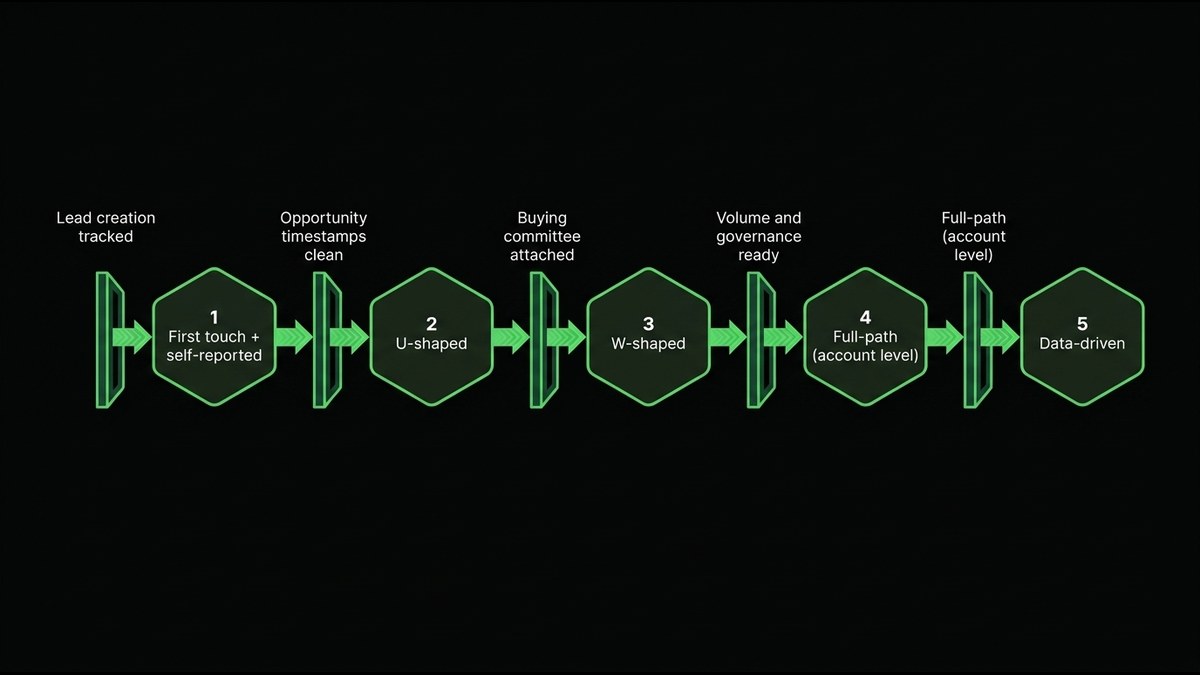
The "start here" ladder
This answers the objection that you lack the volume or the clean CRM for a fancy model. Good. Don't buy one. Start on a rung you can defend and climb when the data allows.
It also answers the objection that every model is wrong, so why bother. Because wrong in a known way is usable. You compare views, find where they disagree, and decide with open eyes.
Two stances shape how I run this. Adding channels rarely fixes growth. Better systems usually do. And most teams measure activity instead of business outcomes, which is why a framework starts from the decision. I've helped SaaS companies reduce CAC while improving lead quality, and it came from better operational alignment, not from adding another channel or a fancier model.
- Rung 1. First-touch view plus self-reported attribution. Works with modest data and a basic CRM.
- Rung 2. U-shaped, once lead creation is tracked reliably.
- Rung 3. W-shaped, once opportunity creation carries clean timestamps.
- Rung 4. Full-path at account level, once buying-committee contacts are attached to opportunities.
- Rung 5. Data-driven, only when volume and governance support it.
Pipeline source tracking: what data comes first?
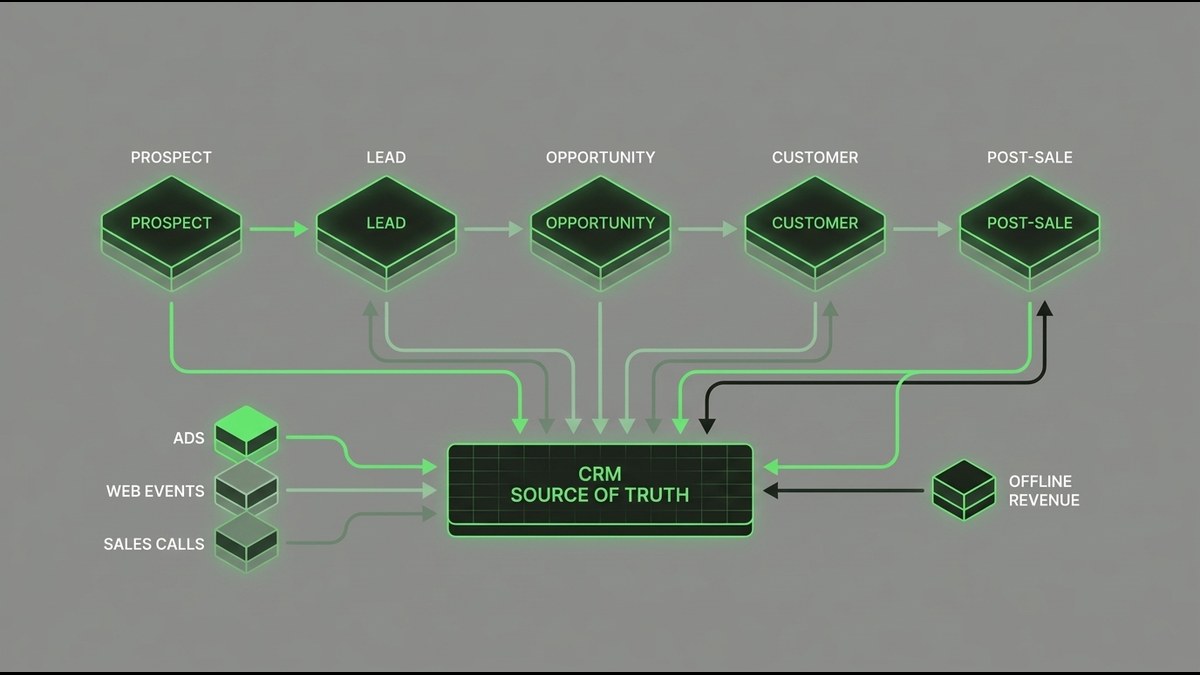
Before any model works, you need records that tell the same story about every deal. The foundation is operational, not analytical. Your CRM has to know where each opportunity came from, who was involved and when each stage changed.
We build this as a RevOps architecture in HubSpot that visualizes the complete customer lifecycle, from prospecting to post-sale. The goal is clear tracking of where each customer originated and what happened next. We treat it as architecture, not as a tool choice. I regularly combine SEO, paid media, CRM, analytics and automation into one integrated operating model instead of treating them as separate projects.
Start with CRM-connected conversion tracking with QA. It stops duplicate or phantom events from inflating your counts. The return path is where most B2B paid programs leak. Sending offline conversions back to your ad platforms lets the platform learn from deals, not clicks.
For GA4, map events to your funnel on purpose, so the web layer stays consistent with the CRM layer. Remember GA4's limits: don't expect position-based reporting from it.
The CRO owns pipeline quality and conversion, so the CRO should sign off on stage definitions. Once the data is live, review it by channel on a cadence: outbound, partnerships, events and podcasts, marketplaces. Look at pipeline created, SQL quality and conversion rates, plus time spent versus leverage. If quality drops, adjust.
- First-touch persistence. Store the original source on the contact record and never overwrite it.
- UTM governance. One naming convention, one owner. Inconsistent tags splinter one channel into six.
- Contact-to-opportunity roles. Attach every buying-committee member to the deal, with a role.
- Lifecycle timestamps. Stamp each stage change. W-shaped models depend on them.
- Offline conversion return. Send closed-won and qualified outcomes back to your ad platforms, so paid media optimizes to pipeline instead of form fills.
- Server-side events. Collect key events on your server so ad blockers and browser limits don't erase them.
How do you validate attribution before moving budget?
Treat attribution as a directional signal. Compare at least two model views plus self-reported "how did you hear about us" data. For large budget shifts, run a holdout or geo test. Move budget only when the views agree directionally or a test confirms it.
Remember that attribution shows association, not causation. A model tells you which touches sit near revenue. Only a test tells you what happens if you remove one. Check platform thresholds before relying on automated models, since data-driven options often carry conversion-volume requirements. Read your platform's current documentation for the exact numbers.
After 15 years in B2B marketing and more than 250 companies, I've seen the same pattern. Teams burned by an over-promising vendor often never asked the dashboard to disagree with anything. A validation step protects you. Any vendor or model worth using should survive it.
Keep a log of what you tested and what happened. Platform tweaks, paid media experiments and their results become your own evidence over time.
- Compare views. Pull the W-shaped view, a first-touch view and last touch for the same period. Note where channels rise or fall between them.
- Add self-reported data. Ask buyers how they heard about you, in a form field, on calls, or both. Software sees clicks. Buyers remember conversations. The gap between them is information.
- Test the big moves. A holdout test pauses a channel for a random slice of your audience and compares results with the rest. A geo test does the same by region. Both separate cause from coincidence.
- Apply a decision rule. If the views agree on direction, move a measured share of budget. If they conflict and the move is large, test first. If they conflict and the move is small, wait a cycle.
RevOps or demand gen: which fixes pipeline faster?
It depends on the failure. If demand is thin, demand generation moves faster. If pipeline is volatile, attribution disputes are constant, or lifecycle data is unreliable, RevOps fixes the cause first. In practice they should run as one system, not two departments.
Adding demand on top of broken data is how teams spend more and learn less. Fixing RevOps with no demand plan is how teams end up with clean reports on thin pipeline. Neither works alone.
SEO, PPC, RevOps, automation and CRO shouldn't exist as separate departments. They're parts of one growth system. That is why I built Effiqs around Growth Operations rather than traditional digital marketing services. Most agencies optimize campaigns. Few optimize the business. Ask any partner you're evaluating three questions: Do you diagnose before you deliver? Do you own architecture, or just channel tasks? Will you tie your work to pipeline and revenue, not impressions?
If the answer to any of those is vague, expect another dashboard that never held up.
- Choose demand gen first when. Tracking is sound, stages are defined, and the real issue is too few qualified accounts entering the funnel. More reach is a legitimate fix there.
- Choose RevOps first when. Pipeline swings quarter to quarter, GA4 and your CRM disagree, sales doubts lead quality, or nobody can say which source produced a closed deal.
- Run both together when. You have both problems, which is common in post-PMF SaaS outgrowing manual processes.
Where to start this quarter
The decision-first rule is simple. Name the budget decision. Check your cycle, volume and data. Pick the simplest multi-touch attribution model B2B leadership will trust. Then validate before you move money.
Diagnosis comes before delivery. Find out where your attribution breaks before you choose a model, and you'll avoid buying a confident answer to the wrong question.
- Write the decision. One sentence: which budget call will attribution inform this quarter?
- Audit the foundation. Check first-touch persistence, stage timestamps, contact roles and offline return. Fix gaps before changing models.
- Run two views. Set up a W-shaped or full-path view at account level next to a first-touch view, and add self-reported attribution.
- ✓ A multi-touch model is a decision tool, so name the budget decision before you name the model.
- ✓ Fix the touches you can't see and the records you can't trust before you blame the model.
- ✓ Default to W-shaped at account level, then test it against a first-touch view and self-reported attribution.
- ✓ Clean first-touch, stage and outcome data matter more than which model you run on top.
- ✓ Move budget when the views agree or a holdout or geo test confirms it, and not before.
FAQ
What is a multi-touch attribution model in B2B?+
A multi-touch attribution model splits credit for a deal across several buyer interactions instead of giving it all to one. Rule-based models use fixed weights, while data-driven models learn weights from converting and non-converting paths. It shows association between touches and pipeline, not proof of cause.
Which multi-touch attribution model is best for B2B?+
There is no single best model. U-shaped suits lead-generation goals, and W-shaped suits pipeline goals because it credits the opportunity-creating touch. Run either at account level and compare it against a first-touch view and self-reported attribution before changing budget.
What causes attribution blind spots in multi-touch B2B sales cycles?+
Blind spots come from untracked touches such as peer networks, DMs, events and podcasts, last-touch bias toward branded search and direct visits, long cycles that outlast lookback windows, and CRM gaps like missing buying-committee contacts or offline conversions. Most are data and process failures, not model failures.
How do you choose an attribution framework?+
Choose by decision, not by feature list. Define the budget decision you need to make, check your cycle length and conversion volume, audit CRM data readiness, then pick the simplest model your CRO, CFO and marketing leader will trust. Upgrade only when the data supports it.
How do you validate attribution before moving budget?+
Compare at least two model views plus self-reported "how did you hear about us" data. For large budget shifts, run a holdout or geo test. Move budget only when the views agree directionally or a test confirms the move.
Does GA4 support U-shaped or W-shaped attribution?+
GA4's built-in attribution options are narrower than most teams assume, and Google has retired several rule-based models, so check what your property still offers. U-shaped or W-shaped reporting generally has to come from your CRM or a dedicated tool.
RevOps or demand gen: which solves pipeline problems faster?+
It depends on the failure. If demand is thin, demand generation moves faster. If pipeline is volatile, attribution disputes are constant, or lifecycle data is unreliable, RevOps fixes the cause first. In practice they should run as one system.
Sources
- [1]Open-source marketing mix modeling example. Meta (Facebook Experimental), Robyn.