
The biggest growth agency contract red flags are open-ended scope billed by the hour, deliverables with no acceptance test, fees that rise with your spend, agency-owned accounts and data, no handover duty, auto-renewal with exit penalties, undisclosed subcontractors, and reporting you cannot tie to revenue. Each one moves risk from the agency to you. Check each clause before signing and ask for specific replacement language.
Most agency contracts get signed by marketing and read by finance last, if at all. A contract that pays for activity guarantees activity. Most agencies optimize campaigns. Few optimize the business. The paper you sign decides which kind you get.
This piece reads eight growth agency contract red flags the way finance reads them. Where does the money go? Who owns what gets built? How do we leave? If you want the wider frame first, run a scorecard for telling a growth partner from a vendor before you open the draft.
These agency agreement risks tend to surface in month four, not on day one. So test them on paper now.
Which scope terms are red flags?
Scope is a red flag when it is written as hours, "as needed" support or a list of activities. A sound contract names each deliverable, the acceptance test for it, and who approves a change before work starts. These are the first growth agency contract red flags to check, because every later clause depends on them.
Flag 1: Scope written as hours or "as needed." Hourly scope pays for effort. The agency bills when it works, whether or not anything ships. Slow work earns more, and the risk stays on your side of the table. "As needed" is worse. It has no edge, so every request turns into an argument about whether it was included. The pattern is easy to spot once you know how scope creep shows up in retainer work.
We reject hourly billing for this reason. Hourly billing rewards slow work and hides risk. Fixed scope puts the risk on the agency: you approve the price and outcome up front, and the agency is accountable to deliver it.
Ask for a fixed scope with a fixed price. Break it into milestones, each tied to a named output. Add a plan for what the team does after launch, so the work doesn't stop at a handoff nobody planned.
"Isn't flexibility good?" Yes, if change approval is written in. Flexibility without a change process is scope creep with friendlier wording. Ask for a one-page change order: what changes, what it costs, and who signs.
Flag 2: Deliverables described as activity, with no acceptance test. "Run paid campaigns" and "optimize the website" are activities. You can't reject them, because nobody can say what done looks like. Most pipeline problems aren't traffic problems. They're operations problems. A scope that only buys activity can't fix that.
A deliverable is something you can inspect. It might be a CRM with defined lifecycle stages. It might be a tracking setup that records a test conversion correctly. It might be a live landing page with the form wired to your system of record. Each one needs a test and an approver.
Tie each line item to a named growth tactic with a defined output. If a line item can't be tied to one, ask what you are paying for. If you can't write the acceptance test for a line item, you are buying activity, not a result.
Which fee and reporting clauses hide CAC?
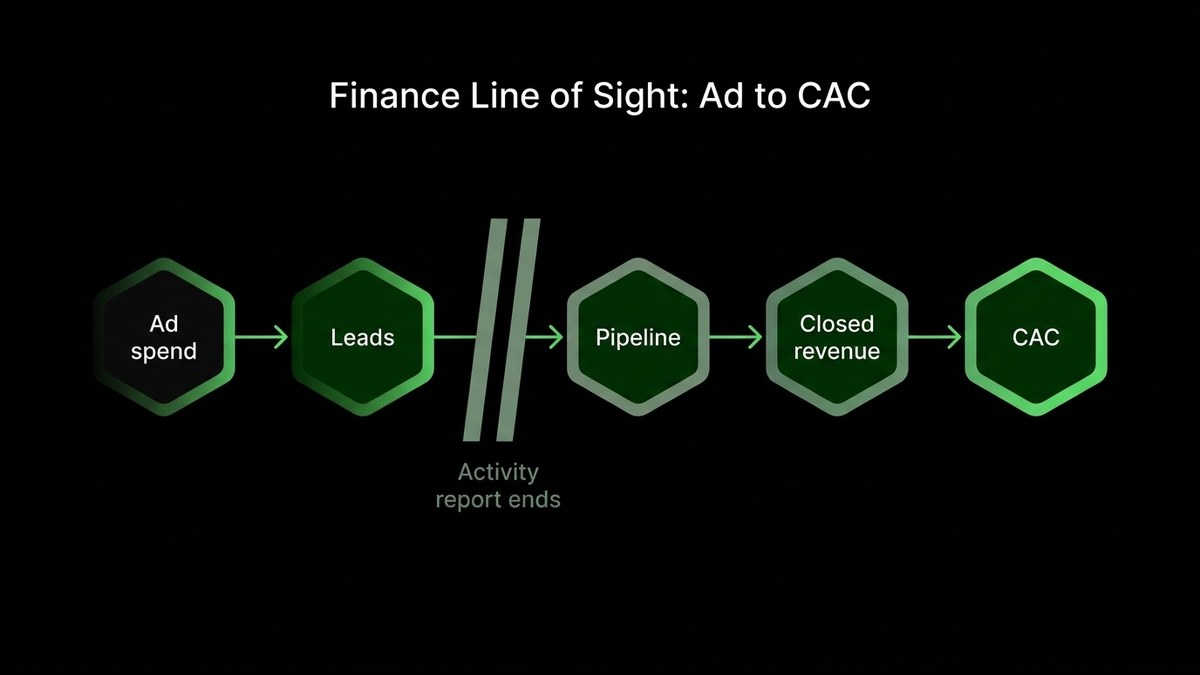
Watch for fees that grow with your ad spend and reports that count activity. Finance needs a fee schedule with caps, named pass-through costs, and metric definitions that connect spend to pipeline and revenue. Among growth agency contract red flags, fee terms are where finance has the most to lose. Contract evaluation here starts with one question: can I trace a dollar from invoice to closed revenue?
Flag 3: Fee mechanics that reward higher spend or hide pass-through costs. A fee that rises with ad spend pays the agency for spending, not for pipeline. Your incentives split the moment you sign. This is how marketing spend opacity starts, and it makes CAC-to-revenue opacity almost certain. Read the fee schedule line by line for the fee red flags listed below.
Ask for a schedule that lists every pass-through cost by name, with a cap and a rule for how it can change. Ask for the fee basis to be a defined build or outcome, not a share of your budget. That is the logic behind pricing tied to what gets built, not hours. The price follows the thing delivered, so you can see what you bought.
Flag 4: Reporting on activity, with no metric definitions or raw-data access. Impressions, clicks and "engagement" are activity. Most marketing teams measure activity instead of business outcomes, and a contract that accepts activity reports locks the habit in. Board reporting needs unit economics that hold up, and activity reports can't supply them.
Attribution isn't about giving credit. It's about making better investment decisions. That is why metric definitions belong in the contract. If "qualified lead" means one thing in the agency's report and another in your CRM, your CAC is whatever the agency says it is.
Ask the contract to name the four things listed below. The last one matters more than it looks. A site that loses visitors quietly turns paid traffic into waste, and an ad-only report never shows it. The goal is a pipeline you can forecast and revenue data your team trusts.
Prefer guarantees that define what an ICP-fit lead is and what one costs. A promise of "more leads" defines nothing. If a report can't be tied to CAC or revenue, it is a status update, not a reporting clause.
- Fee red flag. Percentage-of-spend fees with no cap.
- Fee red flag. Media markups that sit inside "platform costs."
- Fee red flag. Setup fees that never appear in the proposal.
- Fee red flag. Tool subscriptions billed through the agency.
- Fee red flag. Annual escalators buried in the renewal clause.
- Reporting clause. Name the system of record, usually your CRM.
- Reporting clause. Define each reported metric.
- Reporting clause. Give your team raw-data access, not screenshots.
- Reporting clause. Cover conversion on your website in reporting scope, not only ad clicks.
Who should own the accounts and data?
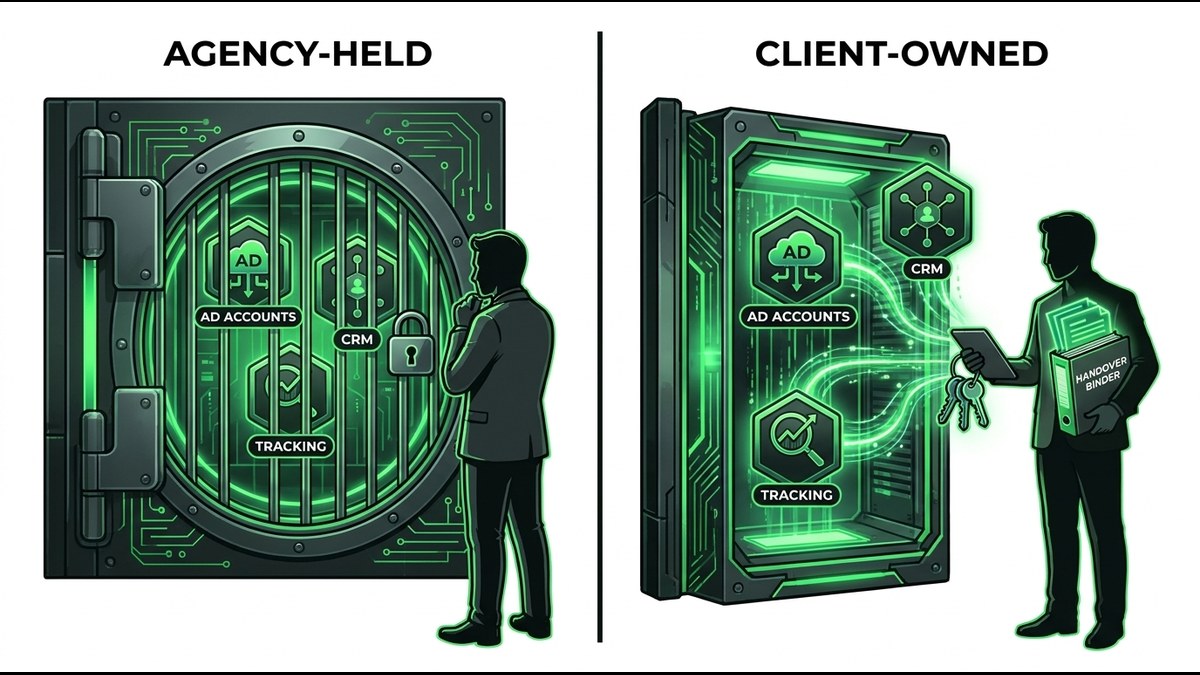
You should own every ad account, CRM, tracking container and dataset built with your money. The contract should say so, grant admin access from day one, and require documentation at the end. Anything less leaves you renting your own infrastructure, and agency-held assets are among the costliest growth agency contract red flags.
Flag 5: Agency-held ad accounts, CRM instances and tracking. Some agencies run your campaigns from their own ad accounts. Some host your CRM on their instance. Some keep the tracking containers under their logins. It feels convenient until the contract ends. Then the history, the audiences and the data stay with them.
The agency model breaks when you never own what's built. Client-owned growth infrastructure beats the dependency retainer, because the system keeps working when the relationship changes.
Ask for ownership language that covers each asset type by name. Ask for admin access on day one, not at termination. Your CRM is the source of truth, so it should be a CRM your team owns and trusts, built on your stack and under your login.
Flag 6: No handover, documentation or training duty at the end. An agency with no handover duty has no reason to make itself replaceable. That is a business model, not an accident. The value stays in people's heads, and you pay to keep it there.
I've spent 15 years in B2B marketing, working with more than 250 companies. The one thing I trust is a handover the contract requires, because goodwill at the end of an engagement is not a plan.
Every engagement we run ends with documentation, playbooks and training, so your team owns and runs the system. Effiqs is designed to work itself out of a job. Ask any agency to write the same duty into the agreement: what is documented, who is trained, and when the handover is accepted. Client-owned RevOps infrastructure such as CRM architecture, lead scoring and attribution is exactly what that documentation should cover.
If the system stops working when the invoices stop, you never owned it.
Which agency agreement risks should a CFO check?
Check five things: scope and acceptance, fee mechanics, ownership and handover, term and exit, and reporting definitions. If any answer is vague, ask for the clause in writing or walk away. Use the list below as a checklist of growth agency contract red flags, as vendor selection criteria and as a contract evaluation guide for any growth agency.
Effiqs is a growth operations agency serving B2B SaaS, FinTech, and Industrial firms, so we read these clauses from both sides of the table. For the full partner check beyond the contract, use the questions worth asking any growth partner.
Diagnose before you commit. See the gaps before you spend a dollar: our free audit returns a ranked list in 48 hours, and the quote for any of our growth operations services comes after, fixed and yours to approve.
This article is a contract-evaluation guide, not legal advice. Have counsel review any agreement before you sign it.
Bring the contract you are about to sign, and we'll show you where it leaves finance exposed.
- Flag 1, scope as hours. "As needed" support billed by effort. Ask for a fixed scope, a fixed price, and a written change-order process.
- Flag 2, activity deliverables. Outputs described as tasks with no way to reject them. Ask for a named deliverable, an acceptance test and an approver for each line.
- Flag 3, fees that track spend. Fees that rise with your ad spend, with pass-through costs unlisted. Ask for a fee schedule with caps and every pass-through cost named.
- Flag 4, activity reporting. Reports of clicks and impressions, with no definitions or raw data. Ask for named metrics, CRM as system of record, raw-data access and site conversion in scope.
- Flag 5, agency-held assets. Ad accounts, CRM and tracking under the agency's logins. Ask for client ownership of every asset, with admin access from day one.
- Flag 6, no handover. No duty to document or train at the end. Ask for documentation, playbooks and training required before final acceptance.
- Flag 7, lock-in. Auto-renewal with exit penalties and no off-ramp. Ask for a term tied to outcomes and a written exit path with handover.
- Flag 8, hidden delivery. Undisclosed subcontractors and no named lead. Ask for disclosure of everyone who delivers and a senior lead accountable by name.
- ✓ A contract that pays for activity only guarantees activity, so write scope as named deliverables with acceptance tests and approvers.
- ✓ Fees that rise with ad spend split your incentives from the agency's, so ask for capped fees and every pass-through cost named.
- ✓ Define metrics in the contract and tie reporting to your CRM, or your CAC is whatever the agency says it is.
- ✓ Own every ad account, CRM and tracking container from day one, and require documentation and training at handover.
- ✓ Tie the term to outcomes, get a written exit path, and require disclosure of who delivers the work.
FAQ
What are the biggest red flags in a growth agency contract?+
The biggest red flags are scope written as hours or "as needed," deliverables with no acceptance test, fees that rise with your ad spend, agency-held accounts and data, no handover duty, auto-renewal with exit penalties, undisclosed subcontractors, and reporting that cannot be tied to revenue. Each one shifts risk from the agency to you.
Is flexible scope in an agency contract a good thing?+
Flexibility is good only if change approval is written in. Without a change process, flexible scope is just scope creep with friendlier wording. Ask for a one-page change order that states what changes, what it costs, and who signs.
Who should own the ad accounts, CRM and tracking in an agency engagement?+
You should. The contract should name each asset type as client-owned, grant you admin access from day one, and require documentation at the end. If the agency holds the accounts, the history, audiences and data can stay with them when the contract ends.
Is a minimum term or auto-renewal always a red flag?+
No. A defined minimum term tied to an outcome is reasonable, because real build work takes time. The red flag is a term that renews itself, carries penalties for leaving, and has no off-ramp. Ask for a term tied to milestones and a written exit path that includes handover.
How can finance tell whether agency reporting is useful?+
Ask whether the report can trace a dollar from invoice to closed revenue. A useful reporting clause names the system of record, defines each metric, gives your team raw-data access, and covers website conversion. If a report can't be tied to CAC or revenue, it is a status update.