
A B2B lead scoring model ranks leads with two separate scores. The ICP fit score shows whether a company is worth working, based on firmographics and role. The behavioral score shows whether the buyer is active now, based on actions like pricing visits and demo requests. Fit decides who gets attention, and behavior decides when.
Fit tells you who deserves a sales conversation. Behavior tells you when. The trouble starts when a scoring model blends both questions into one number. Marketing hands over volume, sales ignores the list, and the score gets blamed.
A B2B lead scoring model usually fails in three recognizable ways. Volume arrives with no ICP fit. Sales and marketing hold different definitions of a good lead. The score cannot be traced back to what closes.
Before you score anything, agree on the ICP behind the score and decide which leads you will turn down. Then build two scores and combine them with a routing rule, not an average.
What is a B2B lead scoring model?
A B2B lead scoring model assigns each lead a numeric value so sales works the right ones first. It combines who the lead is (ICP fit) with what they do (behavior). The output is a priority order and a routing rule, not a vanity number.
It is not a single magic number. It is also not a substitute for lead qualification. Scoring ranks leads. Qualification decides which ones to decline. Teams that skip the second step end up scoring leads they should never have accepted.
Four plain questions sit behind a good model. Who is this (firmographic)? What did they do (behavior)? How deep was the engagement? When did it happen (intent and timing)? The first question feeds the fit score. The other three feed the behavioral score.
For a SaaS company, the model works as part of a revenue system, not as a standalone widget. Strategy defines the ICP, infrastructure carries the data, and demand programs such as lead generation built around pipeline, not form-fills, create the volume the model ranks. Behavioral signals then act as evidence of where buyers move and where friction costs pipeline, replacing assumptions about the journey with measurement.
How do you build an ICP fit score?
Compare your closed-won and closed-lost deals and find the attributes that actually differ: company size, industry, tech stack, buyer role. Weight those attributes, add negative points for known bad fits, and test the result against deals the model has not seen.
Start with evidence you already own, not a persona workshop. Pull the deals from your CRM. Look for a handful of attributes that separate winners from losers. Ignore attributes that look identical in both piles, however important they feel.
ICP scoring is only as reliable as the ICP agreed upstream. Account criteria should come from a documented definition, with clear logic for which accounts qualify and why. If sales and marketing never agreed on that, no weighting scheme will fix it. A B2B lead scoring model built on a disputed ICP just encodes the dispute in numbers.
Then work through these parts:
- Weights. Give more weight to the attributes that separate winners from losers most clearly. Relative weight matters more than exact points.
- Negative scoring. Subtract for disqualifiers: the wrong segment, students, competitors, personal email addresses.
- Committee role. A B2B purchase involves several roles. Score the role a person plays in the buying committee, not just seniority. A title alone misses the real decision structure.
- Validation. Score a set of later deals the model has not seen. If won deals do not score higher than lost deals, the criteria are wrong.
Which behavioral signals should raise a lead's score?
Weight signals that show buying intent over signals that show curiosity. A demo request or repeat pricing visit outweighs a blog read or email open. Add decay so old activity fades, and score at account level when several people from one company are engaging.
Tier your behavioral signals by intent. Set weights from observed outcomes, not gut feel. Check which actions came before closed-won deals, and give those the most weight. Forrester's buyer insights research, grounded in more than 17,500 global buyers, is a useful reference for how B2B buyers actually engage before they talk to sales.
Recency matters. A pricing visit last week says more than one last quarter, so let scores decay over time. Without decay, every long-dormant lead drifts toward hot.
Aggregate at the account level. Signals come from several people on a buying committee. Three contacts from one company reading different pages beat one contact clicking the same email repeatedly. Score the account, then show the contact-level detail underneath.
If you run a trial or freemium motion, product usage is a stronger signal than any content action. Treat reaching a key activation step as the top tier.
Be skeptical of email opens. They show that a message arrived, not that anyone is buying. Give them little or no weight.
The signals only help if they reach the CRM. A CRM-native lead scoring setup keeps fit and behavior in separate properties, with caps, negative values, and decay.
The logic should also live in infrastructure you own. Owned marketing automation infrastructure keeps the schema documented, so your team can adjust weights without waiting on an agency.
- High intent. Demo or contact requests, pricing pages, integration pages.
- Mid intent. Comparison content, webinar attendance.
- Low intent. Newsletter opens, a single blog visit.
Lead prioritization: how do you combine scores?
Use a routing matrix, not an average. High fit with high behavior goes to sales now. High fit with low behavior goes to nurture or account-based plays. Low fit with high behavior gets a light-touch or self-serve path. Low on both gets no rep time.
An average hides the two cases that matter most: the perfect-fit account that is quiet, and the poor-fit visitor that is noisy. Keep the scores apart and let the matrix decide lead prioritization.
Set thresholds from your own conversion data, not from a template. Compare conversion by score band and place each cut-off where conversion changes. A threshold copied from another company reflects that company's deals, not yours. A B2B lead generation agency worth hiring will ask for your conversion data before proposing any cut-off.
High-fit, low-behavior leads are not dead. They are not ready. Nurture programs for leads that are not ready yet keep them warm until a signal moves them into the first quadrant.
The handoff mechanics decide whether any of this works. Fire an alert when a lead crosses the hot threshold. Make scores visible in the CRM through HubSpot lead scoring and synced to marketing tools. Name one response owner, so no lead sits between teams. A B2B lead scoring model without a defined owner is a report, not a system.
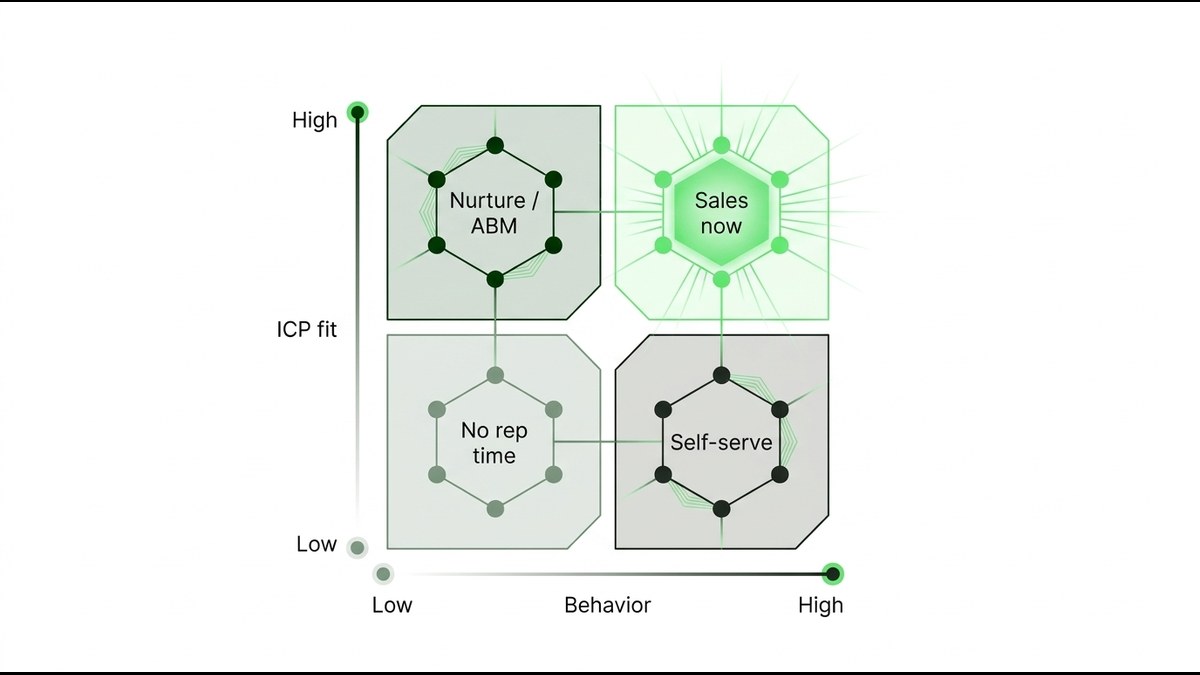
- High fit, high behavior. Route to sales now, with an alert and a named response owner.
- High fit, low behavior. Move to nurture or an account-based play until behavior changes.
- Low fit, high behavior. Send to a light-touch or self-serve path. Do not spend rep time.
- Low fit, low behavior. No rep time. Keep them in low-cost, automated communication or drop them.
How often should you retune a B2B lead scoring model?
Review it on a fixed schedule, at least quarterly, and whenever sales rejects a pattern of leads. Compare scores with what closed, retire signals that stopped predicting, and re-weight the rest. A model nobody reviews drifts away from the market it was built for.
Models rot for predictable reasons. The market shifts. The product changes. CRM data quality decays. Eventually sales stops trusting the number, and from then on the model is decoration.
Run a simple loop: collect sales feedback, with a reason code for every rejected lead; compare score against outcome for the last period; then re-weight, retire signals, and log what changed.
Be honest about limits. Scores are directional, not perfect truth. They improve decisions, but they do not remove judgment.
Measure the score by sales-accepted leads, not MQL volume. In our own work with clients, rebuilding a paid-search program from campaign structure to ad copy cut cost per lead by 35%. Conversions more than doubled and sales-accepted leads nearly tripled. That paid-search rebuild was not a scoring project. It shows why acceptance by sales, not lead volume, validates any lead-quality system.
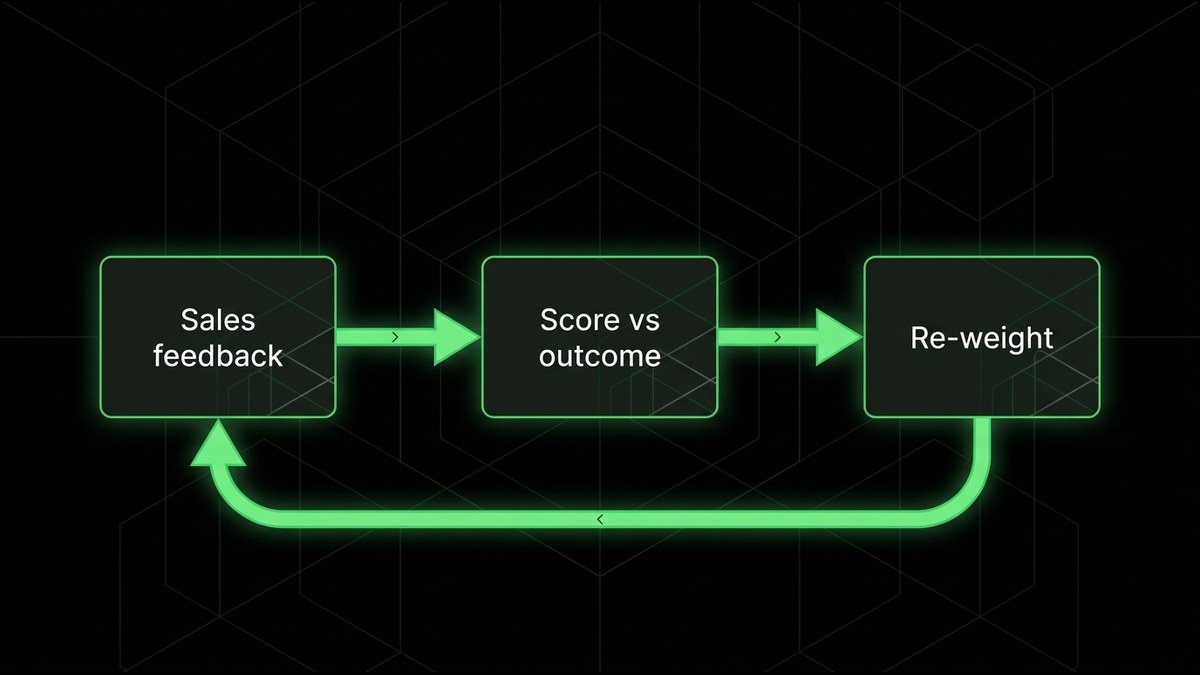
Two scores, one routing rule
Fit says who deserves attention. Behavior says when. The routing rule joins them without hiding either.
A B2B lead scoring model that sales trusts needs the ICP, routing logic and CRM data to agree with each other. If you want to build that system with senior strategy and owned infrastructure behind it, talk to effiqs.
- ✓ A scoring model ranks leads and sets a routing rule, while qualification decides who gets declined.
- ✓ Build the fit score from your own won and lost deals, then prove it on deals it has not seen.
- ✓ Score intent above curiosity, decay old activity, and roll signals up to the account.
- ✓ Route on fit and behavior together, with thresholds from your data and a named owner for hot leads.
- ✓ Retune on a schedule and judge the model by what sales accepts and closes.
FAQ
What is a B2B lead scoring model?+
A B2B lead scoring model assigns each lead a numeric value so sales works the right ones first. It combines who the lead is (ICP fit) with what they do (behavior), and its output is a priority order and a routing rule rather than a single vanity number.
How do you build an ICP fit score?+
Compare your closed-won and closed-lost deals and find the attributes that actually differ, such as company size, industry, tech stack and buyer role. Weight those attributes, subtract points for known bad fits, and validate the result on later deals the model has not seen.
Which behavioral signals matter most in lead scoring?+
Signals that show buying intent matter most: demo or contact requests, pricing pages and integration pages. Comparison content and webinar attendance are mid intent, while newsletter opens and a single blog visit are low intent. Add decay so old activity fades, and score at account level.
Why keep fit and behavior scores separate instead of averaging them?+
An average hides the two cases that matter most: the perfect-fit account that is quiet, and the poor-fit visitor that is noisy. Keeping the scores apart lets a routing matrix send each case to the right action.
How often should a lead scoring model be retuned?+
Review it on a fixed schedule, at least quarterly, and whenever sales rejects a pattern of leads. Compare scores with what closed, retire signals that stopped predicting, and re-weight the rest.
Sources
- [1]Forrester's buyer insights research is grounded in more than 17,500 global buyers. Forrester, Buyer Insights.