March 27, 2026
5
min
Your Direct Motion Has a Ceiling. Build a Partner Go-to-Market Plan That Breaks It.
By Effiqs | Growth Operations for B2B SaaS & Tech
Most B2B SaaS companies sign partner agreements and wait for pipeline that never comes, because they built a partner program, not a partner go-to-market plan. This blog breaks down the critical distinction between the two, explains the four partner archetypes and their revenue profiles, identifies the four execution gaps that cause most partner GTM plans to fail, and provides a five-phase framework, condensed into a structured reference table, for building a partner motion that generates predictable, compounding pipeline. Includes a 30-day diagnostic for CMOs and CROs to assess whether their current partner GTM is actually working.



The Channel Most CMOs and CROs Are Leaving on the Table
At some point, every high-growth B2B SaaS company hits the same wall. The direct motion, inbound, outbound, paid, that built early pipeline starts to slow. CAC climbs. Sales cycles stretch. Every new MQL costs more and converts less.
The instinct is to double down: more SDRs, more ad spend, a bigger content operation. But the motion that consistently breaks through that ceiling is the one most executive teams treat as an afterthought: a partner go-to-market plan.
The numbers are hard to ignore:
- Partner2B’s 2025 data shows that partner-sourced deals close 46% faster, carry 40% higher average order value, and win 53% more often than deals without partner involvement.
- The same Partner2B research finds that channel sales can reduce customer acquisition costs by up to 50% compared to field sales.
- Forrester’s 2025 research adds that two-thirds of organizations expect partner-influenced revenue to grow by more than 30% year over year.
The gap between those outcomes and actual partner investment persists because most companies build a partner program instead of a partner go-to-market plan. They sign agreements, set up a portal, share documents, and wait. Pipeline does not come, not because partners do not work, but because a relationship without a structured system behind it is not a growth motion.
What Is a Partner Go-to-Market Plan and Why Does the Distinction Matter?
A partner go-to-market plan is a documented, cross-functional system for creating, qualifying, and converting revenue through partner channels. It has its own ICP definition, messaging architecture, enablement infrastructure, co-marketing calendar, measurement framework, and a named owner accountable for pipeline outcomes.
That is fundamentally different from a partner program. A partner program manages commercial relationships. A partner go-to-market plan generates revenue from them. Conflating the two is the most expensive mistake B2B organizations make in this space.
What Kind of Partner Are You Actually Building For?
Before any GTM plan can be designed, CMOs and CROs need clarity on which partner archetype to activate. Each carries a distinct revenue profile:
- Technology partners integrate their product with yours to create a combined solution. Pipeline comes through co-marketing, marketplace listings, and shared customer expansion. Deal quality is high because integration signals serious buyer intent.
- Channel partners resell or refer your product to their existing customer base, offering the strongest CAC advantage because the distribution already exists.
- Strategic alliances generate the largest deals through joint value propositions and coordinated enterprise selling, but require the most structured operational support.
- Implementation and services partners accelerate deal velocity and expand your addressable market into segments your direct team cannot reach cost-effectively.
KPMG research from early 2025 found that 75% of business leaders now recognize ecosystem partnerships as a primary growth driver, not a trend, but a structural shift in how B2B markets operate (as cited in Digital Bloom, 2025).
Why Do Most Partner Go-to-Market Plans Fail?
Failure in partner GTM rarely traces back to the quality of the partners or the size of the market. It almost always comes down to four compounding execution gaps:
- No real ICP alignment. Partners are selected based on brand recognition or shared history, not verified customer profile overlap. When your ICP and your partner's ICP do not match, referrals arrive misfit and partners quietly deprioritize the relationship.
- Enablement treated as a one-time event. An onboarding call and a shared folder of PDFs is documentation, not an enablement system. Effective partner enablement is continuous: updated playbooks, competitive battlecards, and shared qualification criteria both teams actually use.
- No attribution infrastructure. In a 2025 survey, 36% of B2B GTM leaders identified scaling partner pipeline as their top challenge, and most could not separate partner-generated pipeline from other sources in their CRM (Digital Bloom, 2025). Activity without attribution is not a strategy.
How to Build a Partner Go-to-Market Plan That Actually Works
The following five-phase framework addresses each execution gap directly. Each phase creates the operational foundation the next one depends on.
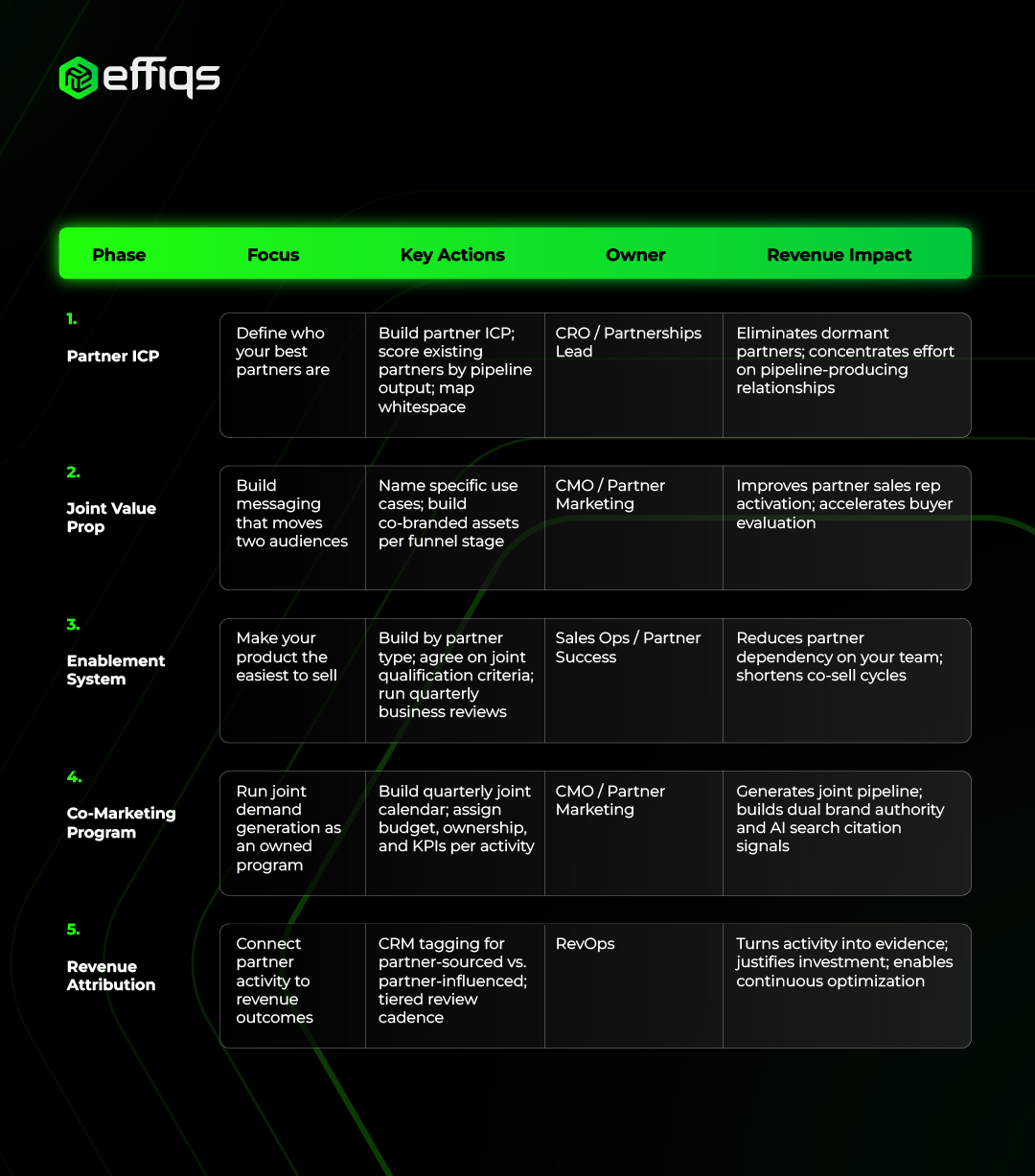
Two principles apply across all five phases. First, joint qualification criteria, agreeing with your partner's sales team on what makes a lead worth pursuing together, is the single highest-leverage enablement investment you can make. It prevents wasted cycles and builds the mutual trust that makes the relationship self-sustaining. Second, keep co-marketing content publicly accessible. Gated assets are underused by partner audiences and invisible to the AI search systems that increasingly shape how B2B buyers form opinions before engaging any vendor.
How a Partner Go-to-Market Plan Connects to the Rest of Your Revenue System
For CMOs and CROs building toward a unified revenue operating system, partner GTM is not a parallel track, it feeds and amplifies every other growth motion:
- With outbound: Account mapping data from partner ecosystems identifies prospects where a partner already has an active relationship. Reaching out to accounts inside a trusted partner's customer base consistently outperforms cold outbound on every metric.
- With demand capture: Content co-created with partners carries dual brand authority, reaches two audiences, and generates stronger citation signals for AI search systems, making it more likely to be surfaced when buyers research your category.
- With RevOps: The operational backbone of a partner GTM plan lives inside your revenue infrastructure: partner attribution fields in your CRM, automated deal registration, shared dashboards, and PRM-to-MAP integration. Without RevOps ownership of that infrastructure, partner data never enters the revenue system.
The Mutiny 2025 State of Sales and Marketing Alignment report found that fully aligned GTM teams are 2.3 times more likely to exceed revenue targets (as cited in GTM Now, 2025). Partner GTM is especially vulnerable to misalignment because it crosses internal functional lines and external organizational boundaries simultaneously. The CMO-CRO alignment model that governs your direct GTM motion must explicitly extend to cover the partner motion.
How Do You Know If Your Current Partner GTM Is Working? A 30-Day Diagnostic
Before committing to a full rebuild, a structured 30-day diagnostic gives CMOs and CROs a clear view of where the gaps actually are. Four questions to answer:
- Partner portfolio assessment: Which relationships are generating pipeline, and which are commercially active but operationally dormant? Analysis typically reveals that 80% of partner value comes from 20% of partners, and that most programs can be simplified immediately.
- ICP alignment audit: For each active partner, how much verified overlap exists between their customer base and your ICP? Are partner referrals producing the same buyer profile as your best direct customers, or a different segment with weaker conversion rates?
- Enablement gap analysis: Can your partners currently qualify, position, and co-sell your product without calling your team for help? Most enablement gaps can be closed within 30 days.
- Attribution infrastructure review: Can you report today on partner-sourced pipeline, partner-influenced pipeline, and partner-attributed revenue as separate CRM line items? This is often the single highest-leverage investment in any partner GTM plan.
Are You Building a Motion or Managing a Relationship?
The CMOs and CROs winning in B2B SaaS right now are not running more campaigns. They are building more durable infrastructure, systems that generate pipeline continuously instead of requiring constant manual intervention to restart.
A partner go-to-market plan, built as a systematic growth motion, is one of the highest-leverage infrastructure investments a B2B SaaS organization can make at the growth stage.
Stop managing relationships and start operating a revenue motion. If your partner pipeline has hit a ceiling, let's fix the infrastructure.
[Book a strategy call] to audit your system and start compounding your revenue.


Interested in more B2B Tech Resources?

Accelerate your B2B SaaS growth now
Build a durable foundation for predictable revenue growth.
BOOK A STRATEGY CALLContact
Programs
Helpful Links