
A RevOps tech stack audit is a structured review of every tool that touches revenue, including CRM, marketing automation, attribution, enrichment and reporting. It ends in a keep, merge, fix or cut decision for each tool. The goal is to remove duplicate spend, manual workarounds and disconnected data that make pipeline unpredictable.
The fourth enrichment tool never fixes the data problem. It adds a fourth invoice. Most companies don't have a lead generation problem. They have an operations problem, and they keep buying software to solve it.
Stacks grow one team at a time, and nobody owns the whole. This guide gives you a RevOps tech stack audit to run this quarter. It treats your RevOps infrastructure as one system instead of a pile of subscriptions.
Diagnosis comes first, because executing fast on the wrong system is the costliest mistake in growth.
What is a RevOps tech stack audit?
A RevOps tech stack audit treats each tool like a budget line. What does it do, who owns it, and which revenue decision depends on it? That separates it from a license inventory. An inventory lists what you pay for. An audit decides what happens next.
Forrester treats tech stack optimization as a strategic priority. Every tool gets a keep, merge, fix or cut decision, not just a place on a list. A list lets everyone feel busy and changes nothing.
Two situations trigger most audits. The first is a CRM nobody trusts. Deal stages are used inconsistently, fields are empty, and the forecast is an estimate the CRO discounts. The second is inherited sprawl: tools that arrived through an acquisition, or were bought country by country, with silos between them.
A marketing stack audit covers only part of this ground. The RevOps version follows a lead from first touch to booked revenue to forecast. RevOps exists to align sales, marketing and customer success around one revenue picture, so it should own the audit.
How do you run a RevOps tech stack audit?
Run these five steps in order. Each one feeds the next.
In step 5, rate each tool from 1 to 5 on three dimensions. Strategic fit: does the tool support a core revenue step, or a legacy habit? Usage: are the intended users active, and are paid features configured? Integration health: does data sync cleanly, or does someone reconcile it by hand?
Set your thresholds before you look at the scores, so politics does not move them. Tools weak on all three are cut candidates. Tools strong on fit but weak on integration are fix candidates.
Handoffs between sales and marketing systems are where trouble starts. That is why sales and marketing alignment belongs inside the audit scope, not after it.
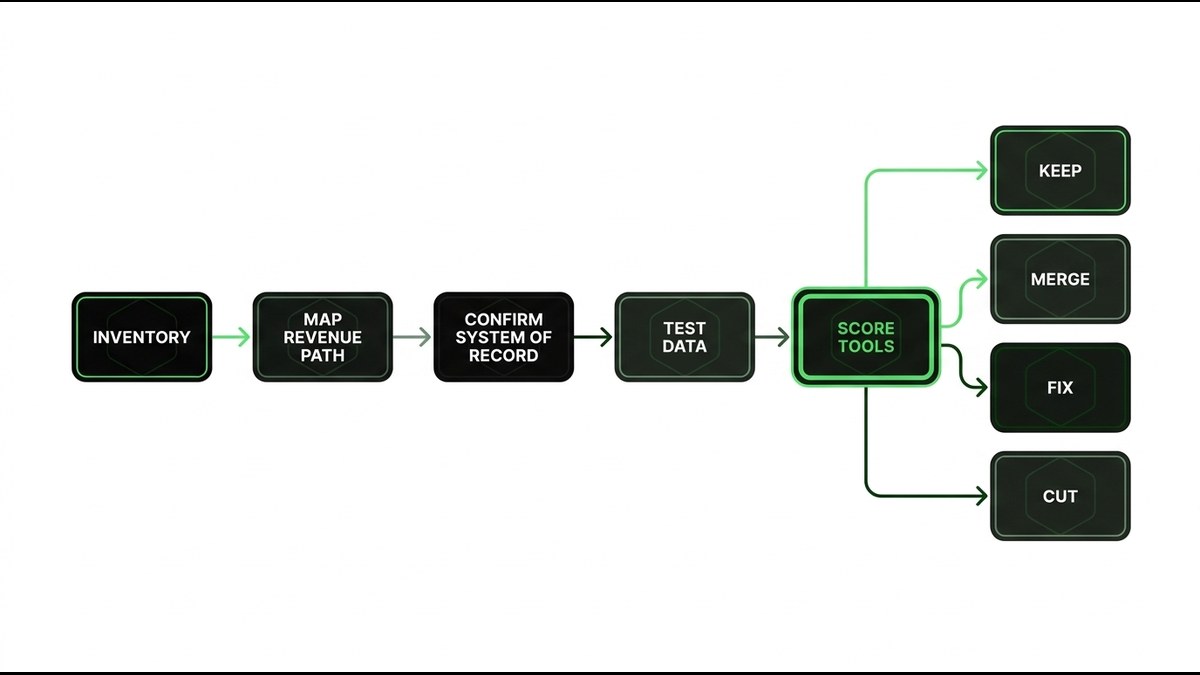
- Step 1: Inventory every tool. Export subscriptions from finance, then cross-check SSO logs for tools finance never sees. Record owner, cost, seats, renewal date, and stated versus actual use.
- Step 2: Map the revenue path. List each step from lead capture to routing, opportunity, close and reporting. Write down which tool performs each step. Duplicates and manual handoffs show up fast. Check the handoffs first, because most stack failures appear between tools, not inside any single tool.
- Step 3: Confirm the system of record. Decide which tool owns leads, accounts, deals and revenue. If two tools claim the same object, you have found a defect.
- Step 4: Test the data. Pull last quarter's closed-won deals and trace each one back to its source. Then check whether dashboards leave out any source and whether CRM numbers reconcile with finance.
- Step 5: Score and decide. Rate each tool from 1 to 5 on strategic fit, usage and integration health, then assign keep, merge, fix or cut.
What should a B2B CRM audit check?
The CRM is the system of record, so it gets its own pass. Inside a RevOps tech stack audit, a B2B CRM audit checks four things.
Feature comparison comes later. Don't start shortlisting vendors from CRM marketing resources until the audit shows whether the problem is the platform or the process around it. In my experience it is the process more often than anyone wants to admit.
- Adoption. A CRM that people don't maintain fails regardless of its features. Check who actually updates records and where reps work around the system.
- Stage governance. Every deal stage needs a written definition and an exit rule. If two reps read "qualified" differently, your pipeline report is fiction.
- Field integrity. Look at empty required fields, duplicate records and source fields that default to "direct." This is CRM data debt, and it compounds quietly.
- Forecast trust. An unreliable CRM produces a forecast leaders can't trust, and RevOps ends up cleaning data instead of improving the system. Ask whether your CRO would defend the forecast to the board without a caveat.
How do you run tech stack ROI analysis?
Most marketing teams measure activity instead of business outcomes. Logins, emails sent and workflows built tell you a tool is busy. They do not tell you it pays. One tool tied to one revenue decision beats a dashboard of twenty usage metrics.
A usable tech stack ROI analysis has two sides, cost and value.
Reconciliation hours are the line most teams skip, and they often outweigh the license. Cost per active seat is a useful cross-check, but only next to the value side.
Then apply one test. A tool that can't be tied to a named revenue decision or report has unproven ROI, whatever its invoice says. If nobody can say which dashboard or forecast call breaks without it, it is a cut candidate.
Give the CRO, the CMO and the RevOps lead the same one-page view: cost, decision supported, and the verdict. Automation spend deserves special scrutiny. Review it against the workflows that actually run, not the ones that were only configured.
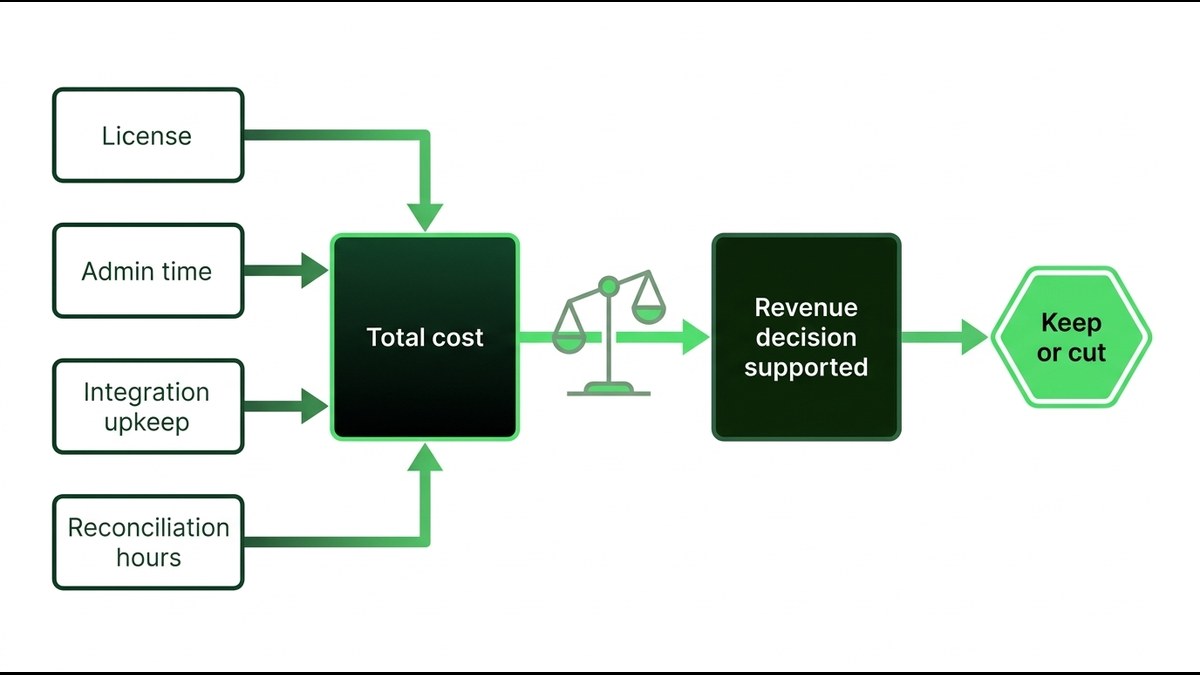
- Total cost of ownership. License, admin time, integration upkeep and the hours spent reconciling its data by hand.
- Value. The named revenue decision or report the tool supports.
Who should own the stack after the audit?
A RevOps tech stack audit fails when findings go into a slide and nobody owns the follow-through. Inherited stack chaos doesn't fix itself. Within a few quarters the stack drifts back to sprawl without three controls.
Some fixes are bounded. Rebuilding a CRM foundation so the forecast is the truth, not an estimate, is a project with a start and an end. Fragmentation across regions or acquisitions needs more: ongoing RevOps ownership that turns many tools into a single source of truth. If your audit surfaces structural work, you can scope the rebuild against the findings you already have.
- One named owner per system. Not a team. A person.
- Written rules for adding or retiring tools. No purchase without an owner, a workflow and a decision it supports.
- A renewal calendar. Review every contract before it auto-renews, using your keep, merge, fix or cut verdicts.
- ✓ An audit is finished only when every tool has a keep, merge, fix or cut decision attached.
- ✓ Hidden waste is overlap and broken handoffs, so audit the connections as hard as the tools.
- ✓ A CRM is worth what its data is worth, so audit trust before features.
- ✓ A tool with no named revenue decision behind it has unproven ROI, whatever its invoice says.
- ✓ The audit only pays off when each system has one named owner and each purchase has a rule.
FAQ
What is a RevOps tech stack audit?+
It is a structured review of every tool that touches revenue, from CRM and marketing automation to attribution, enrichment and reporting. Each tool ends with a keep, merge, fix or cut decision, which is what separates an audit from a simple license inventory.
What are the steps in a RevOps tech stack audit?+
There are five steps: inventory every tool, map the revenue path from lead capture to reporting, confirm the system of record for leads, accounts, deals and revenue, test the data by tracing closed-won deals to their source, then score each tool and assign a decision.
How do you score tools in a tech stack audit?+
Rate each tool from 1 to 5 on strategic fit, usage and integration health. Set thresholds before reviewing the scores. Tools weak on all three are cut candidates, and tools strong on fit but weak on integration are fix candidates.
What should a B2B CRM audit check?+
It should check adoption, stage governance, field integrity and forecast trust. In practice that means who actually updates records, whether every deal stage has a written definition and exit rule, how many required fields are empty or duplicated, and whether the CRO would defend the forecast without a caveat.
How do you calculate ROI for a RevOps tool?+
Compare total cost of ownership with the value of the named revenue decision or report the tool supports. Cost includes the license, admin time, integration upkeep and hours spent reconciling data by hand. If a tool can't be tied to a named decision or report, its ROI is unproven.
Who should own the stack after the audit?+
Each system needs one named owner, meaning a person rather than a team. Add written rules for buying and retiring tools, plus a renewal calendar so every contract is reviewed against its keep, merge, fix or cut verdict before it auto-renews.
Sources
- [1]Forrester treats tech stack optimization as a strategic priority. Forrester.