
HubSpot CRM architecture is the structure that decides how outbound data is stored, grouped and moved: a contact schema that prevents duplicates and captures source, list segmentation that keeps ICP fit separate from engagement, and lifecycle automation that routes every record to the right owner. Build all three, in that order, before you scale sequences.
I manage B2B paid media and the tracking infrastructure behind it. So I read a CRM the way I read an ad account: where did this come from, and can I trust the count? Volume does not break your CRM. It exposes the architecture you never built. More sequences mean more duplicate records, blind attribution and manual triage.
That is a structural problem. A cleanup sprint will not fix it. This guide gives the build order: schema, segmentation, lifecycle.
What is HubSpot CRM architecture for high-volume outbound?
HubSpot CRM architecture is the set of design decisions behind your data model, segmentation and automation. For outbound, it decides whether every contact has a clean record, a known source, a lifecycle stage and an owner before a sequence sends a single email.
Three foundations form the spine of this article.
It is not a tool tour. It is not a settings checklist. It is a system, and HubSpot is the environment it runs in. Routing, alerts and stage changes belong in HubSpot workflows tied to your funnel. They should not be one-off rules added during a busy week.
Outbound is a revenue channel, so the same pain shows up everywhere. Marketing, sales and RevOps tools drift apart. The CRM stops being a trusted source of pipeline truth.
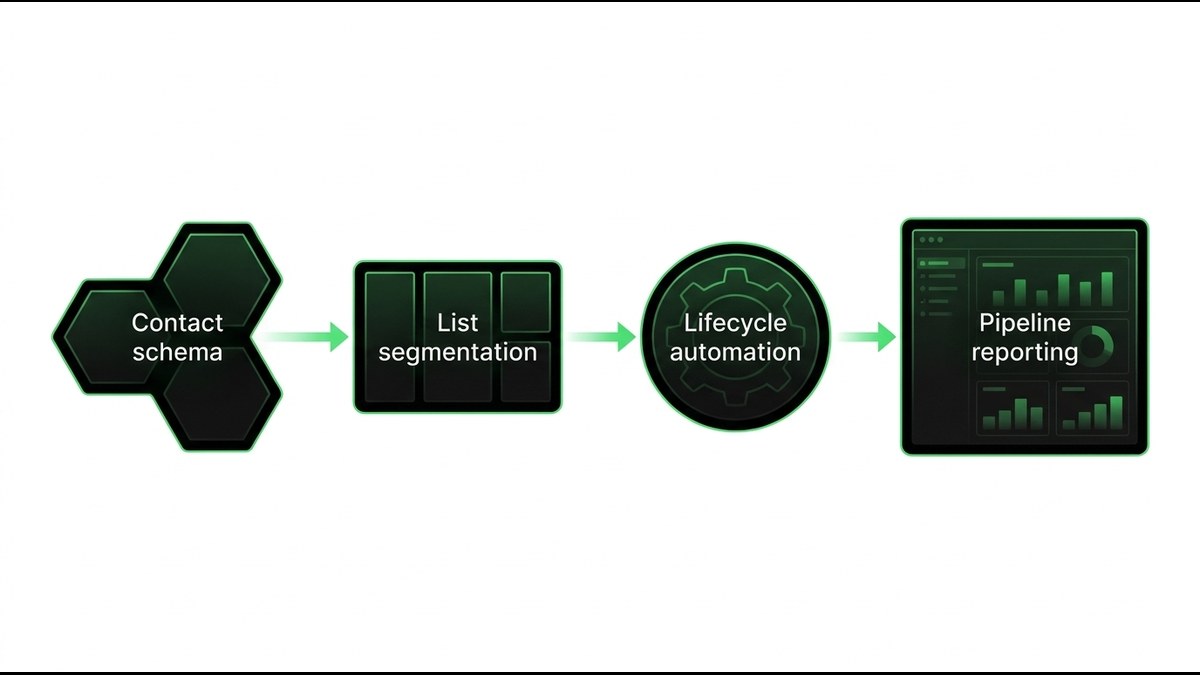
- Contact schema. What you store and how duplicates are blocked.
- List segmentation. Who may enter a sequence, and what happens after they react.
- Lifecycle automation. How a record moves, who owns it and who gets alerted.
Why does high-volume outbound break HubSpot CRM architecture?
Volume multiplies whatever structure already exists. Without a defined schema, segmentation and lifecycle logic, more sequences mean more duplicates, untraceable sources and manual triage. The CRM stops reflecting pipeline reality. Reporting stops being trusted.
You will recognise the failure modes below. The last one matters most. A lead outside your ICP is not pipeline, even when a meeting gets booked. Duplicates distort reporting the same way. If you have seen duplicated conversion events inflate an ad account, you know the logic. The same event counted twice looks like growth.
The usual plan is "we'll clean it up after we see results." That plan costs more than building structure first. Every unstructured record has to be repaired by hand later.
Here is where I stand: "Paid media strategy must focus on tracking, reporting insights, and true buying intent rather than vanity metrics." I apply it to outbound without changes. Sends and opens are activity. Traceable source and real buying intent are signal. I argue against judging outbound by volume, because volume is the easiest number to inflate.
- Duplicate contacts and companies. Two records for one buyer means two owners, two histories and one confused rep.
- Lost source. Nobody can say which outbound touch created the pipeline.
- Manual triage. Replies sit in shared inboxes while someone checks who should answer.
- Off-ICP records counted as pipeline. A booked meeting with the wrong company still inflates the numbers.
How to design the contact schema in your HubSpot CRM architecture
Keep the schema small and enforced. Every field must drive routing, segmentation or reporting. If a field does none of these, leave it out. The objection is familiar: "more fields means more insight." It does not. Extra fields add noise, invite inconsistent entry and slow every report.
Start with the required properties listed below.
For deduplication, pick one identifier logic (email, domain or a composite) and enforce it at entry. The exact choice matters less than the enforcement. A rule applied after import is a cleanup. A rule applied at entry is architecture. Lock property types too. Dropdowns beat free text, because free text splits one value into five spellings.
A record is complete only when it is clean and the problem statement is documented. That standard makes a handoff possible. Many instances that struggle with outbound have a defined sequence but no defined record standard.
I have spent four years in digital marketing across PPC, tracking and reporting insights. One lesson holds in all of them: "Reporting insights should simplify complex data into practical, visual takeaways." A schema built for clean takeaways makes the dashboard obvious. A schema built to "capture everything" turns it into a puzzle.
- ICP fit. Industry, company maturity, senior buyer persona and an identifiable growth pain.
- Source. Where the record entered, stamped at creation.
- Persona. The role you are reaching, so you can model several buyers per account.
- Outreach status. Where the record sits in the sequence logic.
- Owner. One named person, assigned by rule.
How to segment HubSpot lists for outbound sequences
Segment on fit first, then engagement. Fit lists decide who may enter a sequence. Engagement lists decide what happens next. Mixing the two is how off-ICP leads slip into campaigns and inflate activity numbers.
Think of it as a simple matrix of three lists. Fit gates entry. Engagement signals only matter once the record has passed the gate.
Persona matters here. Outbound often reaches several people in one account, across marketing, revenue and executive leadership. If persona is a property, you can run persona-specific sequences. You also avoid sending two stakeholders the same email on the same day.
Fit rules connect to lead scoring as well, with fit and engagement points built around your ICP. Teams often ask which order to fix positioning, funnel, CRM and demand in. For the CRM piece, the answer is clear: segments come before sequences, always.
- Fit list. Question: may this record enter a sequence? Based on: industry, company maturity, senior buyer persona, identifiable pain. Result: in or out.
- Engagement list. Question: what should happen after contact? Based on: replies, meetings, follow-up status. Result: next action and owner.
- Exception list. Question: what needs a human decision? Based on: unclear fit, missing persona, duplicate flags. Result: manual review before entry.
How lifecycle automation works for B2B outbound in HubSpot
Lifecycle automation moves a record through defined stages on defined triggers. It assigns an owner at each step and alerts the right person. It replaces manual handoffs, so a qualified reply reaches sales with a complete record and nothing waits in a shared inbox.
A lifecycle stage is a label for where a person stands with you. Stage names vary by team. The logic does not. Each stage needs an entry trigger, an owner and a next action.
Good CRM workflow automation that B2B teams can trust follows the three rules below. Tracking is where I see this go wrong most. A source that is not captured at entry cannot be rebuilt in a report later. No dashboard fixes it.
The same goes for events. Webinar attendees and podcast listeners should enter the CRM with a source. Their follow-up should join the same workflows as outbound. Otherwise they become a second, unmanaged list.
Your HubSpot sales process stages should mirror how you actually sell. If the process lives in people's heads, the workflows cannot copy it. Write the stages down first, then build.
The handoff standard matters most. Outbound owns pipeline creation, not closing. Ownership passes only when the qualification criteria are met, the record is clean and complete, and the problem statement is documented. Handoff is a rule, not a courtesy.
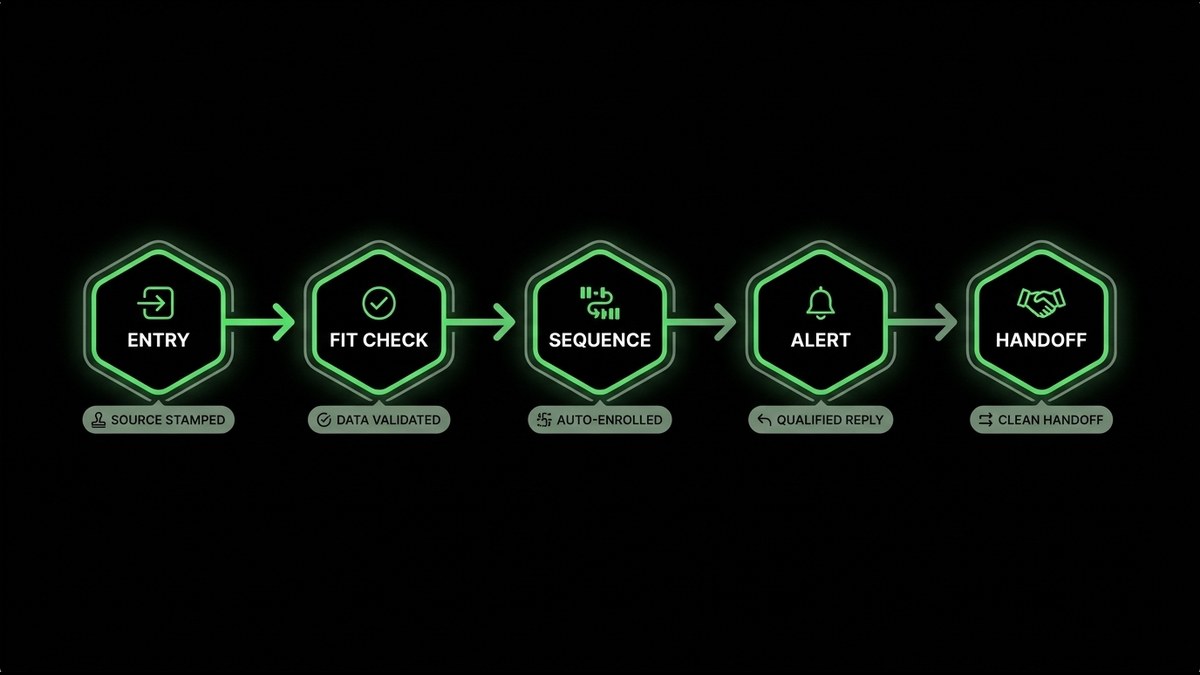
- Assign owners by rule against fit. Not by whoever sees the reply first.
- Stamp source at entry. If it is missing at creation, attribution is lost for good.
- Alert on qualified replies. So triage becomes a review, not a hunt.
What should be in place before you scale HubSpot sequences?
Three things: an enforced contact schema, ICP-based segmentation, and lifecycle automation with clear ownership. Add a source-tracking rule so pipeline can be traced to the outbound touch that created it. Scale volume only after these are tested on a small batch.
Founders ask what has to exist before pipeline scales without them. This is the CRM half of the answer. Use the order below for your HubSpot outbound setup.
The most expensive mistake in growth is executing on the wrong system fast. A test batch is the cheap way to find the wrong system. Read the records, not the send counts. Check duplicates, source gaps and owner assignment first.
This is not an open-ended project. Three foundations, in a set order, come before volume. Everything else can be iterated once the batch proves the base. Once volume rises, the structure needs ongoing care, so plan for HubSpot hygiene and reporting before the first sequence goes live.
- Step 1. Lock required properties and the deduplication rule.
- Step 2. Build fit lists and an exception list.
- Step 3. Write lifecycle stages with entry triggers and owners.
- Step 4. Stamp source at entry on every channel.
- Step 5. Run a small, controlled test batch.
- Step 6. Review the records, fix gaps, then raise volume.
Schema first, then segments, then lifecycle
The order matters. Schema makes records trustworthy. Segmentation decides who is allowed in. Lifecycle automation moves them to the right owner. Skip one and the other two carry the load badly.
Name the problem first, then build the structure. Outbound volume is not the risk. Volume without a record standard is. Good HubSpot CRM architecture is what turns outbound activity into pipeline you can trace.
- ✓ Architecture is the data model, the segments and the automation, designed together before volume arrives.
- ✓ Volume does not create the mess. It makes the existing mess impossible to ignore.
- ✓ A small schema with one deduplication rule and one source field beats a large schema nobody fills in.
- ✓ Fit decides who enters a sequence. Engagement decides what happens next. Never let one list do both jobs.
- ✓ Every record needs an owner, a source and a next step. Test the structure on a small batch, then scale.
FAQ
What is HubSpot CRM architecture for outbound?+
It is the set of design decisions behind your data model, segmentation and automation. For outbound, it decides whether every contact has a clean record, a known source, a lifecycle stage and an owner before a sequence sends a single email.
Why does high-volume outbound break a HubSpot CRM?+
Volume multiplies whatever structure already exists. Without a defined schema, segmentation and lifecycle logic, more sequences mean more duplicates, untraceable sources and manual triage, and reporting stops being trusted.
How should I segment HubSpot lists for outbound sequences?+
Segment on fit first, then engagement. Fit lists, based on industry, company maturity, senior buyer persona and identifiable pain, decide who may enter a sequence. Engagement lists decide what happens after contact. Add an exception list for records that need a human decision before entry.
What should be in place before I scale HubSpot sequences?+
An enforced contact schema with a deduplication rule, ICP-based segmentation, and lifecycle automation with clear ownership. Add a source-tracking rule, then run a small test batch and review the records before raising volume.
When should an outbound record be handed to sales?+
Ownership passes only when the qualification criteria are met, the record is clean and complete, and the problem statement is documented. Outbound owns pipeline creation, not closing, so handoff is a rule rather than a courtesy.