
MSP lead generation that does not depend on referrals means building two or three channels you control: search pages that capture buyers already looking, paid search on high-intent queries, and a short outbound list of named accounts. Add a systematic referral ask, and track every channel to qualified consultations in your CRM.
Your pipeline rests on other people's goodwill. A client recommends you, a peer makes an introduction, and a quarter goes well. Then the flow dips and nobody can say why. We see this pattern often in founder-led firms.
In our view, lead generation is the capture layer inside demand generation, which builds the market. This piece sets out a sequence for adding channels you control, and a way to measure each one. We are not arguing against referrals. We are arguing against having nothing else.
What does MSP lead generation look like?
It is a small set of channels, each with one job. Search and content capture people already looking. Paid search buys presence on high-intent queries. Outbound reaches named accounts. Referrals become one input, not the whole pipeline.
We use a three-job frame: capture, create, ask. Capture is search and paid search. Create is the slower work of building the market. Ask is the referral step, done on purpose.
Channels are not interchangeable. Each does one job well and fails at the others. A search page will not create urgency. An outbound list will not compound on its own.
Most pipelines also record who filled in a form but not why a deal moved or stalled. That lost context is what makes the next quarter hard to plan. The fix starts with choosing channels on purpose.
Takeaway: give every channel one job, and stop expecting any single one to do all three.
Why are referrals a ceiling, not a strategy?
You are the highest-paid SDR in the company. When referrals slow, growth slows with them, and the only lever is your own network.
Referrals depend on other people's timing, so you cannot schedule, scale or forecast them. They also arrive untracked, which hides what drives growth. A pipeline you cannot test is one the founder has to protect by hand.
The ceiling is lack of control, not lack of quality. Referred buyers are often excellent. But buyers also shortlist before they ever contact you, and a firm that only appears through introductions misses every buyer who searches first.
A B2B lead generation strategy sets out segments, offers, channel mix, sequencing and qualification rules. It only works if you can see results. Marketing attribution is the process of measuring and assigning credit to any channel or touchpoint that affects pipeline and revenue. Without it, strategy cannot be tested and stays a document.
Takeaway: the problem with referrals is that you cannot steer or measure them.
Who should an MSP target first?
Target the clients you already win and keep: the same size, stack, industry and buying trigger. Define that profile from closed deals before you spend anything. Without it, new channels bring volume that sales cannot close.
Pull your last dozen wins. Look for what they share, not what you wish they shared. Then look at the deals you lost or regretted. The profile comes first, before any channel decision.
Watch for drift. Pipecorn's ICP guidance lists the signs: large variance in deal size and sales cycle length, low stage-to-stage conversion, tension between marketing and sales, and deals justified as "edge cases." If you hear "this one is different" every week, your profile is too loose.
Takeaway: write the profile from closed deals, then aim every channel at it.
Which channels should an MSP add first?
Add the fewest channels that match how your buyers actually looked for you. This is a sequence of decisions, not a menu. We use four steps.
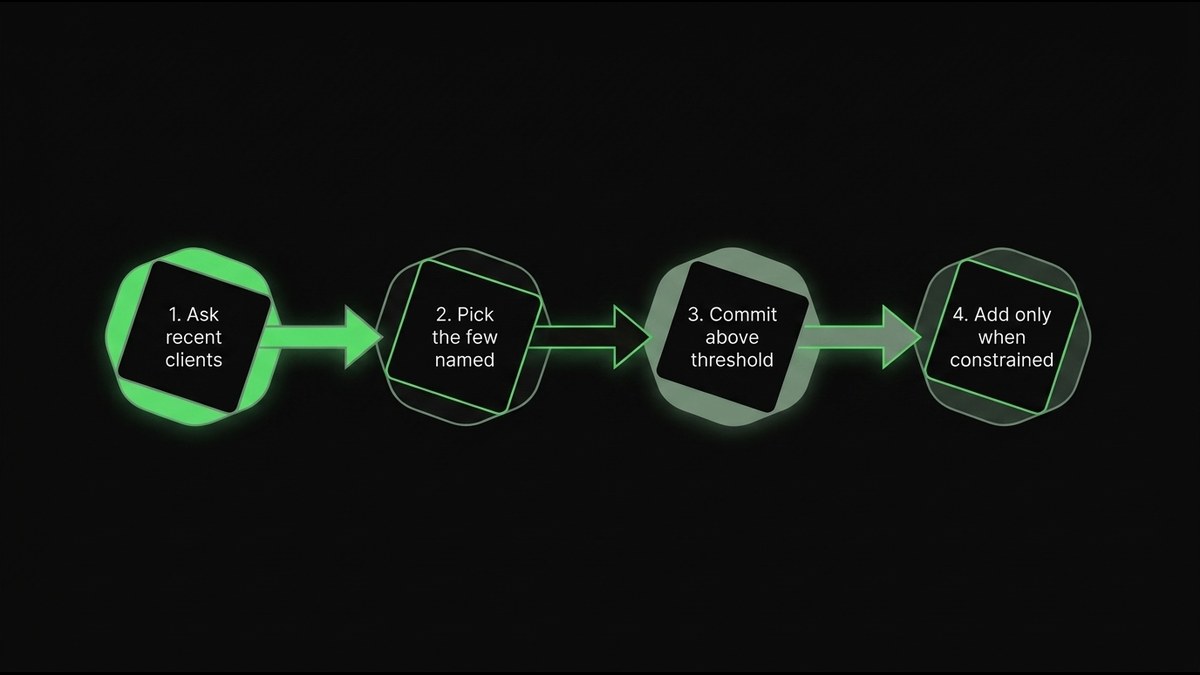
- Ask recent clients.. Find out where they looked and who they consulted.
- Pick the few they named.. Keep the list narrower than any benchmark deck.
- Commit above the threshold.. Fund each channel enough that it can work.
- Add only when constrained.. Never add a channel to escape underperformance.
- Search and content:. Captures existing demand. It compounds slowly and does not create urgency.
- Paid search:. Buys immediate presence on high-intent queries. It stops the moment the budget stops, and it wastes money without tight negative keywords.
- Outbound to named accounts:. Reaches buyers who are not searching. It needs a short, well-researched list and takes sustained effort.
How do you turn referrals into a system?
Ask on a schedule, at defined moments, with a named owner. Referrals close faster than most other sources, yet most firms get them by accident because nobody asks systematically. Make the ask a step in the client lifecycle.
Choose the moments. A successful onboarding, a resolved incident and a strong quarterly review are natural points. Assign one person to each. Log every ask and every introduction in your CRM, so referrals stop being invisible.
The asking is the whole program. It needs no new tool, only a habit and an owner.
Takeaway: keep referrals, but stop leaving them to chance.
Which channel is producing MSP pipeline?
Track every lead source into your CRM and count qualified consultations, not form fills. Agree one definition of "qualified" with whoever takes the call. Review by channel monthly and cut what does not convert.
Few teams do this well. In one study of 1,275 marketers, only 8% could be defined as lead generation optimizers. Most teams are guessing, and the measurement gap is where budget gets lost.
Keep the qualification rules simple. Predictive lead scoring is trained on historical converted leads. A small MSP with few closed deals does not have enough history for that. Start with plain rules: fit to your profile, a named buying trigger, and a decision-maker on the call.
Report against pipeline, not impressions or clicks. That is how we work across B2B teams: $470M+ influenced across 70+ B2B teams over 15+ years, reported against pipeline. We have no MSP-specific result to quote, and we would not imply one. The method still holds: one source field, one qualification rule, one monthly review.
Set up the tracking before you spend. Then each channel earns its place or loses it.
Takeaway: count qualified consultations by channel, and let the numbers decide what stays.
What should you do next?
Start small. Write your profile from closed deals. Ask five recent clients where they looked. Pick two channels, build the tracking, and put a named owner on the referral ask.
If the pipeline still depends on who recommends you, the fix is a system you own. Senior strategy and in-house build can get you there faster, with documentation and playbooks handed over so the system stays with you.
- ✓ Give every channel one job: capture, create or ask. No single channel does all three.
- ✓ Referrals are a ceiling because you cannot steer, schedule or measure them, not because the leads are poor.
- ✓ Write your target profile from closed deals, then aim every channel at it.
- ✓ Pick two channels your buyers named, fund them properly, and widen only when they are working.
- ✓ Count qualified consultations by channel in your CRM, and let the numbers decide what stays.
FAQ
Why shouldn't an MSP rely only on referrals?+
Referrals depend on other people's timing, so you cannot schedule, scale or forecast them, and they usually arrive untracked. Buyers also shortlist before contacting anyone, so a firm that appears only through introductions misses every buyer who searches first.
Which lead generation channels should an MSP add first?+
Add the fewest channels that match how your recent clients actually looked for you. Typically that means search and content to capture existing demand, paid search on high-intent queries, and outbound to a short list of named accounts. Fund each enough to work, and add another only when you are constrained.
How do you make MSP referrals more predictable?+
Ask on a schedule, at defined moments such as a successful onboarding, a resolved incident or a strong quarterly review, with a named owner for each. Log every ask and introduction in your CRM so referrals become visible and trackable.
How should an MSP measure which channel produces pipeline?+
Track every lead source into your CRM and count qualified consultations, not form fills. Agree one definition of qualified with whoever takes the call, review by channel monthly, and cut what does not convert.
Does a small MSP need predictive lead scoring?+
Usually not. Predictive lead scoring is trained on historical converted leads, and a small MSP with few closed deals lacks enough history. Start with plain rules: fit to your profile, a named buying trigger, and a decision-maker on the call.
Sources
- [1]Marketing attribution is the process of measuring and assigning credit to any channel or touchpoint that affects pipeline and revenue. MarTech, What is marketing attribution.
- [2]Signs of a loose ICP: variance in deal size and sales cycle length, low stage-to-stage conversion, marketing and sales tension, deals justified as edge cases. Pipecorn, What is an ICP.
- [3]In one study of 1,275 marketers, only 8% could be defined as lead generation optimizers. Western Kentucky University, Lead generation optimizers study (1,275 marketers).
- [4]Predictive lead scoring is trained on historical converted leads. McKinsey, Unlocking the power of data in sales.